
What is Organic Waste? Biogas Generation, Benefits & Anaerobic Treatment
What is Organic Waste?
Organic waste refers to all biodegradable substances derived from plants, animals, agricultural production, food processing, and daily life. It is naturally decomposed by microorganisms under suitable conditions. Common types include food waste, agricultural residues, livestock manure, garden trimmings, cassava processing waste, kitchen scraps, and municipal organic garbage. Featuring high organic content, high moisture, and easy biodegradation, organic waste is easily decayed, producing unpleasant odors, methane emissions, and water pollution if disposed of randomly. Although it is regarded as garbage, organic waste is actually a valuable renewable biomass resource that can be fully recycled through anaerobic digestion to produce biogas and organic fertilizer.
How Organic Waste Generates Biogas
Organic waste produces biogas through natural anaerobic digestion in a sealed oxygen-free environment. The whole process follows four stable biological stages:
Hydrolysis Stage: Complex macromolecular organic matter in organic waste is decomposed into small-molecule sugars and amino acids by hydrolytic bacteria.
Acidification Stage: Small molecular substances are converted into volatile fatty acids, hydrogen, and carbon dioxide.
Acetogenesis Stage: Intermediate fatty acids are further decomposed into acetic acid, the key precursor for methane production.
Methanogenesis Stage: Methanogenic bacteria convert acetic acid into biogas, which consists of 55%–70% methane and 30%–45% carbon dioxide.
The generated biogas can be used for power generation, industrial heating, and daily energy supply. Fermented residues become high-quality organic fertilizer, realizing a closed-loop circular economy of “waste-energy-fertilizer”.
Benefits of Organic Waste Converting into Biogas
Converting organic waste into biogas brings remarkable environmental, economic and social benefits.
First, reduce environmental pollution. Proper anaerobic disposal avoids random stacking, odor spread, river eutrophication and soil contamination, and greatly cuts methane greenhouse gas emissions.
Second, create clean renewable energy. Biogas replaces coal, diesel and natural gas, optimizing energy structure and reducing reliance on fossil fuels.
Third, save waste disposal costs. Biogas projects reduce landfill and incineration expenses for cities, farms and processing factories.
Fourth, realize resource recycling. Fermented biogas residue is used as organic fertilizer, lowering chemical fertilizer use and improving soil fertility.
Fifth, comply with global carbon neutrality and circular economy policies, helping enterprises and regions obtain green energy incentives.
Four Main Anaerobic Technologies for Organic Waste Biogas
Center Enamel configures four mature anaerobic technologies tailored to different organic waste types, concentrations and project scales.
CSTR Process (Completely Stirred Tank Reactor)
CSTR adopts full mechanical stirring to mix organic waste and microbial flora evenly. It prevents scum and sediment accumulation, perfectly suitable for high-solids organic waste such as livestock manure and food waste. Ideal for large-scale centralized biogas projects.
UASB Process (Upflow Anaerobic Sludge Blanket)
UASB features high treatment efficiency and low operating cost. Wastewater flows upward through the sludge blanket to degrade organic matter efficiently, suitable for liquid organic waste such as agricultural and food processing wastewater.
USR Process (Upflow Solids Reactor)
USR has a simple structure without complex stirring systems. It requires low investment and easy maintenance, perfect for small and medium decentralized organic waste biogas projects in rural areas.
IC Process (Internal Circulation)
IC reactor achieves 3–5 times higher volumetric load than traditional anaerobic equipment. It occupies minimal land, making it the best choice for urban and industrial zones with limited construction space.
Center Enamel’s Overall Advantages in Organic Waste Biogas Projects
As a professional global EPC contractor, Center Enamel has comprehensive strengths in organic waste biogas projects.
Customized Anaerobic Solutions: According to different organic waste characteristics and local climate, flexibly configure CSTR, UASB, USR and IC processes to ensure stable biogas yield and treatment effect.
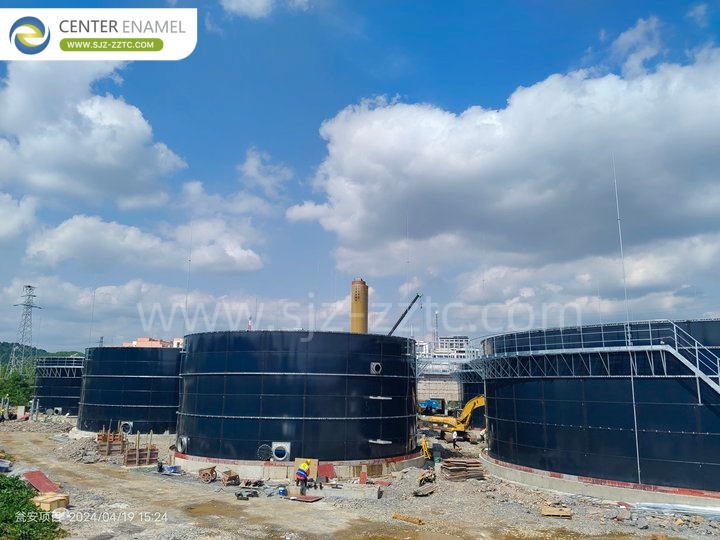
High-Performance GFS Tank Support: Glass-Fused-to-Steel (GFS) Tanks feature strong acid and alkali corrosion resistance, excellent airtightness, and over 30 years of service life, perfectly adapting to complex organic waste fermentation environments.
Strong R&D and Manufacturing Strength: Owns 200+ patented enamel formulas and operates Asia’s largest GFS tank production base, ensuring standardized prefabrication and stable delivery.
Strict International Standards: All products pass 1500V high-voltage spark testing and comply with ISO, AWWA, CE and other global certifications.
Rich Global Project Experience: Accumulated abundant cases in Southeast Asia, South Asia and other regions, familiar with local organic waste traits, environmental policies and tropical construction conditions.
Professional Installation & One-Stop EPC Service: Adopts top-down hydraulic jacking and zero on-site welding, suitable for various complex sites. Provides full services from design, manufacturing, installation to commissioning and after-sales maintenance.
Organic waste is not merely garbage but precious renewable biomass resource. Through mature anaerobic digestion, it can be converted into clean biogas and organic fertilizer, solving pollution while creating economic value. With four mature anaerobic technologies, high-performance GFS Tanks and one-stop EPC capability, Center Enamel provides reliable full-cycle solutions for global organic waste biogas projects, helping regions achieve waste reduction, carbon emission reduction and long-term circular sustainable development.