
What is Poultry Waste? A Complete Guide to Management and Biogas Solutions
Poultry waste is one of the most significant byproducts of the global poultry industry. As the demand for chicken and eggs continues to rise, so does the volume of waste generated by poultry farms. However, what exactly constitutes poultry waste, and more importantly, what can be done with it?
In this comprehensive guide, we will break down the definition of poultry waste, its composition, environmental impact, and the most advanced solutions for turning this challenge into a valuable resource. We will explore how anaerobic digestion can convert poultry manure into renewable biogas and why Center Enamel’s Glass-Fused-to-Steel (GFS) tanks are the premier choice for this transformation.
Defining Poultry Waste: Composition and Types
Poultry waste primarily consists of the excreta (manure) of birds such as chickens, turkeys, and ducks. However, the definition often encompasses more than just the droppings.
According to regulatory definitions, poultry waste falls into two main categories:
Dried Poultry Waste: This is processed, undiluted excreta collected from cage layer flocks. It is characterized by a high nutrient content, typically containing not less than 25% crude protein and not more than 30% ash .
Dried Poultry Litter: This is a combination of poultry excreta and the bedding material (litter) used in floor production systems. Common litter materials include wood shavings, rice hulls, or sawdust. This mixture generally contains not less than 18% protein but has a higher ash content .
The composition of poultry waste is rich in organic matter, nitrogen, phosphorus, and potassium. While these nutrients make it a potentially excellent fertilizer, they also pose a significant environmental risk if not managed properly.
Environmental Challenges of Poultry Waste
Raw poultry manure is a "high-strength" organic waste, meaning it has a very high Biochemical Oxygen Demand (BOD). If simply stored in lagoons or spread untreated on land, it can lead to several severe environmental issues:
Water Pollution: Runoff from poultry farms can carry excessive nitrates and phosphates into local waterways, causing eutrophication-a process that depletes oxygen in the water and kills aquatic life .
Air Pollution and Odor: The decomposition of poultry manure releases ammonia and methane. Methane is a potent greenhouse gas, while ammonia creates pungent odors that affect the quality of life for nearby communities .
Pathogen Risk: Untreated manure can contain pathogens that pose risks to both animal and human health.
With increasingly stringent environmental regulations, the traditional methods of waste disposal are becoming obsolete. The industry must transition toward sustainable and economically viable solutions.
The Solution: Anaerobic Digestion of Poultry Manure
Anaerobic Digestion (AD) is a biological process in which microorganisms break down organic matter, such as poultry manure, in an oxygen-free environment. This process represents a paradigm shift from waste disposal to resource recovery.
AD achieves two major goals simultaneously:
Waste Stabilization: It significantly reduces the volume of waste, neutralizes odors, and kills pathogens.
Energy Production: It produces biogas, a methane-rich gas that can be used as a renewable energy source .
Furthermore, the residual material from the digester, known as digestate, retains most of the original nutrients (N, P, K) and can be applied to land as a high-quality organic soil amendment, closing the nutrient loop .
Overcoming the Challenges of Digestion
While AD is highly effective, poultry manure presents specific technical challenges due to its high nitrogen content. During the digestion process, organic nitrogen is converted to ammonia. High levels of free ammonia can inhibit methanogenesis, the process by which microorganisms produce methane. This inhibition can destabilize the reactor and reduce biogas yields .
Effective strategies to prevent ammonia inhibition include:
Maintaining an Optimal pH Window: Controlling the acidity of the slurry.
Temperature Management: Carefully selecting mesophilic (around 35°C) or thermophilic temperatures .
System Configuration: Utilizing high-performance digesters, such as a CSTR (Continuously Stirred Tank Reactor), which ensures a homogeneous mix and prevents the accumulation of inhibitory substances .
Why GFS Tanks are the Ideal Infrastructure for Biogas
For an anaerobic digestion plant to function effectively, the choice of the reaction vessel is critical. The tank must withstand the corrosive environment of the digestion process and provide a gas-tight seal to capture the biogas.
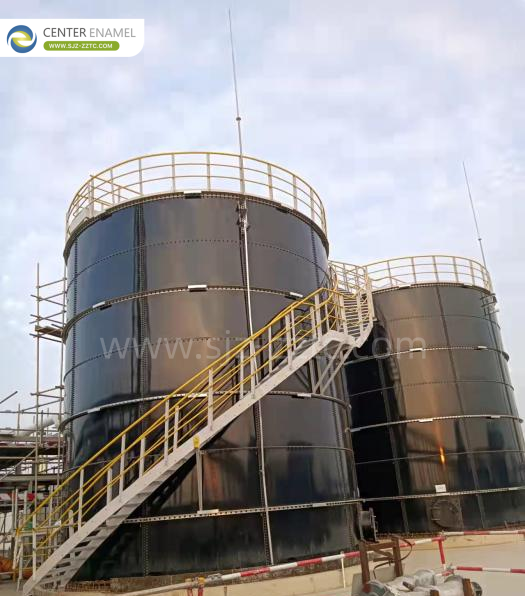
Glass-Fused-to-Steel (GFS) technology has become the gold standard in the industry. The process involves fusing a layer of glass enamel to steel plates at temperatures of approximately 820-930°C. The result is a composite material that offers the strength of steel and the corrosion resistance of glass.
Advantages of GFS Tanks:
Superior Corrosion Resistance: The glass layer is chemically inert, protecting the steel from the aggressive organic acids and hydrogen sulfide (H2SH2S) produced during digestion. This is a crucial advantage over concrete or carbon steel alternatives, which are prone to corrosion and require costly maintenance .
Modular and Rapid Installation: GFS tanks are constructed using bolted panels that are assembled on-site. This modular design allows for rapid deployment and future expansion, making them ideal for farms needing quick installation .
Extended Service Life: With a service life exceeding 30 years and minimal maintenance requirements, GFS tanks offer the lowest total cost of ownership compared to traditional materials .
Center Enamel: Global Leader in Biogas Solutions
Shijiazhuang Zhengzhong Technology Co., Ltd, operating under the brand Center Enamel, is a global leader in the design and manufacture of advanced containment solutions. With decades of experience and over 20 patents in enameling technology, Center Enamel provides high-performance GFS tanks specifically engineered for the rigorous demands of the biogas industry .
Center Enamel provides comprehensive EPC (Engineering, Procurement, and Construction) solutions. This "one-stop" approach covers everything from biological process design and customized tank manufacturing to installation and commissioning, ensuring seamless project execution in over 100 countries .
The CSTR System and Center Enamel's Technology
Center Enamel excels in delivering high-efficiency CSTR (Continuously Stirred Tank Reactor) systems. The CSTR is particularly effective for processing high-solids waste like poultry manure. It uses mechanical mixing to keep the substrate homogeneous, preventing stratification and ensuring optimal contact between the microorganisms and the organic material. This leads to higher and more stable biogas yields .
Integrating Center Enamel's GFS tanks with a CSTR configuration provides a resilient infrastructure that maximizes energy recovery while reliably containing the corrosive process environment.
Efficient Biogas Storage and Safety
Producing the biogas is only part of the equation. To maximize its economic value, the gas must be collected, stored, and supplied to utilization equipment (e.g., CHP generators) at a stable pressure.
Center Enamel's Double Membrane Biogas Holders are state-of-the-art solutions for this purpose. These systems can be installed as an integrated roof on the digester or as a separate unit.
Key benefits include:
Dynamic Pressure Regulation: The inner membrane expands and contracts to accommodate fluctuations in gas production, stabilizing supply to the farm's equipment .
Zero Fugitive Emissions: The system provides a hermetic seal, preventing the escape of methane (a potent greenhouse gas) and controlling odor .
Durability: The specialized composite fabric is resistant to the moisture and corrosive elements present in raw biogas, ensuring long-term reliability .
Conclusion
Transforming poultry waste from a costly liability into a valuable asset is no longer a future concept; it is a present-day reality. By adopting advanced anaerobic digestion solutions, poultry farms can address environmental compliance, generate renewable energy, and produce natural fertilizer.
The success of this transformation relies heavily on the infrastructure chosen. Glass-Fused-to-Steel (GFS) tanks, particularly those manufactured by Center Enamel, offer the superior corrosion resistance, longevity, and structural integrity required for efficient biogas production. As a global provider of integrated EPC solutions, Center Enamel is your trusted partner in the journey toward sustainable and profitable waste management.
FAQs About Poultry Waste and Biogas Solutions
Why is poultry waste considered a difficult substrate for anaerobic digestion?
Poultry manure is rich in nitrogen, which converts to ammonia during digestion. High ammonia levels can inhibit the methanogenic bacteria responsible for biogas production. To manage this, digesters must maintain a stable pH and use systems like CSTR to ensure uniform mixing and prevent toxic build-up, ensuring stable gas yields.
Can biogas from poultry waste be used to generate electricity or heat?
Absolutely. The biogas produced typically contains 55–65% methane. This gas can be burned directly in a Combined Heat and Power (CHP) generator to produce electricity and thermal energy. This renewable power can offset farm energy costs, with excess heat often used to maintain the digester’s optimal temperature.
What makes Glass-Fused-to-Steel (GFS) tanks better than concrete for biogas storage?
Concrete tanks are porous and prone to cracking, which allows corrosive gases to attack the rebar. GFS tanks, however, combine steel strength with a glass coating fired at 820–930°C. This creates a smooth, chemically inert surface resistant to acidic corrosion and gas leakage. They are also modular, allowing for faster installation and easier expansion.