
What Is Reclaimed Water? A Complete Guide to Recycling, Treatment, and Safe Reuse
Reclaimed water (also called recycled water or reused water) is wastewater that has been treated at a municipal or industrial facility to a level suitable for a specific beneficial use. Unlike water discharged directly into rivers or oceans, reclaimed water undergoes additional polishing steps so it can be redirected back into the human water cycle-for irrigation, industrial cooling, landscape maintenance, or even, in advanced schemes, potable supply augmentation.
The defining idea behind reclaimed water is simple: one water source, multiple uses. A single drop of freshwater can first support drinking and domestic needs, then be collected as sewage, treated, and reused for a lower-grade purpose such as crop irrigation or toilet flushing before it finally returns to the environment. This "fit-for-purpose" philosophy is the backbone of modern water-resource planning in arid and water-stressed regions.
Why Reclaimed Water Matters
Freshwater demand is rising globally while supplies are finite. Agriculture consumes roughly 70% of accessible freshwater, industry another 19%, and municipalities the remaining 11%. Climate change, population growth, and over-extraction of aquifers are intensifying stress on every continent. Reclaimed water addresses this gap in several ways:
Drought resilience-cities in California, Singapore, Israel, and parts of Australia rely on recycled water buffers during extended dry periods.
Reduced environmental discharge-treating and reusing effluent lowers the nutrient and pathogen load released into sensitive rivers, lakes, and coastal zones.
Lower cost than alternative supplies-in many cases, local reuse is cheaper than importing water over long distances or desalinating seawater.
Energy and carbon savings-reuse typically consumes less energy per cubic meter than long-distance conveyance or seawater desalination.
How Reclaimed Water Is Produced
Producing reclaimed water builds on the conventional wastewater treatment train, then extends it. A typical scheme includes:
Preliminary treatment-screening, grit removal, and flow equalization.
Primary treatment-sedimentation to remove settleable organic solids.
Secondary treatment-biological degradation of dissolved organics, commonly via activated sludge, moving-bed biofilm reactors, or stabilization ponds.
Tertiary / advanced treatment-filtration (sand, disc, or membrane), nutrient removal (nitrogen and phosphorus through processes such as A2O or MBR), and disinfection (UV, chlorination, ozonation, or advanced oxidation processes like AOP).
Post-treatment storage and distribution-holding the finished water in covered tanks and delivering it through a separate purple-piped or clearly labeled dual distribution system.
The exact treatment depth is dictated by the intended end use: irrigation of food crops eaten raw requires much higher quality than cooling-tower makeup water.
Common Reclaimed Water Applications
Reclaimed water is not a single product but a spectrum of qualities matched to demand. The table below summarizes the most widespread uses and the typical treatment level required.
| Application | Typical Treatment Level | Quality Goal |
| Agricultural irrigation (non-food crops) | Secondary + disinfection | Low pathogen load, low suspended solids |
| Agricultural irrigation (food crops, raw-eaten) | Tertiary + filtration + UV/ozone | Very low bacteria and virus counts |
| Landscape & golf course irrigation | Tertiary + disinfection | Aesthetically clear, odor-free |
| Industrial cooling & process water | Tertiary + softening/RO as needed | Controlled scaling, corrosion, and biofouling |
| Municipal toilet flushing | Tertiary + chlorination | Non-potable, reliable bacteriological control |
| Environmental augmentation (wetlands, streams) | Secondary + nutrient control | Ecologically safe discharge |
| Indirect potable reuse (IPR) | Advanced: MF/UF + RO + AOP + UV | Drinking-water standard after environmental buffer |
Quality Standards and Treatment Technologies
Regulators worldwide classify reclaimed water by use rather than by a single universal grade. The table below compares representative guideline families and the technologies commonly deployed to meet them.
| Standard / Region | Key Parameters Monitored | Typical Technologies Used |
| US EPA / state Title 22 (CA) | Bacteria, turbidity, TSS, BOD | Filtration, chlorination, UV |
| EU Urban Waste Water Directive | BOD, COD, nitrogen, phosphorus | Activated sludge, A2O, polishing filters |
| Australia NHMRC ARMC | Pathogens, chemicals, aesthetics | MBR, reverse osmosis, chloramination |
| Singapore NEWater | Ultrapure potable-grade | MF/UF + RO + UV/AOP |
| China GB/T 18920 (urban reuse) | BOD, turbidity, ammonia, coliform | Secondary + filtration + disinfection |
Across all frameworks, membrane bioreactors (MBR), ultrafiltration (UF), reverse osmosis (RO), and advanced oxidation processes (AOP) have become the workhorses of high-quality reuse, while conventional activated sludge and A2O-based plants continue to dominate large-volume non-potable schemes.
Storing Reclaimed Water Safely at Scale
Producing clean reclaimed water is only half the task; operators must also store it reliably between treatment and use. Poor storage causes recontamination, algal growth, odor, and surface corrosion-all of which undermine public trust.
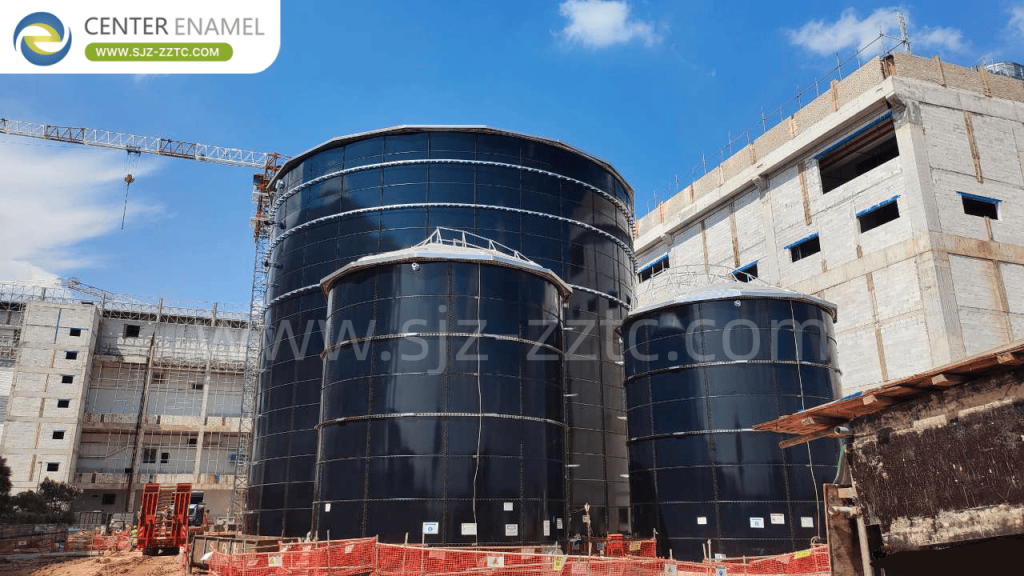
Glass-fused-to-steel (GFS) tanks have become a preferred containment solution for reclaimed water reservoirs and equalization basins worldwide. Their fused glass coating is chemically inert, resists the mild chlorinated and slightly alkaline conditions typical of recycled water, and does not support microbial attachment the way bare concrete or unlined steel surfaces do. Key advantages include:
Non-porous interior surface that resists biofilm formation and simplifies routine disinfection.
Modular bolted construction that allows fast on-site erection, even in remote regions, and easy capacity expansion as reuse schemes grow.
Design life of 30+ years with minimal recoating, lowering whole-life cost compared with concrete or epoxy-lined steel.
Compatibility with floating or fixed covers, including dual-membrane gas-holding covers where biogas is recovered from upstream anaerobic treatment (UASB, CSTR, IC, or USR) of the sewage sludge stream.
Specialist manufacturers such as Center Enamel supply GFS tanks, epoxy-coated steel tanks, and complementary dual-membrane covers for municipal wastewater and reclaimed water projects across Southeast Asia, Africa, the Middle East, and the Americas. Pairing these tanks with proper inlet/outlet design, overflow protection, and a separate reuse piping network ensures the treated water remains safe from the plant to the point of use.
Challenges, Risks, and Public Perception
Reclaimed water faces technical, economic, and social hurdles. Technically, operators must guard against microbial regrowth in distribution, chemical residual buildup, and emerging contaminants such as pharmaceuticals and microplastics. Economically, dual-pipe distribution networks carry a high capital cost that is hard to justify without stable, long-term offtake agreements. Socially, the "yuck factor"-public discomfort with water that once flowed through sewers-remains the single largest barrier to potable reuse programs. Successful programs (San Diego's Pure Water, Singapore's NEWater, Windhoek's direct potable reuse) have shown that transparency, independent monitoring, and visible governance convert skepticism into acceptance over time.
The Future of Reclaimed Water
The trajectory is clear: reuse will move from a fringe option to a mainstream supply. Three trends will shape the next decade. First, membrane and AOP costs continue to fall, pushing advanced treatment within reach of mid-sized cities. Second, decentralized and on-site reuse systems-serving individual factories, campuses, and districts-will multiply alongside municipal schemes. Third, digital monitoring and real-time pathogen sensing will make water quality traceability more transparent, strengthening regulator and public confidence.
For engineering teams, the practical implication is straightforward: design treatment trains that are fit-for-purpose, specify chemically inert storage such as GFS tanks, and build monitoring and communication into the project from day one.
Frequently Asked Questions
Q1: Is reclaimed water safe to drink?
Reclaimed water is generally not piped directly to the tap. Most schemes produce non-potable water for irrigation, industry, or landscaping. Advanced projects (such as Singapore's NEWater or indirect potable reuse schemes) treat water to drinking-water standards, then blend it into reservoirs or aquifers as an additional safety buffer before it enters conventional drinking-water treatment.
Q2: What is the difference between reclaimed water and recycled water?
The terms are nearly synonymous. "Reclaimed water" typically emphasizes the municipal treatment and official reuse designation, while "recycled water" is used more broadly for any industrial or on-site water recovery. Both describe wastewater treated for a beneficial purpose rather than discharged.
Q3: How should reclaimed water be stored?
It should be held in covered, corrosion-resistant tanks with smooth, non-biofilm-forming interiors. Glass-fused-to-steel (GFS) tanks are widely used because their inert glass surface resists chlorinated water, simplifies cleaning and disinfection, and supports modular expansion. Covered storage also prevents algal growth, insect breeding, and external contamination.