
What Is Slaughterhouse Waste? Complete Guide to Treatment, Biogas Recovery and Anaerobic Solutions
What Is Slaughterhouse Waste?
Slaughterhouse waste refers to all solid, semi-solid and liquid by-products generated during the slaughtering, cutting, processing and cleaning of livestock and poultry such as cattle, sheep, pigs, chickens and ducks. These materials have high organic content, high moisture, high fat and protein, and are extremely perishable, making them one of the most challenging organic waste streams in the food industry.
In short, slaughterhouse waste includes every part of the animal that is not used for human consumption or commercial by-products, plus process wastewater. It is not only a waste disposal burden but also a high-quality biomass resource that can be converted into biogas and organic fertilizer through professional treatment.
Composition and Types of Slaughterhouse Waste
Slaughterhouse waste is typically divided into three major categories:
1. Solid Slaughterhouse Waste
- Viscera: lungs, liver, spleen, intestines and intestinal contents
- Blood meal residues, meat trimmings, condemned carcasses
- Bones, hooves, horns, hair, feathers and hide trimmings
- Undigested feed from stomachs and rumen contents
2. Liquid Slaughterhouse Waste (Wastewater)
- Blood, urine and body fluids
- Rinsing water from carcass washing, equipment cleaning and floor washing
- Wastewater containing fat, oil, protein and suspended solids
3. Gaseous and Odor Substances
- Ammonia, hydrogen sulfide, volatile organic compounds (VOCs)
- Strong odor generated by rapid decomposition of organic matter
The characteristic of slaughterhouse waste is extremely high organic concentration, with COD often exceeding 10,000–50,000 mg/L. If discharged directly, it will cause serious water eutrophication, odor nuisance, pathogen spread and groundwater pollution.
Why Slaughterhouse Waste Treatment Is Critical
Untreated slaughterhouse waste brings severe risks:
- Environmental pollution: Rapid corruption produces toxic and odorous gases; high-concentration wastewater damages rivers and soil
- Public health hazards: Contains pathogens such as Salmonella and E. coli, which can spread diseases
- Resource waste: Rich in organic matter, protein and fat that can be recycled into energy and fertilizer
- Regulatory non-compliance: Most countries enforce strict discharge standards for slaughterhouse wastewater
For the meat industry, safe and efficient treatment of slaughterhouse waste is not only an environmental obligation but also a way to create economic benefits through waste-to-energy.
How Slaughterhouse Waste Is Converted Into Biogas via Anaerobic Digestion
Anaerobic digestion is the most mature and widely used technology for slaughterhouse waste treatment. Under closed, oxygen-free conditions, microorganisms decompose organic matter into biogas (55–70% methane) through four stages:
Hydrolysis: Microbes break down proteins, fats and cellulose into small molecules
Acidification: Acidogenic bacteria convert small molecules into volatile fatty acids
Acetogenesis: Acetogenic bacteria produce acetic acid, H₂ and CO₂
Methanation: Methanogens generate methane-rich biogas
After purification, biogas can be used for on-site power generation, heating or upgraded to Bio-CNG. The digestate becomes organic fertilizer, forming a complete circular economy chain.
Four Core Anaerobic Processes for Slaughterhouse Wastewater Treatment
Center Enamel provides four advanced anaerobic processes for treating slaughterhouse waste and wastewater, suitable for different scales and conditions:
1. CSTR (Continuous Stirred-Tank Reactor)
- With mechanical stirring, suitable for high-solid and high-fiber slaughterhouse waste
- Prevents stratification and crusting; stable gas production
- Ideal for large-scale integrated slaughterhouse biogas projects
2. UASB (Upflow Anaerobic Sludge Blanket)
- Relies on high-activity granular sludge; high organic loading rate
- Excellent COD removal efficiency (up to 90–93%)
- Perfect for pre-treated slaughterhouse wastewater with high solubility
3. USR (Upflow Solid Reactor)
- Simple structure, no stirring equipment, low operation cost
- Strong anti-clogging ability for high-suspended solids wastewater
- Suitable for small and medium-sized slaughterhouses in rural areas
4. IC (Internal Circulation)
- Internal circulation improves efficiency 3–5 times than traditional reactors
- Compact footprint, high gas yield, strong load resistance
- For large-scale urban slaughterhouses and centralized treatment plants
Advantages of GFS Tanks in Slaughterhouse Waste and Biogas Projects
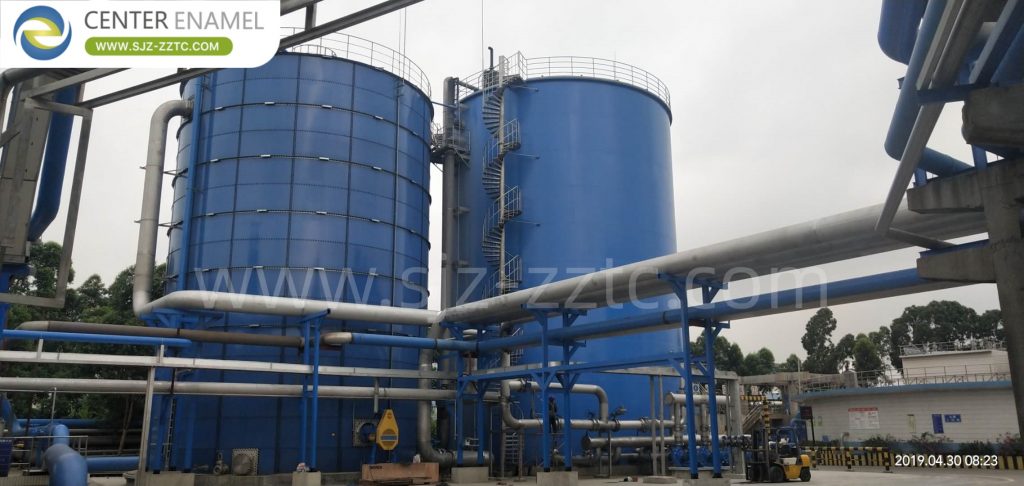
GFS Tanks (Glass-Fused-to-Steel Tanks) are the core equipment for anaerobic digestion and wastewater treatment, especially suitable for harsh environments of slaughterhouse waste:
- Superior corrosion resistance: Enamel coating resists acid, alkali and oil, stable for decades
- Excellent airtightness: Prevents biogas leakage and odor emission
- Modular bolted design: Fast installation, no on-site welding, short construction period
- Long service life: Over 30 years; smooth surface resists scaling and adhesion
- Flexible expansion: Expandable with increased slaughtering capacity and waste volume
- Wide compatibility: Works with CSTR, UASB, USR, IC and all anaerobic systems
Why Choose Center Enamel for Slaughterhouse Waste and Biogas Projects
As a leading global EPC contractor for renewable energy and wastewater treatment, Center Enamel has accumulated rich experience in slaughterhouse waste treatment, biogas production and anaerobic engineering:
- Strong R&D and manufacturing: More than 200 enamel patents; products meet ISO, AWWA and international standards
- Full turnkey EPC services: Design, manufacturing, transportation, installation, commissioning and after-sales
- Customized solutions: Tailor processes according to waste composition, water volume and project scale
- Proven overseas track record: Successful projects in Asia, Africa, Europe and the Americas for slaughterhouses, food factories and farms
- High efficiency and cost-effectiveness: High biogas yield, low failure rate, low operating cost
- Comprehensive after-sales network: Global service ensures stable long-term operation
Typical Successful Project Cases
Case1: Malaysia Biogas Project
Tank Dimensions: φ22.93 × 12.325 m (H) (1 Unit)
Total Volume: 5,087 m³ (1 Unit)
Completion Date: 2025
Case2: France Biogas Project
Process Type: CSTR
Tank Dimensions: φ18.33 × 8.4 m (H) (1 Unit)
Total Volume: 2,215 m³ (1 Unit)
Completion Date: 2021
Slaughterhouse waste is a high-concentration organic waste stream rich in organic matter, fat and protein, requiring professional and harmless treatment. With anaerobic digestion technology, it can be efficiently converted into biogas and organic fertilizer, realizing environmental protection and economic benefits. Center Enamel provides complete solutions including CSTR, UASB, USR, IC and reliable GFS Tanks, supporting slaughterhouses worldwide in waste reduction, energy production and sustainable development. With professional technology and global experience, Center Enamel is your trusted partner for slaughterhouse waste treatment and biogas projects.