
What Is the A²O Process? A Complete Guide to Biological Nutrient Removal
Wastewater contains three primary pollutants that threaten natural water bodies: organic carbon, nitrogen, and phosphorus. When discharged untreated, these nutrients cause eutrophication – algal blooms that deplete oxygen, kill fish, and degrade water quality.
The A²O process (Anaerobic-Anoxic-Oxic) is one of the most widely used biological treatment technologies for simultaneous removal of carbon, nitrogen, and phosphorus from municipal and industrial wastewater. This article explains how the A²O process works, its applications, and the role of GFS tanks in successful project delivery.
What Is the A²O Process?
The A²O process is a biological nutrient removal (BNR) system that divides treatment into three distinct zones:
Anaerobic Zone – No oxygen or nitrate present
Anoxic Zone – Nitrate present, no dissolved oxygen
Oxic (Aerobic) Zone – Dissolved oxygen present
Each zone promotes different microbial communities that work together to remove pollutants. The process is a variation of the basic A/O (Anaerobic-Oxic) configuration, with an additional anoxic zone for improved nitrogen removal.
Why Was the A²O Process Developed?
Conventional activated sludge treatment effectively removes organic carbon (BOD/COD) but does little to remove nitrogen or phosphorus. When nutrient-rich effluent is discharged into lakes, rivers, or coastal waters, it triggers eutrophication – excessive algae growth that leads to:
Oxygen depletion (hypoxia or anoxia)
Fish kills
Loss of aquatic biodiversity
Drinking water taste and odor problems
The A²O process was developed specifically to address these nutrient pollution challenges, enabling wastewater treatment plants to meet increasingly stringent discharge standards.
How the A²O Process Works
The A²O process comprises three consecutive tanks or zones, each creating a specific environment for targeted biological reactions.
Zone 1: Anaerobic Tank
Conditions:
No dissolved oxygen
No nitrate or nitrite
Mixing provided (no aeration)
Key Reactions:
In the anaerobic zone, phosphorus-accumulating organisms (PAOs) release phosphorus stored in their cells-1. This phosphorus release provides energy for PAOs to uptake and store volatile fatty acids (VFAs) from the incoming wastewater.
The anaerobic environment also favors the growth of PAOs over other bacteria, setting up the conditions for enhanced biological phosphorus removal in the downstream aerobic zone.
What Happens to Phosphorus:
PAOs break down stored polyphosphate
Orthophosphate is released into the bulk liquid
PAOs uptake and store VFAs as internal carbon sources (PHA)
Zone 2: Anoxic Tank
Conditions:
No dissolved oxygen
Nitrate (NO₃⁻) and nitrite (NO₂⁻) present
Mixing provided
Internal recycle from oxic zone brings nitrate-rich mixed liquor
Key Reactions:
In the anoxic zone, denitrifying bacteria use nitrate as an electron acceptor to consume organic matter. This process converts nitrate into harmless nitrogen gas (N₂), which escapes to the atmosphere – permanently removing nitrogen from the wastewater.
The Denitrification Reaction:
NO₃⁻ → NO₂⁻ → NO → N₂O → N₂ (gas)
Internal recycling from the oxic zone to the anoxic zone is critical. Without this recycle, nitrate would accumulate in the system, and total nitrogen removal would be minimal.
Zone 3: Oxic (Aerobic) Tank
Conditions:
Dissolved oxygen present (2–4 mg/L typical)
Air supplied via diffusers or surface aerators
Maximum biological activity
Key Reactions – Three Processes Occur Simultaneously:
1. Carbon Oxidation (BOD/COD Removal)
Aerobic heterotrophic bacteria consume remaining organic matter, converting it to CO₂ and water.
2. Nitrification
Autotrophic bacteria convert ammonia to nitrate in a two-step process:
Ammonia-oxidizing bacteria (AOB): NH₃ → NO₂⁻
Nitrite-oxidizing bacteria (NOB): NO₂⁻ → NO₃⁻
3. Phosphorus Uptake (Luxury Uptake)
PAOs, now in an aerobic environment, uptake large quantities of phosphorus – far more than they released in the anaerobic zone. This "luxury uptake" stores phosphorus as polyphosphate within PAO cells.
Final Clarifier
After the oxic zone, mixed liquor flows to a secondary clarifier where activated sludge settles. Key features include:
Return Activated Sludge (RAS): Returned to the anaerobic zone to maintain biomass concentration and bring PAOs through the full anaerobic → anoxic → oxic cycle.
Waste Activated Sludge (WAS): Phosphorus-rich sludge is removed from the system. This is how phosphorus is permanently eliminated – by wasting sludge containing PAOs with stored polyphosphate.
Treatment Performance of the A²O Process
The A²O process achieves excellent removal of multiple pollutants:
| Parameter | Typical Influent | Typical Effluent | Removal Efficiency |
| COD | 300–1,000 mg/L | <50–100 mg/L | 80–95% |
| BOD | 150–500 mg/L | <10–30 mg/L | 85–98% |
| Total Nitrogen (TN) | 30–60 mg/L | <10–15 mg/L | 70–85% |
| Total Phosphorus (TP) | 5–15 mg/L | <1–2 mg/L | 75–90% |
Advanced configurations can achieve even stricter limits. With secondary anoxic zones or anammox integration, TN below 10 mg/L and TP below 0.5 mg/L are attainable.
Key Design and Operational Parameters
Successful A²O performance depends on several critical parameters:
Internal Recycle Ratio
The recycle flow from the oxic zone to the anoxic zone typically ranges from 100% to 300% of the influent flow rate. Higher recycle ratios improve nitrogen removal but increase pumping costs. Without adequate recycle, denitrification is limited by nitrate availability.
Sludge Retention Time (SRT)
The A²O process requires careful SRT management:
For nitrification: SRT > 5 days at 20°C (longer at colder temperatures)
For phosphorus removal: Shorter SRT (3–5 days) to waste PAOs before they become overgrown by other organisms
Typical range: 8–15 days depending on temperature and discharge requirements
Temperature Effects
Nitrification is temperature-sensitive. As temperatures decrease, nitrification rates slow, requiring longer SRT or larger tank volumes. Studies have shown that decreased temperatures correlate with reduced nitrification efficiency.
Organic Carbon Availability
Denitrification requires sufficient readily biodegradable carbon. When influent COD/TN ratio is low (common in many municipal wastewaters), external carbon sources may be needed for complete nitrogen removal.
Advanced A²O Configurations
A²O with Anammox Integration
Recent innovations integrate anaerobic ammonium oxidation (anammox) into A²O systems. By establishing partial denitrification/anammox (PD/A) in the anoxic zone and partial nitritation/anammox (PN/A) in the oxic zone, total nitrogen removal can increase from 54% to over 80% without external carbon addition.
Five-Stage Bardenpho
This configuration adds a second anoxic and aerobic zone after the standard A²O, enabling even lower effluent TN (below 3 mg/L) for sensitive receiving waters.
Hybrid A²O with Biofilm Carriers
Adding fixed-film carriers to A²O tanks increases biomass concentration, improves low-temperature performance, and reduces footprint. This integrated fixed-film activated sludge (IFAS) approach is particularly valuable for plant upgrades.
A²O vs. Other Treatment Processes
| Process | Carbon Removal | Nitrogen Removal | Phosphorus Removal | Complexity |
| Conventional Activated Sludge | High | None | None | Low |
| A/O (Anaerobic-Oxic) | High | None | High | Medium |
| A²O (Anaerobic-Anoxic-Oxic) | High | High | High | Medium-High |
| 5-Stage Bardenpho | High | Very High | High | High |
| SBR | High | High | High | Medium |
The A²O process offers the best balance for most municipal applications – excellent nutrient removal with reasonable complexity and operating costs.
Applications of the A²O Process
The A²O process is widely used for:
Municipal Wastewater Treatment – Primary application worldwide, particularly in China where it serves approximately 33% of wastewater treatment capacity
Industrial Wastewater – Food processing, dairy, beverage, and other high-strength organic wastewaters
Nutrient-Sensitive Watersheds – Discharges to lakes, reservoirs, and coastal areas requiring TN and TP limits
Water Reuse Projects – Producing high-quality effluent for irrigation or industrial reuse
GFS Tanks for A²O and Biogas Projects
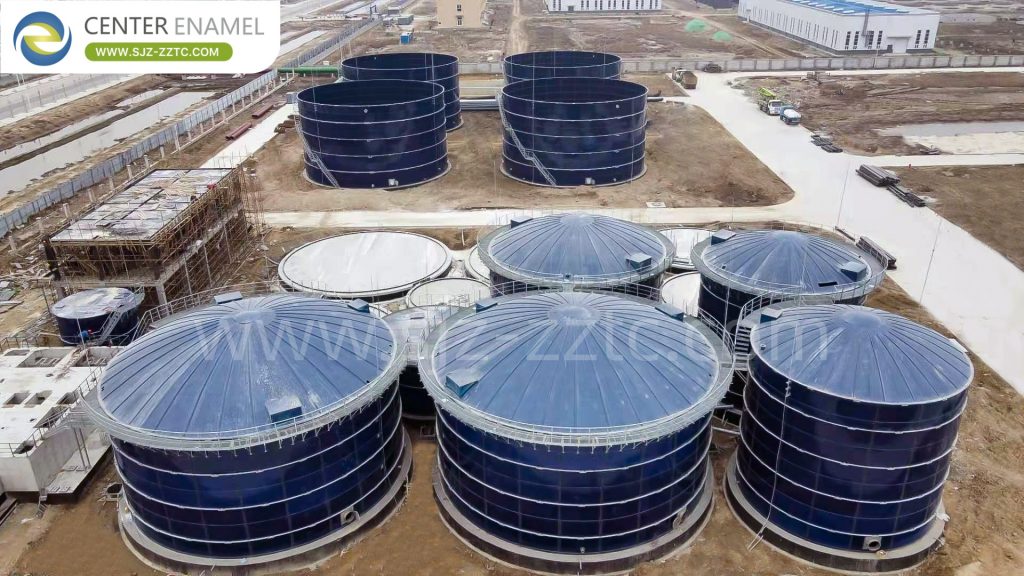
Successful A²O implementation requires durable, corrosion-resistant tanks for each zone – anaerobic, anoxic, and oxic. Glass-Fused-to-Steel (GFS) tanks from Center Enamel are the industry standard for wastewater and biogas projects worldwide.
Why GFS Tanks for A²O Systems?
| Feature | Benefit |
| Corrosion resistance | Withstands H₂S, organic acids, and mixed liquor environment |
| Long service life | 30+ years with no repainting or recoating |
| Bolted assembly | Installs in days, not months – no welding required |
| Factory-coated glass finish | Consistent quality, impervious to chemical attack |
| UV-resistant | Suitable for outdoor installation |
| Expandable | Additional modules can be added as capacity grows |
GFS Tanks for Biogas Projects
When the A²O process is combined with anaerobic pre-treatment (such as UASB or CSTR), the biogas produced can be captured for renewable energy. GFS tanks are ideal for:
Anaerobic digesters – Primary biogas reactors
Biogas storage – Double-membrane gas holders integrated with GFS tanks
Sludge holding tanks – Digestate storage prior to dewatering
Equalization basins – Corrosion-resistant flow balancing
The molecular glass coating fused to steel at 820°C creates an inert barrier that resists the corrosive hydrogen sulfide (H₂S) produced during anaerobic digestion – a common cause of concrete tank failure.
Center Enamel: Your EPC Contractor for A²O and Biogas Projects
With over 30 years of experience and projects completed in more than 100 countries, Center Enamel is a leading EPC Contractor for wastewater treatment and Biogas Project delivery.
Center Enamel's Capabilities
Engineering & Planning
Preliminary feasibility studies
Process design (A²O, UASB, CSTR, UBF, etc.)
Tank sizing and hydraulic modeling
Permit assistance and regulatory compliance
Procurement
GFS tank manufacturing (largest production base in Asia)
Double-membrane gas holders
Piping, mixers, diffusers, and process equipment
Quality control per ISO 28765, NSF/ANSI 61, and AWWA D103-09
Construction
On-site supervision
Bolted tank assembly (fast installation with small crews)
Equipment installation and system integration
Quality control and safety management
Commissioning
Biological startup (seeding anaerobic and aerobic biomass)
Performance testing
Operator training
As-built documentation and warranty
Global Project Experience
Center Enamel has successfully delivered:
Municipal A²O plants across Asia, Africa, and South America
Biogas projects for palm oil mills (Indonesia, Malaysia), cassava processing, and livestock farms
Industrial wastewater treatment for beverage, dairy, and food processing facilities
GFS tanks ranging from small digesters to 10,000+ m³ reactors
The A²O process is a proven, reliable biological nutrient removal technology that efficiently removes carbon, nitrogen, and phosphorus from municipal and industrial wastewater. Its three-zone configuration – anaerobic, anoxic, and oxic – leverages natural microbial processes to protect receiving waters from eutrophication.
For successful A²O and Biogas Project delivery, GFS tanks from Center Enamel provide the durable, corrosion-resistant containment essential for long-term performance. As a full-service EPC Contractor, Center Enamel delivers complete turnkey solutions – from planning through commissioning – backed by over three decades of global experience.
Whether you are upgrading an existing facility, designing a new A²O plant, or developing a biogas energy project, Center Enamel has the engineering expertise, manufacturing capability, and project management experience to deliver reliable, cost-effective solutions.
Contact Center Enamel today to discuss your wastewater treatment and biogas project requirements.
Frequently Asked Questions (FAQs)
Q1: What is the main difference between A/O and A²O processes?
The A/O (Anaerobic-Oxic) process has only two zones and removes phosphorus effectively but provides minimal nitrogen removal. The A²O process adds an anoxic zone between the anaerobic and oxic zones, with internal recycling from the oxic to anoxic zone, enabling denitrification and significant total nitrogen reduction.
Q2: Can GFS tanks be used for all three zones of an A²O system?
Yes. GFS (Glass-Fused-to-Steel) tanks are suitable for anaerobic, anoxic, and oxic zones. The glass coating resists corrosion from mixed liquor, hydrogen sulfide, and organic acids. Their bolted design allows rapid installation, and the smooth glass surface prevents biofilm accumulation that can occur in concrete tanks.
Q3: How does Center Enamel support A²O and Biogas Projects as an EPC Contractor?
As an EPC Contractor, Center Enamel provides complete turnkey solutions including preliminary planning, detailed engineering, tank manufacturing (GFS tanks), equipment procurement, site management, construction supervision, biological commissioning, and operator training. With over 30 years of experience and projects in 100+ countries, Center Enamel delivers reliable, compliant, and cost-effective wastewater and Biogas Project solutions.