
What is the AOP Process in Wastewater?
AOP, short for Advanced Oxidation Process, is a cutting-edge deep wastewater treatment technology widely adopted across municipal sewage, industrial effluent and polluted groundwater remediation. Different from traditional aerobic and anaerobic biological methods that struggle with refractory organics, toxic chemicals and micro-pollutants, AOP generates highly reactive hydroxyl radicals and other oxidative species to thoroughly decompose stubborn contaminants into harmless water, carbon dioxide and inorganic salts.
This article elaborates on the core mechanism, mainstream classifications, key advantages and practical application scenarios of the AOP process. It also introduces how GFS Tanks support AOP systems and biogas projects, as well as Center Enamel’s rich engineering experience in global wastewater and biogas fields.
Core Working Principle of the AOP Process
The core of all AOP technologies lies in producing hydroxyl radicals (•OH), which possess extremely strong oxidation capacity and can react with almost all organic substances under normal temperature and pressure. These radicals break the molecular chains of refractory pollutants such as dyes, antibiotics, pesticides and residual chemical agents that cannot be degraded by conventional treatments.
The entire reaction flow is straightforward. First, targeted equipment and chemical combinations trigger radical generation.
Then hydroxyl radicals attack complex organic molecules, gradually splitting large molecular structures into small organic fragments. Finally, these fragments are completely mineralized into non-toxic substances. AOP can be deployed as pre-treatment to improve the biodegradability of high-concentration wastewater, or as post-treatment for deep purification to help effluent meet strict discharge standards. It effectively solves the pain point that traditional processes fail to remove trace toxic pollutants.
Mainstream Types of AOP Processes
According to different radical generation ways, AOP is divided into four widely used types in actual wastewater engineering, each with unique applicable scenarios:
Fenton & Photo-Fenton Process: It mixes ferrous ions with hydrogen peroxide to produce hydroxyl radicals. Featured with low investment and simple operation, it is ideal for pharmaceutical wastewater, landfill leachate and high-concentration organic sewage. The photo-Fenton version introduces ultraviolet light to boost reaction efficiency.
Ozone-based AOP: Ozone reacts with water or hydrogen peroxide to form massive radicals. It excels at decolorization, deodorization and disinfection, and is commonly used for textile wastewater and drinking water advanced treatment.
UV/H₂O₂ Process: Combining ultraviolet radiation and hydrogen peroxide to produce radicals. This type leaves no residual chemicals and is suitable for food processing wastewater and reused water treatment.
Electrochemical AOP: Generates oxidizing substances through electrode reaction. It requires no additional chemicals and is friendly for oily wastewater and heavy metal-containing industrial effluent.
Key Advantages and Application Scenarios of AOP Process
Compared with conventional wastewater treatment technologies, AOP has prominent competitive edges. Firstly, it has ultra-strong degradation ability for refractory, toxic and persistent organic pollutants, achieving thorough pollutant mineralization rather than simple separation. Secondly, the reaction runs under normal temperature and pressure, with mild operating conditions and no strict requirements for site space. Thirdly, it is highly flexible and can be combined with biological processes, sedimentation and filtration to form a complete treatment system. In addition, AOP produces little sludge, reducing subsequent sludge disposal costs.
Nowadays, AOP has become a standard deep treatment unit for multiple industries. It is extensively applied in textile printing and dyeing wastewater, pharmaceutical wastewater, chemical sewage, landfill leachate, municipal tail water advanced treatment and aquaculture wastewater purification. For enterprises facing increasingly stringent environmental discharge regulations, AOP is the preferred technical choice to upgrade existing wastewater systems.
GFS Tanks: Reliable Carrier for AOP and Biogas Projects
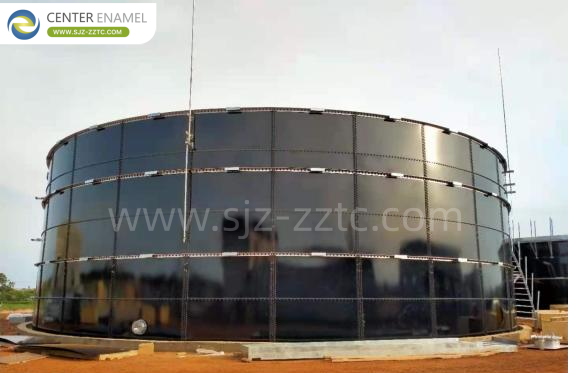
Stable equipment is the foundation for the long-term operation of AOP systems and supporting biogas projects. GFS Tanks (Glass-Fused-to-Steel Tanks) have become the mainstream container equipment for wastewater treatment and biogas engineering due to superior comprehensive performance. In AOP treatment systems, GFS Tanks can serve as regulating tanks, reaction tanks and intermediate storage tanks; in matched biogas recycling systems, they act as core anaerobic fermentation tanks.
Fused with high-temperature enamel coating, GFS Tanks feature excellent acid and alkali resistance, fully adapting to the complex chemical environment of AOP reaction and the corrosive gas produced by biogas fermentation. The modular bolted structure enables fast on-site installation without field welding, which is suitable for various construction sites. With a service life of more than 30 years and low daily maintenance costs, GFS Tanks effectively reduce the overall operation cost of wastewater and biogas projects in the whole life cycle. Meanwhile, its excellent air tightness prevents gas leakage in biogas projects and ensures stable operation of the whole system.
Center Enamel’s Rich Experience in Wastewater and Biogas Projects
As a professional global EPC contractor and GFS Tanks manufacturer, Center Enamel has decades of practical experience in wastewater treatment and biogas resource recycling projects worldwide. The company is proficient in integrating AOP process, biological treatment and anaerobic biogas technology to design customized overall solutions for different industries and different water quality characteristics.
Center Enamel provides one-stop services including project design, equipment manufacturing, cross-border transportation, on-site installation, system commissioning and staff training. All products comply with ISO, AWWA and other international quality standards. Up to now, it has delivered numerous successful projects covering Southeast Asia, Europe, South Asia and other regions. Whether it is industrial wastewater equipped with AOP deep treatment or livestock and agricultural wastewater supporting biogas production, Center Enamel can guarantee stable, efficient and long-term operation of the system for clients.
As an indispensable deep treatment technology for modern wastewater engineering, the AOP process makes up for the defects of traditional treatment methods and becomes a core technology to solve refractory sewage pollution. When matched with durable and high-performance GFS Tanks, the stability and service life of the entire wastewater and biogas system are greatly improved.
Relying on mature technical accumulation and rich global project experience, Center Enamel can combine AOP, biological treatment and biogas recycling to create energy-saving and eco-friendly overall solutions. With the continuous upgrading of global environmental protection standards, AOP combined with supporting facilities will be more widely promoted, helping all walks of life realize standardized sewage discharge and circular resource utilization.
Frequently Asked Questions (FAQ)
Q1: When do we need to use the AOP process?
AOP is mainly used to treat refractory toxic wastewater or polish tail water that conventional biological processes cannot purify.
Q2: Can AOP work together with other wastewater treatment technologies?
Yes. It is often combined with anaerobic and aerobic processes to build a full-set efficient treatment system.
Q3: Why choose GFS Tanks for AOP wastewater projects?
GFS Tanks resist strong chemical corrosion, feature easy installation and long service life for harsh operating conditions.