
What Is the Best Way to Manage Our Solid Waste? Turning Trash into Renewable Biogas Energy
Managing the ever-growing volume of solid waste is one of the most pressing environmental challenges of our time. With global municipal solid waste generation reaching an estimated 2.1 billion tons annually, over one-third of this waste is not managed in an environmentally safe manner . Finding the best way to manage solid waste requires a fundamental shift from outdated disposal methods to sustainable resource recovery. Among the various approaches available, converting organic waste into biogas through anaerobic digestion stands out as the most effective, environmentally sound, and economically viable solution, transforming an environmental liability into a valuable renewable energy asset.
Traditional Solid Waste Disposal Methods and Their Drawbacks
Historically, human societies have dealt with solid waste through three primary methods: open dumping, landfilling, and incineration . These traditional approaches, while simple and inexpensive, have proven unsustainable and harmful to both human health and the environment.
Open Dumping and Landfilling
Open dumping has been the most common and cheapest method of waste disposal throughout history, with waste simply hauled to the edge of town and abandoned . Even today, open dumping remains widespread in many developing regions. Sanitary landfills, which emerged as an "improvement" over open dumps, involve engineering controls such as lining to prevent groundwater contamination, waste compaction, and leachate collection . However, landfilling creates anaerobic conditions that slow biological decay and generate significant quantities of methane—a greenhouse gas with approximately 20–25 times greater impact than carbon dioxide . Furthermore, landfills consume vast land areas, generate objectionable odors, attract disease vectors, and produce leachate that can contaminate soil and groundwater .
Incineration and Open Burning
Incineration drastically reduces waste volume—by up to 90%—and can generate electricity through waste-to-energy facilities . However, incinerators require substantial capital investment, release pollutants even with modern controls, and face significant siting challenges due to public opposition . Open burning of solid waste, still practiced globally, causes severe air pollution and releases harmful gases that contribute to respiratory illness and global warming .
Why Traditional Methods Fail
The fundamental problem with traditional disposal methods is that they treat solid waste as something to be eliminated rather than a resource to be recovered. They generate greenhouse gas emissions, consume finite land resources, create long-term environmental liabilities, and fail to capture the inherent energy value in organic materials . As global populations grow and waste generation increases, these approaches have become unsustainable.
The Shift from Disposal to Resource Recovery
The international community increasingly recognizes the need to move up the "waste hierarchy"—prioritizing waste prevention, reuse, and recycling over disposal . This shift represents a fundamental change in how we view solid waste: not as refuse to be discarded, but as valuable resources to be recovered.
The Waste Hierarchy Approach
Leading environmental organizations, including the World Health Organization, U.S. EPA, and the European Commission, advocate for waste management systems that follow a clear hierarchy . Prevention and reduction are prioritized at the top, followed by reuse and recycling. Recovery—including energy recovery through biogas production—is preferred over disposal. This approach maximizes resource recovery while minimizing environmental impact.
Why Energy Recovery Matters
For organic waste streams, which comprise 50–70% of municipal solid waste, anaerobic digestion offers the most sustainable recovery option . Unlike recycling of physical materials, which has limitations for food waste and other organics, anaerobic digestion captures both energy and nutrients. The process generates renewable biogas for electricity, heat, or vehicle fuel, while producing nutrient-rich digestate that can be used as fertilizer . This dual benefit makes it an essential component of integrated waste management systems worldwide.
How Solid Waste is Converted into Biogas
The conversion of organic solid waste into biogas is achieved through a natural biological process called anaerobic digestion . This engineered process harnesses microorganisms to break down organic matter in the absence of oxygen, producing methane-rich biogas as a byproduct.
The Four Stages of Anaerobic Digestion
Anaerobic digestion proceeds through four sequential stages. First, hydrolysis breaks down complex organic polymers (carbohydrates, proteins, and fats) into simpler soluble compounds. Second, acidogenesis converts these compounds into volatile fatty acids and alcohols. Third, acetogenesis transforms these intermediates into acetic acid, hydrogen, and carbon dioxide. Finally, methanogenesis—the critical stage—produces methane (CH₄) and carbon dioxide (CO₂), the primary components of biogas .
The biogas typically contains 50–70% methane, with the remainder largely CO₂ and trace amounts of hydrogen sulfide, moisture, and other impurities . The methane concentration determines the fuel value of the gas and its suitability for various energy applications.
Key Anaerobic Digester Technologies
Several digester technologies exist for producing biogas, each suited to different feedstock types and project scales:
Continuous Stirred-Tank Reactors (CSTRs): These are among the most widely used digester designs, featuring continuous mixing to ensure uniform contact between microorganisms and feedstock. CSTRs excel at processing high-solid-content feedstocks and maintaining stable, consistent gas production .
Fixed-Dome Digesters: Common in small-scale applications, these partially underground structures use a fixed gas storage dome. They are simple, low-cost, and have a long lifespan, but require specific feedstock characteristics .
Plug Flow Digesters: These systems process feedstock through a long, narrow tank in a "plug flow" pattern, making them suitable for homogeneous waste streams with low solid content .
Balloon Digesters: Featuring flexible, inflatable gas storage, these are compact and easy to install but may be prone to leaks and are not appropriate for all feedstock types .
Biogas Purification and Utilization
Raw biogas must be purified before use in most applications, as impurities like hydrogen sulfide (corrosive) and moisture can damage equipment and reduce combustion efficiency . Purification methods include water scrubbing, chemical scrubbing, and pressure swing adsorption, which remove contaminants and increase the methane concentration .
Energy Applications
Biogas is a versatile energy carrier. It can be used directly in boilers for heat generation, combusted in combined heat and power (CHP) engines to produce electricity and recover thermal energy, or upgraded to biomethane (renewable natural gas) for injection into gas networks or use as vehicle fuel . The captured biogas reduces reliance on fossil fuels and provides energy security for facility operations.
Fertilizer Production from Digestate
The nutrient-rich digestate remaining after anaerobic digestion can be processed into high-quality organic fertilizer. Studies show that the germination index of digestate-based organic fertilizer can reach up to 140%, demonstrating its agricultural value . This creates a complete circular economy—organic waste generates clean energy, and the residue supports sustainable agriculture, reducing the need for chemical fertilizers.
Center Enamel: One-Stop Biogas Solutions for Global Customers
Center Enamel provides comprehensive one-stop biogas solutions for clients worldwide, from initial design to installation and long-term support. As a global leader with proven expertise in more than 100 countries, Center Enamel delivers complete systems engineered to international standards .
Comprehensive Services
Center Enamel's full-service approach covers the entire project lifecycle. Customized Engineering Design tailors solutions based on waste characteristics, climate conditions, and project goals. Process Design and Equipment Supply provides complete anaerobic digestion systems, including CSTR reactors, GFS tanks, and purification equipment. EPC (Engineering, Procurement, and Construction) Services manages projects from concept to commissioning. Installation Support and After-Sales Service ensures efficient, professional on-site support .
GFS Tanks for Biogas Storage
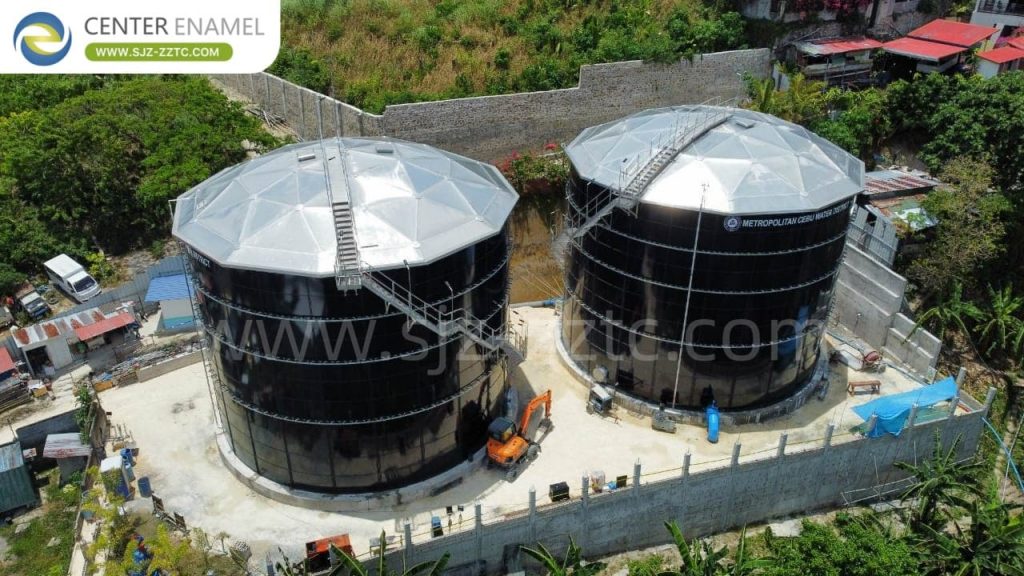
GFS (Glass-Fused-to-Steel) tanks are the preferred storage solution for biogas applications due to their unmatched corrosion resistance and durability. The glass coating is fused to steel at temperatures exceeding 820°C, creating an inert surface immune to hydrogen sulfide and organic acids . GFS tanks offer a service life of 30 years or more with minimal maintenance, feature modular bolted construction for rapid assembly, and meet rigorous international standards including AWWA D103, EN28765, ISO 28765, and NSF/ANSI 61 .
Proven Global Track Record
Center Enamel has successfully delivered biogas projects worldwide. In Canada, the company supplied two GFS tanks with a total volume of 798 m³ for an anaerobic digestion project . In Egypt, Center Enamel provided GFS tanks and Double Membrane Roofs for slaughterhouse wastewater treatment applications . For major livestock operations in China, Center Enamel delivered GFS digester tanks with capacities exceeding 17,000 m³ . These projects demonstrate the company's capacity to deliver large-scale, reliable biogas infrastructure across diverse environments and applications.
The Sustainable Future of Solid Waste Management
The best way to manage solid waste is to view it as a resource rather than a problem. By adopting anaerobic digestion and biogas recovery, communities can simultaneously address waste disposal challenges, generate renewable energy, reduce greenhouse gas emissions, and produce valuable fertilizer for agriculture . This approach aligns with the global transition toward circular economies and supports climate commitments under the Paris Agreement to reduce methane emissions from waste disposal . As the World Bank projects continued increases in waste generation, the need for sustainable, resource-recovery solutions has never been more urgent . For municipalities, industries, and agricultural operations worldwide, the path forward is clear: transform organic solid waste into biogas for a cleaner, more sustainable energy future.
FAQ Section
1. What is the most sustainable way to manage organic solid waste?
The most sustainable approach is anaerobic digestion, which converts organic waste into biogas for renewable energy and produces nutrient-rich fertilizer. This replaces landfilling and incineration while capturing methane emissions and creating economic value from waste.
2. How does biogas production help reduce greenhouse gas emissions?
Capturing methane from organic waste prevents its release into the atmosphere, where it would have 20–25 times the global warming impact of carbon dioxide. The biogas can replace fossil fuels, delivering significant carbon footprint reductions.
3. What are the key components of a complete biogas project?
A complete biogas project includes waste pre-treatment, anaerobic digestion in CSTR or other reactor technology, biogas purification and storage using GFS Tanks, utilization equipment (boilers, generators, or upgrading systems), and digestate management for fertilizer production.