
What is the Difference Between Domestic and Municipal Wastewater?
A Complete Guide to Wastewater Types, Treatment, and Sustainable Solutions
Many people use the terms domestic wastewater and municipal wastewater interchangeably, but they are not the same. Understanding what is the difference between domestic and municipal wastewater is essential for urban planners, environmental engineers, utility managers, and policymakers to design safe, efficient, and compliant wastewater treatment systems.
Domestic wastewater comes from individual households, while municipal wastewater is a combined stream that includes domestic, commercial, institutional, and sometimes light industrial wastewater, collected through a public sewer network. Choosing the right treatment technology—especially advanced anaerobic processes and reliable GFS Tanks—directly affects public health, environmental safety, and urban sustainability.
As a global leader in wastewater and biogas EPC solutions, Center Enamel provides full-cycle engineering, equipment, and installation services for municipal wastewater projects worldwide. This article clarifies the key differences between the two wastewater types, explains why municipal wastewater treatment matters, introduces four high-efficiency anaerobic technologies, and shows how Center Enamel supports reliable, long-life wastewater infrastructure.
Difference Between Domestic and Municipal Wastewater
1. Definition & Sources
Domestic Wastewater Also called household sewage, domestic wastewater is generated exclusively from residential activities:
- Toilets, bathrooms, showers, and sinks
- Kitchens, dishwashers, and laundry
- Greywater (non-toilet) and blackwater (toilet waste)
- It is relatively consistent in composition and volume per household.
Municipal Wastewater Municipal wastewater is a collective wastewater stream managed by city or district authorities. It includes:
- Domestic wastewater from residential areas
- Commercial wastewater from restaurants, offices, shops, and laundries
- Institutional wastewater from schools, hospitals, and government buildings
- Pre-treated light industrial wastewater
- Sometimes stormwater in combined sewer systems
In short: All domestic wastewater is part of municipal wastewater, but not all municipal wastewater is domestic.
2. Composition & Contaminants
| Item | Domestic Wastewater | Municipal Wastewater |
| Main components | Organic matter, nutrients, soap, pathogens | Mixed organics, chemicals, oils, solids, pathogens |
| Industrial chemicals | Almost none | May contain detergents, solvents, or food waste |
| Flow volume | Low, stable per household | Large, highly variable |
| Pollution load | Mild, predictable | Complex, fluctuating, higher strength |
| Treatment difficulty | Relatively simple | More complex due to mixed sources |
3. Collection & Management
- Domestic: On-site septic tanks or small decentralized systems.
- Municipal: Centralized sewer networks, pump stations, and large-scale treatment plants managed by local government.
This fundamental difference explains why municipal wastewater treatment is a critical public infrastructure issue.
The Importance of Municipal Wastewater Treatment
Effective municipal wastewater treatment is one of the most important investments in public health and environmental protectionU.S. Environmental Protection Agency. Here’s why it matters:
1. Protect Public Health
Untreated wastewater carries bacteria, viruses, and parasites that cause waterborne diseases. Proper treatment eliminates pathogens and keeps communities safe.
2. Preserve Aquatic Ecosystems
Wastewater contains nitrogen, phosphorus, and organic matter that trigger eutrophication, killing fish and destroying habitats. Treatment removes these pollutants before discharge.
3. Support Water Resource Sustainability
Treated effluent can be reused for irrigation, industrial use, or groundwater recharge, easing water scarcity in urban areas.
4. Reduce Climate Impacts
Anaerobic treatment captures methane, a potent greenhouse gas, and converts it into biogas energy, lowering carbon emissions.
5. Ensure Regulatory Compliance
Municipalities must meet strict national and international discharge standards to avoid penalties and environmental damage.
6. Promote Circular Economy
Wastewater is no longer just waste—it is a resource for water, energy, and nutrients (biosolids for fertilizer).
Municipal wastewater treatment is the lifeline of modern cities. To handle high volumes and complex composition, advanced anaerobic technologies have become the preferred solution globally.
4 Advanced Anaerobic Technologies for Municipal Wastewater Treatment
Anaerobic digestion uses microorganisms to break down organic pollutants without oxygen, producing clean biogas while reducing sludge and energy costs. Center Enamel provides four proven anaerobic technologies for municipal wastewater projects:
1. CSTR (Completely Stirred Tank Reactor)
Ideal for high-solid organic sludge and mixed wastewater.
- Full mechanical mixing prevents scum and sediment
- Stable performance with variable feed composition
- High organic loading rates
- Suitable for large-scale municipal sludge treatment
2. UASB (Upflow Anaerobic Sludge Blanket)
Best for low-solid, high-concentration soluble wastewater.
- Granular sludge bed maximizes microbial contact
- High treatment efficiency, low operational cost
- Compact footprint
- Mature technology for municipal and food wastewater
3. USR (Upflow Solids Reactor)
Designed for high-suspended-solid wastewater.
- Simple structure, low investment
- No mechanical mixer, low energy use
- Strong shock resistance
- Perfect for medium-scale municipal facilities
4. IC (Internal Circulation)
High-rate system for heavy organic loads.
- Biogas-driven internal circulation
- 3–5 times higher loading rate than conventional systems
- Ultra-compact footprint
- Excellent for urban plants with limited land
These technologies make municipal wastewater treatment efficient, energy-saving, and sustainable.
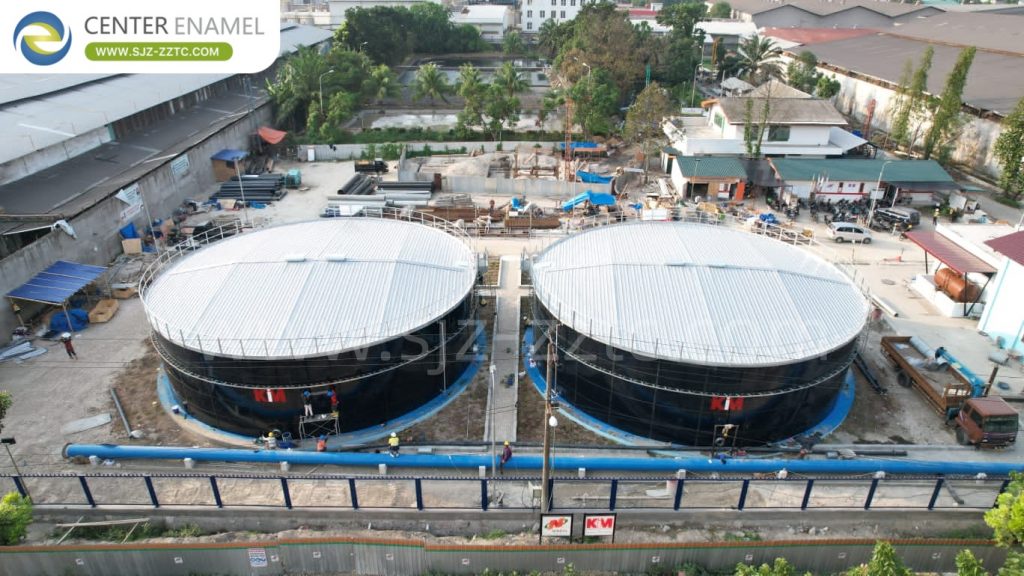
Core Equipment: GFS Tanks for Municipal Wastewater Projects
A successful municipal wastewater system requires durable, corrosion-resistant tanks. Center Enamel’s GFS (Glass-Fused-to-Steel) Tanks are the global industry standard.
Key Advantages of GFS Tanks
- Extreme corrosion resistance: Fused at 820–930°C; stable in pH 1–14 environments
- Long service life: Over 30 years of maintenance-free operation
- Smooth, non-porous surface: Prevents biofilm buildup and easy cleaning
- Bolted modular design: Fast installation, no on-site welding
- Strong structural strength: Withstand earthquakes, wind, and heavy use
- Certified quality: Comply with ISO 28765, AWWA D103, NSF/ANSI 61, CE
GFS Tanks are widely used for:
- Anaerobic digestion reactors
- Wastewater equalization and storage
- Sludge holding tanks
- Effluent storage tanks
They are the ideal match for CSTR, UASB, USR, and IC systems.
Why Choose Center Enamel for Municipal Wastewater EPC Solutions
When you need professional answers to what is the difference between domestic and municipal wastewater and reliable treatment systems, Center Enamel is your trusted global partner.
1. Full-Cycle Turnkey EPC Service
From design, manufacturing, installation to commissioning and after-sales—one-stop responsibility.
2. Customized Anaerobic Solutions
We select the best technology (CSTR/UASB/USR/IC) based on wastewater type, flow, and local conditions.
3. World-Leading GFS Tanks
Asia’s largest production base; 200+ patented enamel formulas; strict 1500V spark test per tank.
4. International Certifications
Fully compliant with global standards for municipal water projects.
5. Rich Global Experience
Successful projects in over 60 countries, including many municipal wastewater systems.
6. Professional Installation
Hydraulic jacking top-down method; no scaffolding or large cranes; fast, safe deployment.
7. Local After-Sales Support
Dedicated regional teams ensure stable long-term operation.
Center Enamel turns complex municipal wastewater challenges into reliable, sustainable, and cost-effective solutions.
Successful Municipal & Wastewater Projects by Center Enamel
Case 1: Saudi Arabia Municipal Wastewater Treatment Project
Tank Dimensions: φ24.06 × 4.85 m (H) — 5 Units
Total Volume: 11,020 m³
Completion Date: 2024
Case 2: Indonesia Municipal Fire Water Project
Application: Fire Water Storage
Project Location: Indonesia
Tank Dimensions: φ7.64 × 34.8 m (H) — 1 Unit
Total Tank Volume: 1,594 m³
Completion Date: 2018
To answer what is the difference between domestic and municipal wastewater: domestic refers to household sewage only, while municipal includes domestic, commercial, institutional, and mixed wastewater collected via public sewers. Municipal wastewater treatment is essential for public health, ecological protection, water sustainability, and low-carbon development.
With advanced CSTR, UASB, USR, and IC anaerobic technologies and durable GFS Tanks, Center Enamel delivers safe, efficient, and long-life EPC solutions for municipal wastewater projects worldwide. Whether you need to clarify wastewater types or design a full treatment system, Center Enamel provides professional, reliable, and sustainable support.