
What Is the Difference Between STP and ETP? A Complete Guide to Wastewater Treatment Systems
In the field of environmental engineering and wastewater management, STP and ETP are two core systems that are often mentioned but frequently misunderstood. Many facility managers, project investors, and industrial operators cannot clearly distinguish the difference between the two, leading to incorrect system selection, substandard effluent, and even legal non-compliance. This article gives a clear, detailed, and SEO-optimized explanation: What is the difference between STP and ETP?
First, let’s define the two terms:
- STP = Sewage Treatment Plant It treats domestic wastewater from residential, commercial, public, and urban areas.
- ETP = Effluent Treatment Plant It treats industrial effluent from manufacturing, processing, and production lines.
Simply put: STP cleans sewage from daily life; ETP treats industrial wastewater from factories. They differ completely in source, composition, treatment process, complexity, cost, and discharge standards.
What Is STP (Sewage Treatment Plant)?
STP is designed to treat household and municipal sewage. This wastewater comes from toilets, kitchens, bathrooms, laundry, restaurants, offices, hotels, schools, and residential communities.
Characteristics of STP Wastewater
- Mainly organic, biodegradable pollutants
- Low toxicity, no heavy metals or hazardous chemicals
- Relatively stable water quality and flow
- Contains organic matter, food residues, soap, oil, and bacteria
- Moderate COD and BOD levels
Typical Applications of STP
- Residential complexes and apartments
- Hotels, resorts, and shopping malls
- Hospitals, schools, and office buildings
- Urban municipal sewage networks
- Rural decentralized sewage treatment
What Is ETP (Effluent Treatment Plant)?
ETP is a customized treatment system designed specifically for industrial wastewater discharged during production processes. Industrial effluent varies greatly by industry and often contains complex, toxic, non-biodegradable, or high-concentration pollutants.
Characteristics of ETP Wastewater
- Extremely high COD, BOD, TDS, and oil content
- May contain heavy metals, dyes, acids, alkalis, toxic chemicals, or residual solvents
- Strong fluctuation in water quality and flow
- May be corrosive, colored, odorous, or oily
- Requires specialized pre-treatment and advanced processing
Typical Applications of ETP
- Textile dyeing and printing factories
- Food & beverage, slaughterhouses, dairy plants
- Distilleries, bio-processing, and fermentation plants
- Pharmaceutical and chemical industries
- Electroplating, tanning, and manufacturing facilities
Key Differences Between STP and ETP
The table below summarizes the core differences between STP and ETP for quick reference:
| Item | STP (Sewage Treatment Plant) | ETP (Effluent Treatment Plant) |
| Wastewater Source | Domestic, municipal, commercial life sewage | Industrial production effluent |
| Main Pollutants | Organic matter, oil, suspended solids, bacteria | Toxic chemicals, heavy metals, dyes, oil, high COD |
| Toxicity | Low or non-toxic | May be toxic, corrosive, or hazardous |
| Water Quality Stability | Stable and predictable | Highly variable and unstable |
| Main Treatment Logic | Physical + biological treatment | Chemical + physical + biological + advanced treatment |
| Process Complexity | Simple to moderate | High to very high |
| Operation Cost | Low to moderate | High (chemicals, energy, maintenance) |
| Discharge Standard | Urban / municipal / reuse for greening | Strict industrial / environmental protection standards |
| Reuse Water Quality | Suitable for irrigation, flushing, cleaning | May require ultrafiltration, RO, or zero liquid discharge |
| System Purpose | Sanitation and urban environmental protection | Pollution control, compliance, and resource recovery |
This comparison shows that STP and ETP are not interchangeable. Using an STP to treat industrial wastewater will result in permanent system failure and environmental hazards. Using an ETP for domestic sewage is economically inefficient and unnecessary.
Treatment Processes: STP vs ETP
STP Treatment Process
STP mainly uses biological treatment as the core technology. Microbes naturally decompose organic pollutants.
- Preliminary treatment: Screening, grit removal
- Primary treatment: Sedimentation
- Secondary treatment: Activated sludge, MBR, biofilter, or anaerobic digestion
- Disinfection: Chlorination or UV
- Discharge or reuse
ETP Treatment Process
ETP requires a combination of chemical, physical, and biological processes to handle complex pollutants.
- Pre-treatment: Neutralization, coagulation, flocculation, oil separation
- Advanced oxidation or reduction for toxic substances
- Anaerobic or aerobic biological treatment
- Filtration, carbon adsorption, or membrane separation
- Sludge dewatering and hazardous waste management
- Industrial wastewater often has unique characteristics, so ETP systems are highly customized for each factory.
Why Understanding STP vs ETP Is Critical
Regulatory Compliance Industrial wastewater must be treated by ETP to meet emission standards. Using STP violates environmental laws.
System Efficiency Correct system matching ensures stable operation, low energy consumption, and long service life.
Cost Control Avoid over-investment or insufficient treatment capacity caused by wrong selection.
Environmental Protection Proper treatment prevents water pollution, soil contamination, odor, and health risks.
Four Advanced Anaerobic Technologies for Wastewater Treatment
Whether in high-concentration STP or ETP (especially food, beverage, distillery, slaughterhouse, and breeding wastewater), anaerobic treatment is the most energy-efficient and cost-effective core process. The four most widely used technologies are:
1. CSTR (Continuous Stirred-Tank Reactor)
Equipped with mechanical stirring, suitable for high-solid, high-suspension wastewater. Prevents stratification and crusting, ensures stable biogas production. Ideal for large-scale organic wastewater projects.
2. UASB (Upflow Anaerobic Sludge Blanket)
Relies on high-activity granular sludge. High organic load, high COD removal efficiency, small footprint. Perfect for soluble high-concentration wastewater after pre-treatment.
3. USR (Upflow Solid Reactor)
Simple structure, low investment, strong anti-clogging ability. Directly treats high-solid wastewater without complex pre-treatment. Suitable for small and medium rural or industrial projects.
4. IC (Internal Circulation Reactor)
High load, high efficiency, internal circulation improves treatment capacity by 3–5 times. Compact layout, high gas yield. Used in large-scale industrial centralized treatment plants.
Advantages of GFS Tanks in STP & ETP Projects
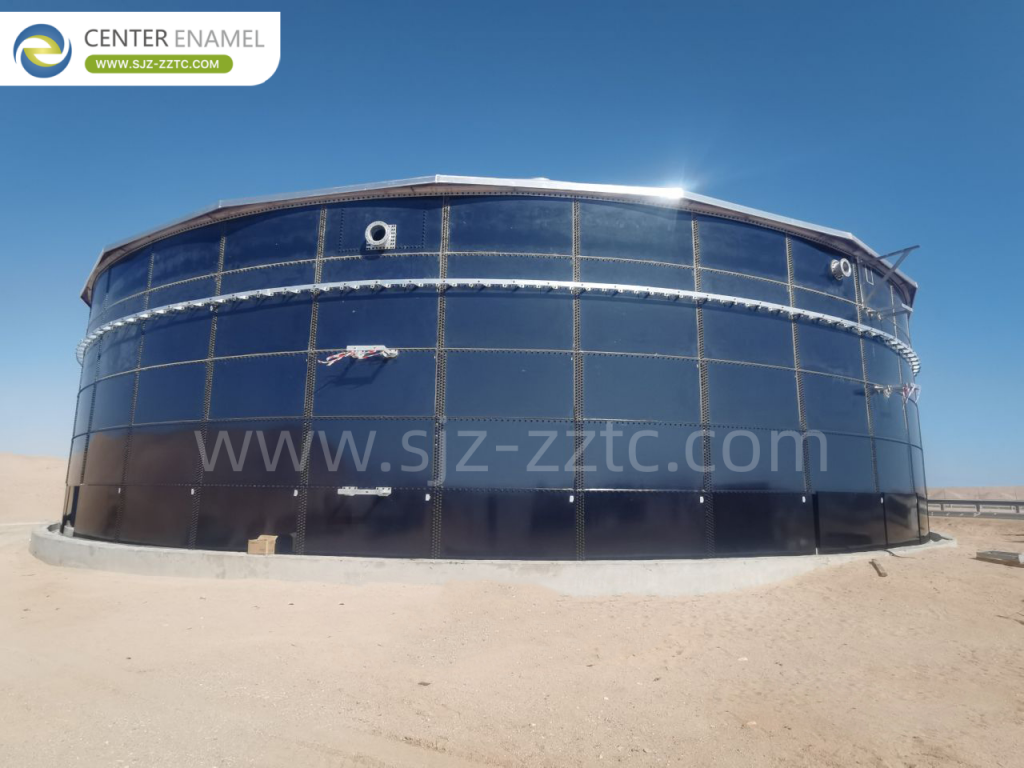
GFS Tanks (Glass-Fused-to-Steel Tanks) are widely used in STP, ETP, anaerobic systems, and biogas projects due to their superior performance:
- Extreme corrosion resistance: Resists acid, alkali, oil, and salt, stable in harsh wastewater environments
- Excellent airtightness: Prevents biogas leakage and odor emission
- Modular bolted design: Fast installation, no on-site welding, short construction period
- Long service life: Over 30 years, smooth surface resists scaling and adhesion
- Flexible expansion: Can expand capacity with project development
- High compatibility: Suitable for CSTR, UASB, USR, IC and all anaerobic processes
Center Enamel: Rich Experience in Biogas & Wastewater Projects
As a leading global EPC contractor for wastewater treatment and renewable energy, Center Enamel has extensive experience in STP, ETP, anaerobic digestion, and biogas projects worldwide.
Core Strengths
- More than 200 enamel technology patents, products meet ISO, AWWA and international standards
- Full turnkey EPC services: design, manufacturing, transportation, installation, commissioning, after-sales
- Customized solutions for STP and ETP systems
- Rich experience in high-concentration organic wastewater and biogas projects
- Stable, reliable, and cost-effective system solutions
- Global service network ensuring long-term stable operation
Typical Project Fields
- Municipal and domestic sewage STP
- Industrial effluent ETP for food, brewery, slaughterhouse, chemical, textile
- High-concentration wastewater anaerobic treatment
- Biogas production and waste-to-energy projects
- GFS Tanks for wastewater storage and anaerobic reactors
STP and ETP are two completely different wastewater treatment systems. STP treats domestic sewage with simple, biological processes; ETP treats industrial effluent with complex chemical, physical, and biological technologies. Choosing the right system is essential for compliance, efficiency, and environmental protection.
With advanced anaerobic processes (CSTR, UASB, USR, IC) and high-performance GFS Tanks, Center Enamel provides reliable, efficient, and sustainable solutions for both STP and ETP projects worldwide. With strong technology, rich experience, and full-service capabilities, Center Enamel is your trusted partner for wastewater treatment and biogas engineering.