
What Is the Gas-Liquid-Solid Separator?
The gas-liquid-solid (GLS) separator is the device at the top of a UASB reactor that splits the reactor’s three streams in one step: it releases biogas upward, lets clarified effluent overflow, and returns sludge back to the blanket. Without it, the biomass would wash out with the treated water and the reactor would lose its treatment capacity. It is the component that makes a mixer-free, media-free UASB possible.
How the Three Phases Separate
Gas-liquid-solid separation happens in two stages. First, baffles and an inverted cone slow the upward flow and deflect biogas into a collection dome, so gas no longer drags sludge upward. Second, the clarified liquid passes over a settling zone where any entrained granules drop out and slide back down inclined surfaces into the blanket, while only clean effluent reaches the overflow weir. The geometry—deflector angle, settling height, and weir position—is what determines how much sludge is retained.
Comparative Data Table: The Three Streams and Their Paths
| Phase | What it is | Where it goes |
| Gas | methane + CO₂ biogas | collection dome → gas line |
| Liquid | clarified treated effluent | settling zone → overflow weir |
| Solid | granular sludge | deflectors → back to blanket |
Why the Separator Decides Reactor Performance
The GLS is where biomass retention is won or lost. A well-designed separator lets the reactor run at high upflow velocity without losing granules, which is what permits the short hydraulic retention and high loading that make UASB efficient. A poorly designed one lets sludge escape, so the blanket thins, loading must drop, and COD removal falls. In practice, separator geometry—not the tank itself—is the main reason two UASB plants on the same wastewater perform very differently.
Frequently Asked Questions (FAQ)
Q1: What is the gas-liquid-solid separator?
A: The three-phase device at the top of a UASB that releases biogas, clarifies the effluent, and returns granular sludge to the blanket—retaining the biomass that makes the reactor work.
Q2: What are its three phases?
A: Gas (methane and CO₂, sent to a collection dome), liquid (clarified effluent, sent over the overflow weir), and solid (granular sludge, deflected back into the blanket).
Q3: Why is it critical to a UASB?
A: Because UASB has no mechanical mixing or media to hold biomass, the separator is the only thing keeping slow-growing granules inside. Lose it and the biomass washes out, collapsing treatment.
Q4: What happens if the separator fails?
A: Sludge escapes with the effluent, the blanket thins, organic loading must be cut, and COD removal drops. Separator geometry is often the hidden reason one UASB outperforms another on identical wastewater.
Project Case Reference
Malaysia Biogas Project — Malaysia · 2026
5 GFS Tanks · 27,000 m³ Total Volume · 22,000 m³ Biogas/Day
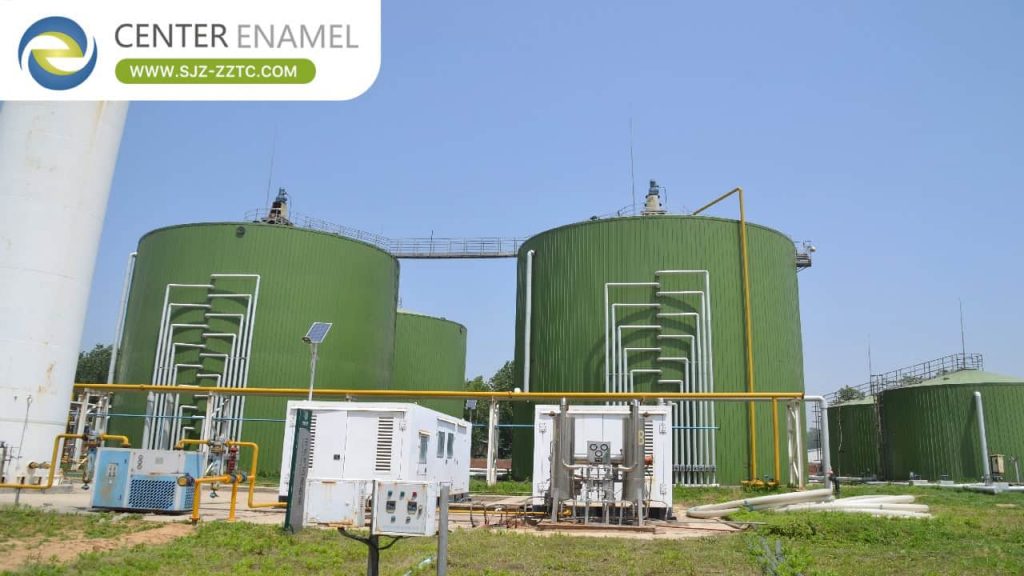
A large-scale biogas project in Malaysia featuring 5 Glass-Fused-to-Steel (GFS) tanks. The project achieves approximately 80% digestibility, with each single tank producing about 4,400 m³ of biogas daily, totaling 22,000 m³ per day across all 5 tanks.
Technical Specifications
Single Tank Volume: 5,400 m³ (Ø24.46 × 12 m)
Total Effective Volume: 27,000 m³ (5 tanks)
Daily Biogas Production: 22,000 m³ total
Digestibility: ≈ 80%
Gas Production Rate: 0.45 m³ / kg COD removed
Tank Type: Glass-Fused-to-Steel (GFS)
Water Quality Data
| Parameter | Inlet Water | Effluent |
| COD | ≥ 60,000 mg/L | ≥ 12,000 mg/L |
| BOD | ≤ 25,000 mg/L | ≤ 5,000 mg/L |