
What Is the MBR Process? Principle, Applications, and Advanced Wastewater Solutions
Water scarcity and increasingly stringent environmental discharge regulations have propelled advanced wastewater treatment technologies to the forefront of industrial and municipal engineering. Among these innovations, the Membrane Bioreactor (MBR) process has emerged as a gold standard for producing high-quality effluent. By combining traditional biological treatment with modern membrane filtration, the MBR system delivers superior pollutant removal in a remarkably compact footprint.
Understanding how the MBR process works, how it compares with high-rate anaerobic technologies like IC, UASB, CSTR, and USR, and why premium containment infrastructure such as Glass-Fused-to-Steel (GFS) tanks matters is essential for facility managers and environmental engineers.
Introduction to the MBR Process
The Membrane Bioreactor (MBR) process is an advanced wastewater treatment technology that integrates biological degradation with membrane liquid-solid separation. In a conventional Activated Sludge Process (CAS), secondary clarifiers or settling tanks are used to separate treated water from biomass. However, these settling tanks require significant land area and can be vulnerable to sludge bulking or poor settling characteristics.
The MBR process eliminates the secondary clarifier entirely. Instead, ultrafiltration (UF) or microfiltration (MF) membrane modules are submerged directly into the aeration tank or placed in a separate membrane tank. Water is drawn through the membrane pores via suction, while bacteria, suspended solids, and even many pathogens are completely retained within the biological reactor.
Core Working Principle of Membrane Bioreactors
The operational mechanism of an MBR system revolves around maintaining an exceptionally high concentration of active biomass while ensuring absolute physical barrier filtration.
High Biomass Concentration: Because membranes retain all suspended solids, Mixed Liquor Suspended Solids (MLSS) concentrations in an MBR can reach 8,000 to 12,000 mg/L or higher—roughly two to four times that of conventional systems.
Extended Sludge Retention Time (SRT): Operating at long SRTs allows slow-growing nitrifying bacteria to proliferate, ensuring exceptional biological nitrogen removal.
Absolute Solid-Liquid Separation: Membrane pores typically range from 0.04 to 0.4 microns. This acts as an impermeable barrier to suspended solids, colloids, and bacteria, yielding a crystal-clear effluent ready for direct discharge or high-grade reuse.
Key Advantages of the MBR Process over Conventional Systems
The integration of membrane filtration into biological wastewater treatment offers several distinct operational and environmental benefits:
Compact Footprint: By eliminating secondary settling basins and operating at high MLSS concentrations, MBR plants require up to 50% less spatial footprint than conventional activated sludge plants.
Superior Effluent Quality: MBR technology consistently delivers near-total removal of suspended solids, turbidity, and significant reductions in BOD and COD, alongside partial disinfection by blocking bacteria.
High Volumetric Loading Capacity: The ability to maintain dense microbial populations allows MBR systems to process higher organic loads efficiently within smaller reactor volumes.
Reduced Sludge Production: Operating at high sludge ages results in lower net biological sludge generation, cutting down on downstream sludge handling and disposal costs.
Overview of High-Rate Anaerobic Technologies: IC, UASB, CSTR, and USR
While MBR is an exceptional aerobic polishing and high-efficiency treatment process, high-strength industrial organic wastewaters often require anaerobic pretreatment. Four prominent anaerobic technologies frequently integrated into comprehensive treatment schemes include:
IC (Internal Circulation) Reactor: A tall, multi-stage anaerobic reactor utilizing internal gas-lift loops to achieve high organic loading rates and superior mixing in a compact footprint.
UASB (Upflow Anaerobic Sludge Blanket): A widely adopted technology where wastewater flows upward through a dense biological sludge blanket, fostering granular biomass and generating renewable biogas.
CSTR (Continuous Stirred-Tank Reactor): Equipped with mechanical agitation, CSTR systems are ideal for digesting high-solid organic slurries, livestock manure, and viscous industrial waste streams.
USR (Upflow Solid Reactor): A specialized anaerobic vessel engineered specifically to handle wastewater and slurries containing elevated suspended solid fractions with reliable operational simplicity.
Advantages of Glass-Fused-to-Steel (GFS) Tanks in Wastewater Treatment
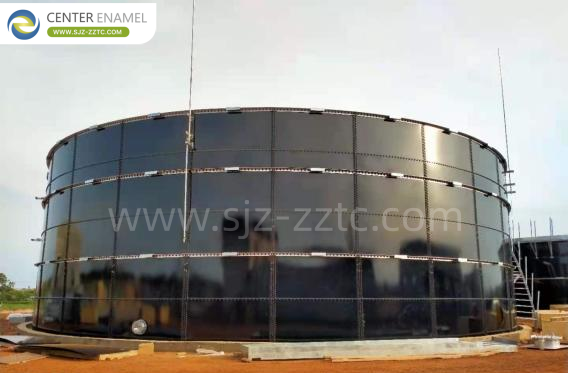
Choosing robust, corrosion-resistant containment infrastructure is just as critical as selecting the treatment technology. Glass-Fused-to-Steel (GFS)—also known as Glass-Lined Steel—tanks have become the premier choice for modern biological reactors, equalization basins, and MBR buffer tanks.
Exceptional Corrosion Resistance: The high-temperature fusion of glass to high-strength steel creates an inert, impermeable bond that withstands harsh chemical cleaning agents, corrosive wastewater, and aggressive biological environments.
Hygienic and Smooth Interior: The ultra-smooth glass surface prevents bio-fouling, scale formation, and sludge adhesion, ensuring easy cleaning and optimal hydraulic performance.
Rapid Modular Installation: Prefabricated panels are bolted on-site, significantly cutting construction timelines compared to traditional cast-in-place concrete tanks.
Scalability and Long Lifespan: GFS tanks boast a service life exceeding 30 years and can be easily expanded, dismantled, or relocated as facility demands evolve.
Center Enamel: Your Trusted Partner for Comprehensive Wastewater Solutions
Executing complex industrial or municipal wastewater projects demands proven engineering expertise, top-tier containment equipment, and comprehensive technical support. Center Enamel is a premier, globally recognized professional wastewater treatment solution provider with decades of industry leadership.
Center Enamel specializes in the research, development, and manufacturing of cutting-edge Glass-Fused-to-Steel (GFS) tanks, bolted steel tanks, and specialized anaerobic reactors (such as UASB, IC, CSTR, and USR systems). Serving diverse industrial sectors and municipal clients worldwide, Center Enamel delivers custom-engineered, turnkey solutions that guarantee environmental compliance, structural longevity, and superior operational performance.
Frequently Asked Questions (FAQs) About the MBR Process
Q1: What is the primary difference between a conventional activated sludge process and an MBR system?
The primary difference lies in how solid-liquid separation is achieved. Conventional activated sludge relies on gravity settling in secondary clarifiers, which can be disrupted by poor sludge settling or high organic loads. The MBR process replaces gravity clarifiers with physical membrane filtration (ultrafiltration or microfiltration), completely retaining biomass inside the reactor and yielding superior, particle-free effluent regardless of sludge settling properties.
Q2: What are the main limitations or challenges associated with MBR technology?
While MBR systems offer exceptional effluent quality and a compact footprint, the primary challenges include higher capital investment costs for membrane modules and increased energy consumption required for continuous membrane aeration (used for scouring and fouling control). Regular chemical cleaning and membrane maintenance are also necessary to sustain long-term permeability.
Q3: Why are Glass-Fused-to-Steel (GFS) tanks ideal for housing wastewater treatment systems?
Glass-Fused-to-Steel (GFS) tanks combine the structural strength and flexibility of steel with the chemical inertness and corrosion resistance of glass. They provide unmatched durability against harsh chemicals, wastewater gases, and biological degradation. Furthermore, their modular bolted construction allows for rapid on-site erection, minimal ongoing maintenance, and easy future expansion.