
What Is the Meaning of Garden Waste? Biogas Conversion & Professional Treatment
What is the meaning of garden waste? Garden waste, also known as green waste, refers to all organic solid waste generated from landscape maintenance, garden trimming, tree pruning, lawn mowing, and plant renewal. It includes branches, leaves, grass clippings, withered flowers, shrub trimmings, and root residues. As cities and residential communities continue to expand, garden waste output increases year by year.
Without proper disposal, it occupies land, rots and emits odors, breeds pests, and releases greenhouse gases. However, garden waste is rich in cellulose, hemicellulose, and organic nutrients, making it an excellent raw material for biogas production. This article explains the meaning and characteristics of garden waste, how it converts into biogas, four mainstream anaerobic technologies, advantages of GFS Tanks, and comprehensive strengths of Center Enamel in garden waste biogas projects.
What Is the Meaning of Garden Waste? Definition & Characteristics
Garden waste is a type of clean organic green waste produced in parks, residential gardens, scenic areas, urban green belts, and private courtyards. Its main components include fallen leaves, lawn grass, pruned branches, withered flowers and plants, and plant rhizomes.
Core Features of Garden Waste
- High organic content and biodegradable.
- Rich in fiber, easy to decompose under natural conditions.
- Large seasonal output, concentrated in pruning seasons.
- Non-toxic and pollution-free compared with domestic and agricultural waste.
- Easy to rot, generating odor and methane if piled randomly.
Traditional disposal methods such as landfilling, incineration, and random stacking waste resources and cause secondary pollution. Converting garden waste into biogas through anaerobic digestion has become the most eco-friendly and resource-efficient solution.
How Does Garden Waste Generate Biogas
Garden waste relies on anaerobic digestion to produce biogas in an oxygen-free sealed environment. The whole process is divided into four stable biological stages:
- Hydrolysis Stage: Microorganisms decompose cellulose and macromolecular organics in garden waste into small-molecule sugars and amino acids.
- Acidification Stage: Small-molecule substances are converted into volatile fatty acids, hydrogen, and carbon dioxide.
- Acetogenesis Stage: Fatty acids are further decomposed into acetic acid, the key precursor for methane formation.
- Methanogenesis Stage: Methanogenic bacteria convert acetic acid into biogas, containing 55%–70% methane and 30%–45% carbon dioxide.
The produced biogas can be used for power generation, heating, and park energy supply. Fermented residues become high-quality organic fertilizer, which can be returned to gardens and green belts, forming a perfect circular economy model.
Benefits of Garden Waste Biogas Production
- Reduce landfill occupation and lower urban waste disposal costs.
- Eliminate decay odor and pest breeding caused by random stacking.
- Capture methane emissions to help cities achieve carbon reduction goals.
- Produce clean biogas to replace fossil fuels and optimize energy structure.
- Create organic fertilizer to nourish garden soil and reduce chemical fertilizer use.
Four Main Anaerobic Technologies for Garden Waste
Center Enamel matches four mature anaerobic technologies for garden waste characteristics and project scales.
CSTR Process (Completely Stirred Tank Reactor)
CSTR adopts full mechanical stirring to mix garden waste and microbial flora evenly. It prevents floating scum and sediment accumulation, suitable for high-fiber large-scale centralized garden waste biogas projects.
UASB Process (Upflow Anaerobic Sludge Blanket)
UASB features high organic removal efficiency and low operating cost. It is suitable for liquid leachate and partially decomposed garden waste treatment, ideal for medium-sized urban green waste projects.
USR Process (Upflow Solids Reactor)
USR has a simple structure and low investment. It requires no complex stirring system and is easy to maintain, perfect for small community and park decentralized biogas projects.
IC Process (Internal Circulation)
IC is an advanced high-rate anaerobic technology with 3–5 times higher load than traditional reactors. It saves construction land and is the best choice for urban projects with limited space.
Advantages of GFS Tanks in Garden Waste Biogas Projects
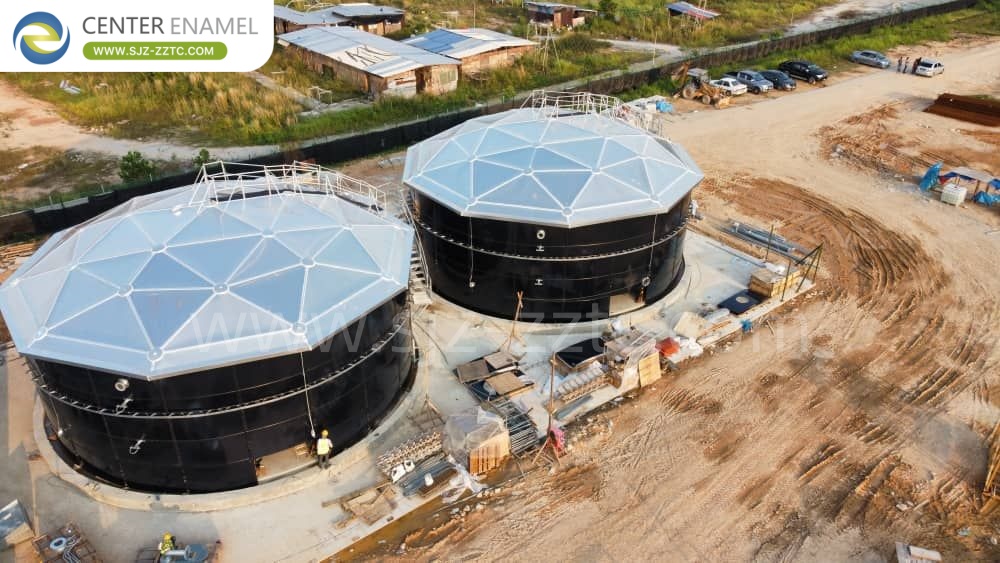
GFS Tanks (Glass-Fused-to-Steel Tanks) are the core equipment for garden waste biogas projects, with irreplaceable advantages over concrete and ordinary steel tanks.
Super Corrosion Resistance: Fused at over 820°C, GFS Tanks resist acid, alkali, and microbial corrosion generated during garden waste fermentation.
Excellent Airtightness: Sealed bolted structure prevents biogas leakage, improving gas production efficiency and avoiding odor escape.
Long Service Life: Up to 30+ years of service life, low maintenance cost, far better than concrete tanks.
Fast Installation: Factory prefabricated components, on-site bolt assembly, no long curing period, shortening construction cycle.
Strong Climate Adaptation: Resists ultraviolet aging, rain erosion, and temperature changes, suitable for outdoor garden environments.
Flexible Expansion: Easy to disassemble and expand, adapting to annual changes in garden waste output.
Center Enamel’s Advantages in Garden Waste Biogas Projects
Professional Customization: Tailor anaerobic processes and GFS Tank solutions according to local garden waste components and seasonal output.
Leading Manufacturing Strength: Operates Asia’s largest GFS Tank production base with 200+ patented enamel formulas.
Strict International Standards: All tank plates pass 1500V high-voltage spark test, complying with ISO, AWWA, CE and other global certifications.
Rich Project Experience: Has completed numerous urban green waste and garden biogas projects, familiar with urban environmental standards and construction norms.
Professional Installation: Adopts hydraulic jacking top-down installation and zero on-site welding, suitable for park and urban green belt complex terrain.
One-Stop EPC Service: Covers project design, equipment manufacturing, installation, commissioning and long-term after-sales maintenance.
The meaning of garden waste is not merely green garbage; it is valuable renewable biomass resource. Rational disposal via anaerobic digestion can turn garden waste into clean biogas and organic fertilizer, solving pollution while creating economic and environmental benefits. With four mature anaerobic technologies, high-performance GFS Tanks and one-stop EPC capability, Center Enamel provides reliable full solutions for global garden waste biogas projects, supporting urban greening, carbon reduction and sustainable circular development.