
What Is the Process of Municipal Wastewater Treatment? Full Process & Center Enamel Solutions
Municipal wastewater is one of the most common sources of water pollution worldwide. It mainly comes from residential communities, commercial zones, restaurants, public facilities, hotels, and urban surface runoff. These waters contain high levels of organic matter, suspended solids (SS), nitrogen, phosphorus, pathogens, oils, and detergents.
If discharged directly without treatment, they will cause eutrophication, river and coastal pollution, and serious threats to public health and ecological safety. Therefore, a complete and stable municipal wastewater treatment process is essential for urban environmental protection and sustainable water recycling.
In this article, we will explain the standard municipal wastewater treatment process in detail, and introduce how Center Enamel, as a professional Municipal Sewage Treatment Project EPC Contractor, provides optimized processes, high-performance GFS Tanks and full-cycle solutions for global municipal sewage projects.
Complete Municipal Wastewater Treatment Process
A modern municipal wastewater treatment plant generally includes five core stages: Pretreatment, Primary Treatment, Secondary (Biological) Treatment, Tertiary (Advanced) Treatment, and Sludge Treatment. Each stage has clear functions to gradually remove pollutants and produce effluent that meets discharge standards.
1.1 Pretreatment (Preliminary Treatment)
Pretreatment is the first barrier to protect subsequent equipment and stabilize the influent condition.
- Screening: Remove large debris such as plastic bags, fibers, branches, stones, and sanitary products to prevent clogging pumps and pipelines.
- Grit Removal: Separate sand, gravel, and heavy inorganic particles to reduce abrasion to pumps, pipes, and biological reactors.
- Flow and Equalization: Balance water volume and water quality fluctuations caused by peak water use, weather, and seasonal changes, ensuring stable operation of subsequent processes.
1.2 Primary Treatment (Physical Sedimentation)
Primary treatment mainly uses gravity settling to remove settleable suspended solids and part of organic matter.
- Wastewater enters primary clarifiers and stays for 1–2 hours.
- Heavy solids settle to the bottom as primary sludge.
- Grease, oil, and light scum float to the surface and are removed by skimmers.
- This stage can remove about 40–60% of SS and 20–30% of BOD₅, greatly reducing the load of biological treatment.
1.3 Secondary Treatment (Biological Treatment)
Biological treatment is the core of municipal wastewater treatment, responsible for degrading dissolved and colloidal organic pollutants.It uses aerobic or anaerobic microorganisms to “eat” organic matter, converting COD/BOD₅ into carbon dioxide, water, and microbial biomass.
Common biological processes include:
- Activated Sludge Process: Mix sewage with activated sludge in aeration tanks, provide oxygen through aeration, and let microorganisms degrade pollutants efficiently.
- A/O, A²/O Processes: Achieve simultaneous nitrogen and phosphorus removal to prevent eutrophication in rivers and oceans.
- MBR (Membrane Bioreactor): Use membrane filtration instead of secondary sedimentation tanks for high-quality effluent and small footprint.
- Anaerobic Processes: Such as UASB Process, IC, CSTR, USR, suitable for high-concentration organic sewage and sludge digestion, with biogas recovery for energy saving.
After biological reaction, mixed liquid enters secondary clarifiers to separate sludge and water. Most sludge is returned to maintain microbial concentration; excess sludge is sent to sludge treatment units.
1.4 Tertiary Treatment (Advanced Treatment)
Tertiary treatment further polishes effluent to meet strict reuse or discharge standards, especially for sensitive water bodies and coastal areas.Common units:
- Filtration: Sand filter, activated carbon filter, or ultrafiltration to remove fine suspended solids.
- Nutrient Removal: Deep removal of nitrogen and phosphorus to avoid algal blooms.
- Disinfection: UV, chlorine, or ozone to kill bacteria, viruses, and other pathogens to protect public health.
- Treated Water Storage: Store qualified effluent for landscape, greening, flushing, or industrial reuse.
1.5 Sludge Treatment and Disposal
Sludge is a byproduct of wastewater treatment and must be properly handled to avoid secondary pollution.Typical steps:
- Thickening: Reduce moisture content and volume.
- Digestion: Anaerobic or aerobic digestion to stabilize organic matter and reduce odor and pathogens.
- Dewatering: Use filter presses to further remove water for easy transportation.
- Utilization or Disposal: Landfill, composting, incineration, or building materials utilization.
Center Enamel’s Core Technologies for Municipal Wastewater Treatment
As a leading Municipal Sewage Treatment Project EPC Contractor, Center Enamel provides customized, stable, and cost-effective solutions combining advanced anaerobic processes and high-performance equipment.
Key Anaerobic Processes Provided by Center Enamel
UASB Process (Upflow Anaerobic Sludge Blanket)UASB is the most widely used core process for municipal sewage. It forms a high-concentration sludge blanket at the reactor bottom. Wastewater flows upward and contacts microorganisms, achieving high organic removal efficiency with low energy consumption and low investmentCenter Enamel. It is highly adaptable to tropical and subtropical climates and urban sewage with load fluctuations.
IC Process (Internal Circulation)With biogas-driven internal circulation, IC has ultra-high volumetric load and small footprint, ideal for large-scale plants in dense cities with limited land.
CSTR Process (Completely Stirred Tank Reactor)Full-mixing design avoids sediment and scum. It has strong resistance to high SS and catering waste, ensuring stable biogas production.
USR Process (Upflow Solid Reactor)Simple structure, low energy consumption, and high reliability, suitable for small towns, communities, and decentralized projects.
Core Equipment: GFS Tanks (Glass-Fused-to-Steel Tanks)
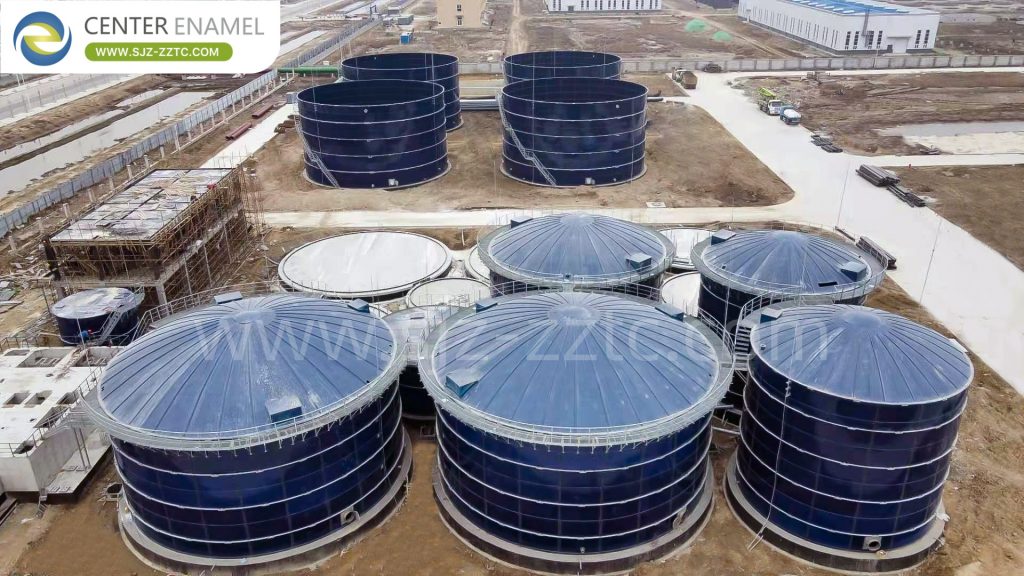
GFS Tanks are the flagship equipment of Center Enamel for municipal wastewater projects, manufactured by fusing special enamel onto steel plates at over 820°C, combining steel strength and glass corrosion resistance.
Key advantages:
- Extreme Corrosion Resistance: Stable in pH 1–14, resistant to acid, alkali, salt, and coastal corrosion, suitable for harsh environments.
- Long Service Life: Designed for 30+ years, UV-resistant, seismic, and wind-resistant.
- Fast Installation: Factory-prefabricated, bolted on-site, no welding or long curing time, shortening construction period by 50% compared with concrete tanksCenter Enamel.
- Wide Application: Used as UASB/IC/CSTR/USR reactors, equalization tanks, clarifiers, sludge tanks, and treated water storage tanks.
- NSF/ANSI 61 Certified: Safe for water and wastewater systems.
Center Enamel also provides FBE tanks, biogas holders, aluminum dome roofs, grilles, pumps, aeration systems, and automatic monitoring equipment to form a complete system solution.
Why Choose Center Enamel as Your EPC Partner
Strong R&D and Manufacturing Capacity
Center Enamel owns Asia’s largest GFS tank production base, with more than 200 patented enamel formulas and self-produced enamel frit. Each steel plate passes a strict 1500V high-voltage spark test to ensure zero coating defects.
Full-Cycle EPC Service
We provide one-stop service from design, manufacturing, construction, installation, commissioning to after-sales support, reducing coordination costs and shortening project delivery time.
Adapted to Complex Environments
Our solutions are optimized for tropical heat, high humidity, coastal salt spray, seismic zones, and narrow urban sites. The hydraulic jacking installation system enables top-down assembly without scaffolding or large cranes, suitable for crowded cities and remote areas.
Compliance with International Standards
All designs meet local environmental, discharge, and safety regulations, and comply with ISO, AWWA, OSHA, NSF/ANSI 61, ensuring smooth acceptance and long-term stable operation.
Energy Saving and Low-Carbon Benefits
Biogas recovery from anaerobic treatment can be used for power generation or heating, reducing operating costs and supporting global carbon neutrality goals.
Rich Global Project Experience
Center Enamel has completed numerous municipal wastewater projects in Asia, Africa, and other regions, with deep understanding of local climate, policies, and construction conditions, effectively reducing project risks.
The municipal wastewater treatment process is a complete system including pretreatment, primary settling, biological treatment, advanced treatment, and sludge treatment. Each step is critical to ensure effluent meets standards and protect ecological safety.
For any municipal sewage project, choosing a professional Municipal Sewage Treatment Project EPC Contractor with mature processes and reliable equipment is the key to long-term stable operation. Center Enamel integrates advanced anaerobic technologies represented by UASB Process, high-quality GFS Tanks, and full-cycle EPC services to provide customized, durable, and efficient solutions for cities worldwide.
We are committed to promoting water recycling, improving environmental quality, and becoming a trusted long-term partner for sustainable municipal wastewater management.