
What Is the Waste from Palm Oil Mills? Understanding POME and Sustainable Biogas Solutions
Palm oil is one of the most widely used vegetable oils in the world, found in everything from cooking oil and margarine to cosmetics, detergents, and biodiesel. Millions of tons of palm oil are produced annually across Southeast Asia, Africa, and Latin America. However, behind this massive industry lies a significant environmental challenge that many people never see: the waste generated by palm oil mills.
So, what is the waste from palm oil mills? The answer is Palm Oil Mill Effluent, commonly known as POME. This article provides a comprehensive guide to POME: what it is, why it matters, and how modern technology can transform it from a pollutant into a valuable resource.
What Is POME? Defining Palm Oil Mill Effluent
Palm Oil Mill Effluent (POME) is the wastewater generated during the processing of fresh fruit bunches (FFBs) into crude palm oil. It is not a single substance but a complex mixture of organic materials, water, oils, and residual solids.
For every ton of FFBs processed, a typical palm oil mill discharges approximately 0.7 to 1 cubic meter of POME. With millions of tons of palm oil produced globally each year, the total volume of POME generated is enormous.
The Three Main Sources of POME
POME is produced during three critical stages of palm oil processing:
Sterilizer Condensate: When fresh fruit bunches are sterilized with steam, the condensate collected contains dissolved organic matter.
Clarification Wastewater: During the clarification process where crude palm oil is separated from the mixture, significant amounts of oily wastewater are generated.
Hydrocyclone Wastewater: From the separation of kernels and fibers.
Physical and Chemical Characteristics of POME
To understand why POME requires proper treatment, it is essential to look at its characteristics:
| Parameter | Typical Value |
| Temperature | 60-80°C (hot) |
| pH | 3.3-4.6 (acidic) |
| Appearance | Thick, brownish liquid |
| Oil & Grease | High concentration |
| Total Solids (TS) | 3-6% |
| BOD (Biological Oxygen Demand) | Very high (25,000-45,000 mg/L) |
| COD (Chemical Oxygen Demand) | Very high (50,000-100,000 mg/L) |
Fresh POME is hot, acidic, thick, and brownish in appearance. It contains high levels of organic matter, suspended solids, oil, and grease. If discharged directly into rivers or onto land without treatment, POME can deplete oxygen in water bodies, kill aquatic life, and release methane-a greenhouse gas 25 times more potent than carbon dioxide.
Why Is POME a Problem If Left Untreated?
When palm oil mills do not manage POME properly, the consequences can be severe:
Water Pollution: High BOD and COD levels cause oxygen depletion in rivers, leading to fish kills and loss of biodiversity.
Greenhouse Gas Emissions: Open lagoon systems release methane directly into the atmosphere, contributing significantly to climate change.
Odor Issues: Decomposing POME produces unpleasant smells that affect nearby communities.
Soil Contamination: Improper land application can lead to nutrient imbalances and groundwater contamination.
However, POME is not simply "waste." It is also a resource waiting to be tapped.
The Hidden Opportunity: POME as an Energy Source
Despite its negative characteristics, POME has a significant advantage: it is highly biodegradable. The same organic matter that causes pollution can be converted by anaerobic bacteria into biogas-a renewable fuel composed primarily of methane (50-70%) and carbon dioxide.
This is where modern biogas solutions come into play. Instead of allowing methane to escape from open lagoons, a properly engineered system captures it for productive use.
Benefits of Converting POME to Biogas:
Renewable Energy Generation: Biogas can power mill boilers, dryers, or electricity generators, reducing reliance on fossil fuels.
Greenhouse Gas Reduction: Capturing methane prevents its release into the atmosphere.
Water Quality Improvement: Anaerobic digestion significantly reduces BOD and COD levels.
Fertilizer Production: The nutrient-rich digestate (containing nitrogen, phosphorus, potassium, magnesium, and calcium) can be safely applied to palm oil plantations.
Center Enamel: Professional One-Stop Biogas Solutions for Palm Oil Mills
For over 36 years, Center Enamel has been a global leader in water, wastewater, and biogas projects. As the largest manufacturer of Glass-Fused-to-Steel (GFS) tanks in Asia, the company provides complete, turnkey biogas solutions tailored specifically to the challenges of POME treatment.
Center Enamel’s approach covers every stage of the process:
Pretreatment: Screen machines, horizontal flow oil separators, and regulating tanks remove solids, grease, and balance flow fluctuations.
Anaerobic Digestion - USR Process: The Upflow Solids Reactor (USR) is specifically designed for high-solids wastewater like POME (TS 3-6%). Wastewater flows upward through a dense bed of anaerobic bacteria, producing biogas efficiently.
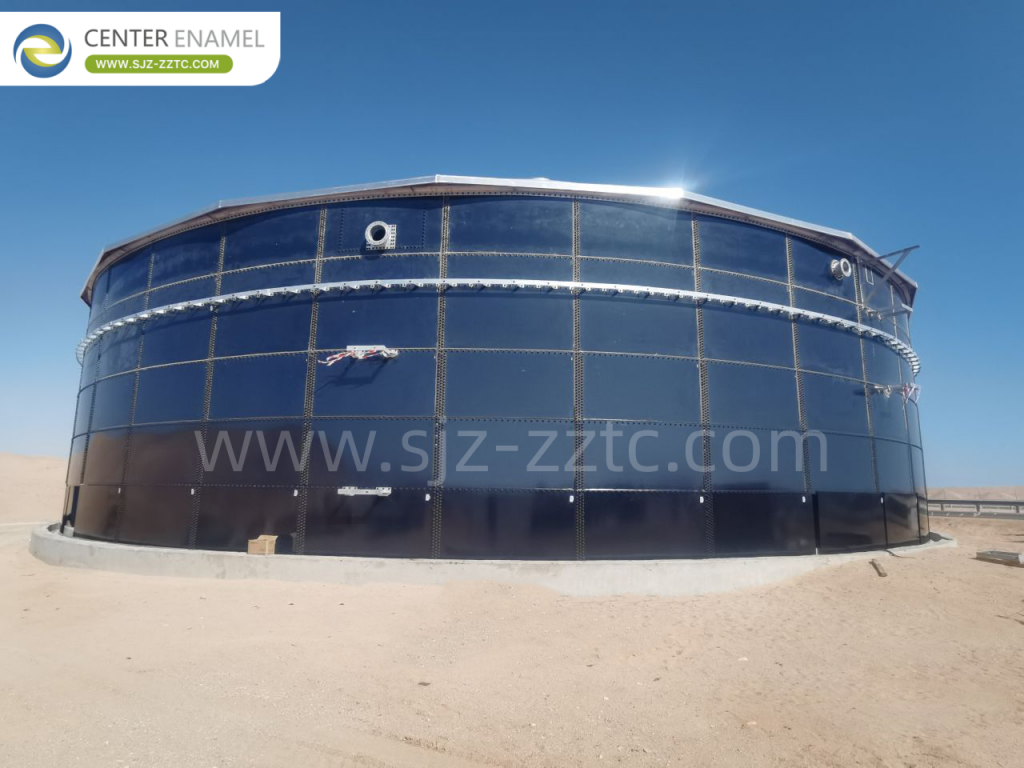
Biogas Storage - GFS Tanks with Double Membrane Roof: Center Enamel’s glass-fused-to-steel tanks offer exceptional corrosion resistance against acidic POME. Paired with a double membrane roof, the system provides a sealed, efficient, and cost-effective biogas capture solution.
Supporting Equipment: Gas holders, hot water boilers, emergency torch systems, dehydration and desulfurization tanks, and screw sludge dewatering machines complete the plant.
Center Enamel offers EPC services (Engineering, Procurement, and Construction) , meaning they handle everything from site assessment and civil design to installation and commissioning. For palm oil mill owners, this one-stop responsibility means less complexity, better coordination, and guaranteed performance.
With over 250,000 GFS tank sheets produced annually and a professional technical team, Center Enamel delivers rapid on-site installation-even in remote locations. Their certifications (ISO9001, NSF61, CE/EN1090, EN28765) and experience across more than 100 countries make them the trusted partner for turning palm oil mill waste into renewable energy.
Conclusion: From Waste to Worth
So, what is the waste from palm oil mills? It is Palm Oil Mill Effluent (POME) -a hot, acidic, organic-rich wastewater that, if left untreated, harms the environment. But with advanced biogas solutions such as the USR Process and durable GFS Tanks, POME transforms from a pollution problem into a profitable energy asset. Center Enamel provides the expertise, equipment, and turnkey execution to make this transformation possible for palm oil mills worldwide.
Frequently Asked Questions (FAQ)
Q1: Is POME hazardous to human health if not treated properly?
While POME itself is not classified as a hazardous material, improper management can lead to contamination of drinking water sources and breeding grounds for disease vectors such as mosquitoes. The high organic content also produces foul odors that can affect the quality of life for nearby communities. Proper treatment using anaerobic digestion eliminates these risks by breaking down harmful organic compounds.
Q2: How much biogas can be produced from one cubic meter of POME?
Under optimal mesophilic conditions (35-37°C) using the USR Process, one cubic meter of raw POME can typically produce 25-35 cubic meters of biogas. This biogas contains 50-70% methane, which can be used directly in boilers or upgraded for electricity generation. The exact yield depends on the influent COD concentration and operational parameters.
Q3: Does Center Enamel provide after-sales support for biogas projects?
Yes. Center Enamel offers comprehensive after-sales support, including operator training, spare parts supply, remote troubleshooting, and optional long-term maintenance contracts. Their team can conduct periodic performance audits to ensure the USR Process and GFS Tanks continue operating at peak efficiency throughout the plant’s lifetime. This support is available for projects in all countries where Center Enamel operates.