
What Kitchen Waste Cannot Be Composted? A Complete Guide to Safe & Sustainable Waste Treatment
Many households, communities, and restaurants hope to reduce waste by composting, but they often face a common question: What kitchen waste cannot be composted? Composting is a traditional aerobic decomposition method, but it has strict limits on material types. Some kitchen waste not only fails to decompose properly but also damages compost quality, attracts pests, produces odors, and spreads pathogens. Understanding non-compostable kitchen waste helps avoid mistakes and choose more reliable disposal methods.
For most organic kitchen waste—including items that cannot be composted—anaerobic digestion and biogas production provide a safer, more efficient, and more environmentally friendly solution. This article explains which kitchen waste is unsuitable for composting, how biogas technology solves these problems, and how professional systems support large-scale sustainable waste management.
What Is Composting?
Composting is an aerobic decomposition process in which microorganisms break down organic materials under oxygen, moisture, and temperature conditions. The final product is organic fertilizer that can improve soil structure and provide nutrients. Traditional composting works for fruit peels, vegetable trimmings, coffee grounds, eggshells, and plant residues. However, composting has obvious limitations: it requires long fermentation times, regular turning, proper carbon-nitrogen balance, and strict material control. Many common kitchen items disrupt the process and are not suitable for composting.
What Kitchen Waste Cannot Be Composted?
Below are the main categories of kitchen waste that should never be added to compost piles:
1. Cooked Oil, Grease, Fat, and Fried Food
Oil, fat, and greasy leftovers block oxygen exchange in compost, slow down decomposition, produce strong odors, and attract rats, flies, and stray animals. They also form a waterproof layer that damages the compost structure.
2. Meat, Fish, and Bone Scraps
Meat and fish quickly rot, smell terrible, and attract pests. They may carry bacteria, viruses, and parasites. Bones are difficult to decompose and can remain intact for years.
3. Dairy Products (Milk, Cheese, Yogurt, Butter)
Dairy items decompose rapidly, release strong odors, and attract animals. They also increase pathogen growth and cause excessive acidity in compost.
4. Spoiled or Processed Food with Salt, Sugar, or Spices
High salt, sugar, and strong spices harm beneficial microorganisms, unbalance the compost system, and reduce fertilizer quality.
5. Citrus Peels in Large Quantities
Citrus peels contain high oil and acidic substances that kill compost microbes and slow decomposition. Small amounts are acceptable, but large volumes are unsuitable.
6. Onion, Garlic, and Spicy Residues
These materials have strong antibacterial properties and can reduce microbial activity, affecting fermentation efficiency.
7. Charcoal, Ash, and Burnt Food
Charcoal and ash contain heavy metals or alkaline substances that contaminate compost and harm plants.
8. Non-Organic Impurities
Plastic bags, foam boxes, wrapping paper, toothpicks, glass, and metal cannot decompose and damage compost and equipment.
These materials are the main answer to what kitchen waste cannot be composted. For large-scale catering, urban, and community waste, composting is clearly insufficient. A more stable, efficient, and inclusive method is needed.
Why Biogas Technology Is Better Than Composting for Kitchen Waste
When composting fails or is unsuitable, anaerobic digestion biogas technology becomes the optimal solution. Unlike composting, biogas systems work in oxygen-free closed environments and can safely process nearly all organic kitchen waste—including most items that cannot be composted.
Key Advantages of Biogas Over Composting
- Accepts oil, fat, meat, fish, dairy, and spicy waste
- No odor leakage, no pest attraction
- Higher resource utilization: produces clean energy
- Shorter treatment cycle, higher efficiency
- Suitable for large-scale urban and commercial projects
- Residue becomes safe organic fertilizer after digestion
Biogas technology turns the limitations of composting into strengths and provides a truly sustainable way to handle kitchen waste.
How Kitchen Waste Is Converted to Biogas
Kitchen waste is first sorted, crushed, and homogenized. It then enters a closed anaerobic reactor where four stages of decomposition occur:
- Hydrolysis: large molecules break into small soluble substances
- Acidification: organic matter becomes volatile fatty acids
- Acetogenesis: intermediates convert to acetic acid and hydrogen
- Methanation: methanogens produce biogas (55–70% methane)
Biogas can be used for cooking, heating, or electricity generation. The by-product digestate is safe, odorless organic fertilizer. This closed-loop system is the future of kitchen waste management.
Four Advanced Anaerobic Technologies for Kitchen Waste Biogas Projects
To support stable and efficient biogas production, four mature anaerobic processes are widely used:
1. CSTR (Continuous Stirred-Tank Reactor)
With mechanical stirring, CSTR is ideal for high-solid, high-oil kitchen waste. It provides stable fermentation, high gas yield, and strong anti-shock capacity for large-scale projects.
2. UASB (Upflow Anaerobic Sludge Blanket)
Uses high-activity granular sludge with high organic load and small footprint. Suitable for pre-treated soluble kitchen waste.
3. USR (Upflow Solid Reactor)
Simple structure, low investment, anti-clogging. Perfect for small and medium-sized community and rural projects.
4. IC (Internal Circulation)
High-efficiency reactor with 3–5 times the treatment capacity of traditional systems. Saves space for large urban centralized treatment plants.
These technologies make biogas projects adaptable to any kitchen waste composition and project scale.
Why GFS Tanks Are Essential for Biogas Projects
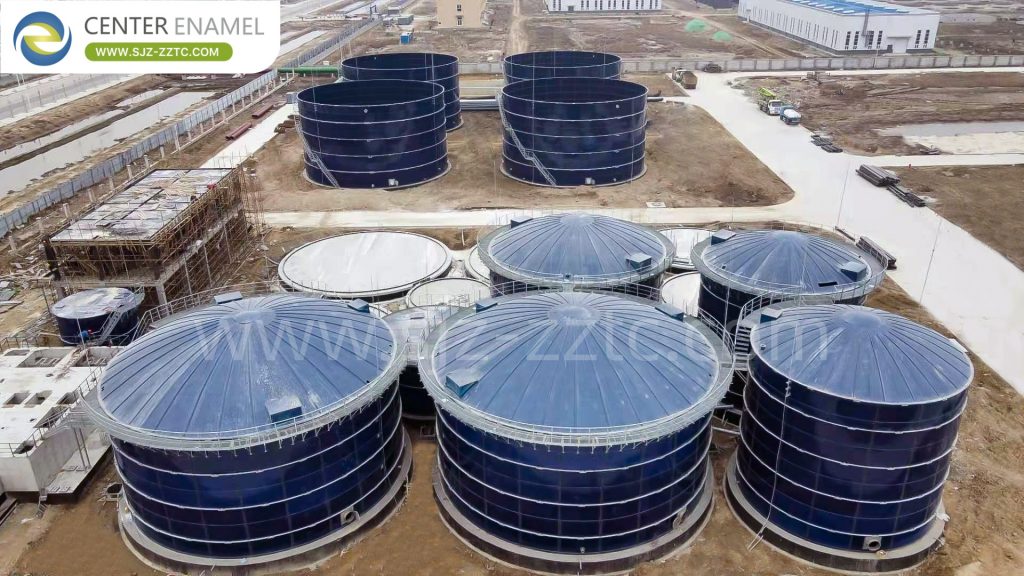
Glass-Fused-to-Steel (GFS) Tanks are the core equipment for modern kitchen waste biogas projects. Their advantages include:
Super corrosion resistance: withstands acid, alkali, hydrogen sulfide, and salt spray
Excellent airtightness: prevents biogas leakage and ensures safe operation
Modular bolted design: factory-prefabricated, fast installation, no welding
Long service life: over 30 years, low maintenance
Strong weather resistance: adapts to high temperature, humidity, and coastal environments
Flexible expansion: capacity can be increased easily as waste volume grows
GFS tanks provide reliable support for stable, long-term biogas project operation.
Center Enamel: Trusted EPC Contractor for Kitchen Waste Biogas Projects
Center Enamel is a leading global provider of full turnkey biogas project solutions with rich experience in kitchen waste, food waste, and organic waste treatment.
Our Core Strengths
- Full EPC services: design, production, transportation, installation, commissioning, training, after-sales
- Customized anaerobic systems: CSTR, UASB, USR, IC tailored to local conditions
- High-quality GFS tanks with patented enamel technology
- Professional hydraulic jacking installation for safe, fast construction
- Hundreds of successful projects worldwide
- Stable performance, high biogas yield, low operating cost
We help communities, cities, and enterprises turn kitchen waste into clean energy and achieve sustainable development goals.
To answer what kitchen waste cannot be composted: oil, fat, meat, fish, dairy, spicy food, citrus peels in large amounts, and processed food are all unsuitable. Composting has material limits, odor issues, and pest risks. In contrast, biogas technology via anaerobic digestion can safely process almost all organic kitchen waste, produce clean energy, and generate safe fertilizer. Supported by CSTR, UASB, USR, IC technologies and durable GFS tanks, biogas projects are the most reliable large-scale solution. As a professional EPC contractor, Center Enamel provides full-cycle, high-efficiency kitchen waste biogas projects worldwide. Choosing biogas means choosing a smarter, greener, and more sustainable way to manage kitchen waste.