
What Makes a Biomass Project Unprofitable?
A biomass project usually turns unprofitable because of feedstock problems first—unreliable supply, high delivered cost, or moisture too high to burn efficiently—followed by no heat off-take for CHP, a low capacity factor, and over-design. In practice the plant that loses money is almost always one where fuel logistics and utilization were underestimated, not one where the boiler was wrong.
Root Cause 1 – Feedstock Logistics and Cost
Biomass is bulky, low-density, and seasonal. If delivered fuel cost exceeds the energy value, or supply is interrupted, the plant idles. Transport beyond ~50 km often erases margins. Secure, year-round, dry feed at a known cost is the single biggest profitability driver.
Root Cause 2 – High Moisture
Above ~50% moisture, combustion needs auxiliary fuel (see moisture limits). Wet feed forces bought-energy drying or co-firing, cutting efficiency from the 35–45% electrical / 80–90% total CHP range down sharply. Fuel moisture and uniformity dominate plant economics more than the boiler itself.
| Failure mode | Effect | Fix |
| Unreliable feed | idle time, lost revenue | contracts, storage |
| High moisture | aux fuel, low efficiency | dry / blend / AD |
| No heat off-take | low total efficiency | find heat customer |
| Low capacity factor | high unit cost | firm feed + O&M |
| Over-design | stranded CapEx | size to real feed |
Root Cause 3 – No Heat Off-Take (CHP Value Lost)
Standalone power plants discard the heat, sitting at ~35–45% electrical only. A CHP plant exporting steam for district heating or process heat lifts total efficiency to 80–90% and roughly doubles the revenue per unit of fuel. Without a heat customer nearby, biomass power is hard to justify against cheaper generation.
Root Cause 4 – Low Capacity Factor and Over-Design
Biomass plants earn only when running. Low utilization spreads fixed O&M over few MWh and inflates unit cost. Over-sizing to a hoped-for feed that never materializes strands CapEx. Size to the firm, contracted feed—not the optimistic maximum.
Root Cause 5 – Emissions and Ash Burden
Emissions control (ESP/baghouse, FGD, DeNOx) and ash handling add CapEx and OpEx; contaminated feed raising metal-laden fly ash to landfill can add disposal cost. These are manageable but must be in the model from day one.
Technical Considerations
Model the plant on delivered fuel cost, moisture, and a confirmed heat off-take; size storage for seasonal gaps; choose grate vs fluidized bed by fuel; and keep the electrical/total efficiency split explicit. Where feed is very wet, anaerobic digestion may beat combustion outright.
How to Keep a Biomass Project Profitable
Lock feed contracts with moisture specs, build covered storage, secure a heat off-take before financial close, size to firm feed, and recover latent heat. Reject projects where fuel cost, moisture, or utilization cannot be controlled.
Project Case Study
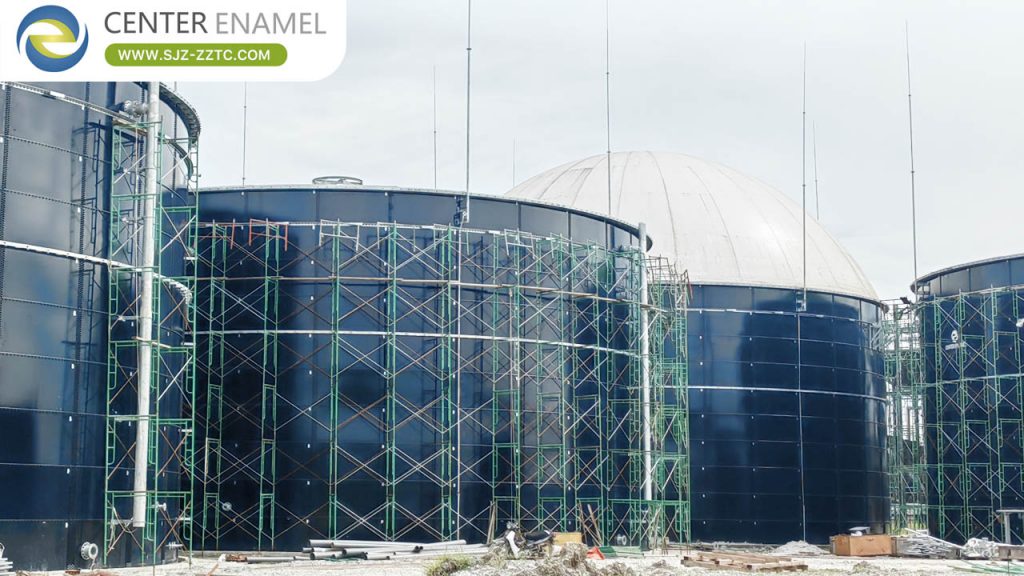
Sri Lanka Palm Oil Wastewater Treatment Project. While an anaerobic (SBR) plant for palm oil mill effluent, it sits in the same palm-energy sector where solid biomass and fibers are combusted. Center Enamel supplied bolted reactor tanks (Ø24.46 × 6 m, 2 sets) treating 250 T/D of POME in humid, tropical conditions—illustrating that in high-moisture agro settings, handling the wet stream well (or digesting it) is what protects project economics.
| Project | Sri Lanka Palm Oil Wastewater Treatment |
| Location | Sri Lanka |
| Industry | Palm oil / Agro-industry |
| Application | POME treatment, energy-adjacent |
| Product | SBR bolted reactor tanks |
| Capacity | 250 T/D POME |
| Quantity | 2 Ø 24.46 × 6 m reactors |
| Material | Glass-Fused-to-Steel (GFS) |
| Standards | ISO 28765, AWWA D103 |
| Status | Delivered reference project |
About Center Enamel
Center Enamel brings engineering capability to biomass and agro-industrial projects: beyond digesters, the company supplies process-water, effluent, and ash-handling storage tanks built for humid, corrosive, high-cycling duty, with installation support drawn from dozens of international reference projects. The engineering lesson the company demonstrates is to control the wet front end and by-product streams so the plant’s utilization and margins are protected—directly addressing the feedstock and moisture failure modes above.
Advantages and Limitations
Biomass gives firm, dispatchable renewable power and useful heat (CHP). The profit killers are controllable: feedstock security, moisture, heat off-take, and realistic sizing. A project that ignores any of these is the one that loses money.
Comparison: Profitable vs Unprofitable Biomass
| Factor | Profitable | Unprofitable |
| Feed | contracted, dry | spot, wet |
| Heat | CHP off-take | power only |
| Utilization | high | low |
| Sizing | to firm feed | over-designed |
A biomass project becomes unprofitable from feedstock insecurity, high moisture, no CHP heat off-take, low capacity factor, and over-design—usually in combination. Control fuel logistics and utilization, secure a heat customer, and size to real feed to keep the numbers positive.
Frequently Asked Questions (FAQ)
Q1: What makes a biomass project unprofitable?
A: Mostly feedstock problems—unreliable or costly, wet supply—plus no heat off-take, low utilization, and over-sizing.
Q2: Why do biomass plants fail?
A: They fail when delivered fuel cost exceeds energy value, moisture forces auxiliary fuel, or the plant idles from supply gaps.
Q3: Is a heat off-take essential?
A: Near-essential for good economics: CHP lifts total efficiency to 80–90% vs ~35–45% electrical alone.
Q4: Does moisture really matter that much?
A: Yes—above ~50% MC combustion needs auxiliary fuel and efficiency falls sharply.
Q5: How do I avoid losses?
A: Contract dry feed, build storage, secure a heat customer, size to firm feed, and keep emissions/ash in the model.
Q6: When is combustion the wrong choice?
A: Very wet, low-LHV feed is often better digested (AD) than dried and burned.
Tell us your biomass type, delivered cost, moisture, and whether a heat off-take exists. We will sanity-check the economics and specify corrosion-resistant GFS or epoxy tanks for the wet and ash-handling front end.