
What Moisture Is Too Wet to Burn?
Above about 50% moisture content (MC, wet basis), biomass generally becomes too wet to burn without auxiliary fuel. Water consumes combustion energy to evaporate and robs the flame of heat, so self-sustained burning needs the fuel’s lower heating value to survive that penalty. For clean, efficient combustion, dry feed toward <10–15% MC; between 30–50% you can burn it but efficiency and stability suffer.
What “Moisture Content” Means
Moisture content is the water mass as a percentage of total (wet) fuel mass. Freshly harvested wood can be 40–60% MC; wet ag residue and manure solids are often 60–90%. Every kilogram of water must be heated to 100°C and vaporized—about 2.26 MJ/kg—before the fuel’s own carbon can release net heat.
Why Water Kills Combustion
Combustion must first pay the latent heat of vaporization for all that water, then heat the steam up the stack. High moisture means most of the fuel’s calorific value is spent on its own water, leaving little to sustain flame temperature (≈800–1000°C needed) or make steam. Below a threshold, you must inject fossil fuel or electricity just to keep the fire alive.
| Moisture content | Burnability | Note |
| <15% | excellent | ideal for efficient combustion |
| 15–30% | good | most plants target this |
| 30–50% | marginal | lower efficiency, watch stability |
| >50% | too wet | needs auxiliary fuel |
The Energy Threshold
As a rule, if MC exceeds ~50% and the dry-fuel LHV is below roughly 8–10 MJ/kg, self-sustained combustion is hard without support. Wood (dry LHV ~18–20 MJ/kg) tolerates more moisture than low-calorific residues; a wet, low-LHV sludge is the worst case.
Applications and Exceptions
Some systems handle wet feed deliberately: fluidized-bed boilers with hot bed material can burn 40–60% MC fuels, and co-firing with dry coal or biomass buffers moisture. But standalone grate firing of wet biomass is where the 50% line bites hardest.
Technical Considerations
Drying is the usual fix—see the drying-energy article—but waste heat from the plant itself (flue gas, turbine exhaust) should be the drying source to keep the energy balance positive. Pre-mixing wet with dry fuel also pulls average MC down without a dedicated dryer.
How to Decide If Your Feed Is Too Wet
Measure MC and LHV of the actual fuel. If MC >50% or the net (LHV minus water penalty) is under ~8 MJ/kg, plan drying, co-firing, or a fluidized bed. Below 30%, you are generally fine with a standard grate boiler.
Project Case Study
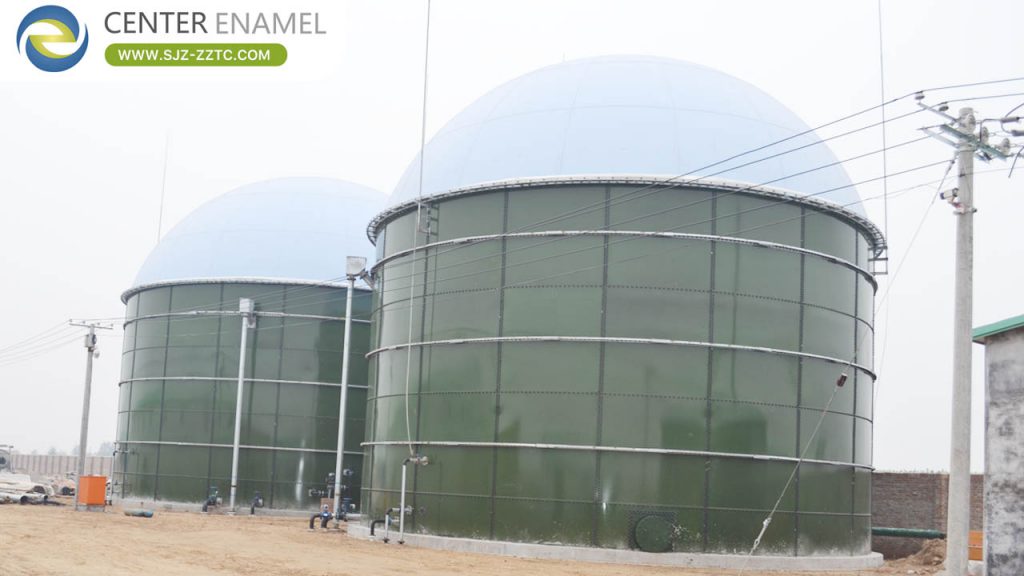
Indonesia Biogas Project — Dumai. An early international palm-oil wastewater and residue project where Center Enamel supplied 3 GFS tanks (installation by a 7-person team in 40 days). Palm operations continuously manage high-moisture fibers and POME; the project reflects the agro-sector reality that wet biomass streams need either digestion or drying before combustion, and robust tankage for the wet front end.
| Project | Indonesia Biogas Project — Dumai |
| Location | Dumai, Indonesia |
| Industry | Palm oil / Agro-industry |
| Application | Palm wastewater & residue handling |
| Product | GFS bolted tanks |
| Capacity | 3 GFS tanks, rapid install |
| Quantity | 3 Ø 19.86 × 8.4 m tanks |
| Material | Glass-Fused-to-Steel (GFS) |
| Standards | ISO 28765, AWWA D103 |
| Status | Delivered reference project |
About Center Enamel
In humid, tropical, high-moisture agro settings, Center Enamel demonstrates its international standards and installation discipline: bolted GFS tanks built to ISO 28765 / AWWA D103, manufactured under ISO 9001, CE/EN 1090 marked, and installed by small, fast teams (as in Dumai —7 engineers in 40 days’). For biomass projects the company supplies the wet front-end storage—POME, leachate, process water—that sits upstream of any drying or combustion step, with corrosion-resistant enameled steel suited to constant moisture exposure.
Advantages and Limitations
Drying or blending wet feed unlocks otherwise unusable fuel and raises efficiency. Limits: drying costs energy (must be waste-heat sourced), and very wet, low-LHV streams may still need co-firing or AD instead of burning.
Comparison: Drying Options for Wet Feed
| Option | Energy source | Fit |
| Flue-gas dryer | plant waste heat | best energy balance |
| Blend with dry fuel | none | simple, partial |
| Dedicated dryer | bought fuel/electric | avoid if possible |
| Fluidized bed | hot bed material | handles 40–60% MC |
Biomass above ~50% moisture is too wet to burn without auxiliary fuel; dry toward <10–15% MC for efficient, self-sustained combustion, and between 30–50% expect lower efficiency. Use plant waste heat for drying, or a fluidized bed, rather than buying energy.
Frequently Asked Questions (FAQ)
Q1: What moisture is too wet to burn?
A: Above ~50% MC, biomass usually needs auxiliary fuel; self-sustained combustion needs the dry-fuel LHV to survive the water-evaporation penalty.
Q2: Why does water hurt combustion so much?
A: Evaporating and heating water (about 2.26 MJ/kg) consumes the fuel’s own heat, dropping flame temperature below what sustains burning.
Q3: What MC is ideal?
A: Below 10–15% MC for efficient combustion; most plants operate 15–30% as a practical target.
Q4: Can wet biomass ever burn?
A: Yes—fluidized-bed boilers with hot bed material handle 40–60% MC, and co-firing with dry fuel buffers moisture; the 50% line is strictest for grate firing.
Q5: How do I know if my feed is too wet?
A: Measure MC and LHV; if MC >50% or net LHV <~8 MJ/kg, plan drying, co-firing, or a fluidized bed.
Q6: What is the best way to dry?
A: Use plant waste heat (flue gas/turbine exhaust) for drying; avoid bought-fuel dryers unless unavoidable.
Send your fuel type, moisture, and LHV. We will advise whether drying, blending, or a fluidized bed fits, and specify corrosion-resistant GFS or epoxy tanks for the wet storage front end.