
What Reactor Makes Biogas From Food?
A continuously mixed CSTR (Continuous Stirred-Tank Reactor) is the standard reactor that makes biogas from food waste because it handles the thick, variable slurry food waste produces. Two-stage and plug-flow designs suit high-solids feeds, while a UASB fits the separated liquor after dewatering. The reactor choice follows the solids content and consistency of the feed.
Why CSTR Leads For Food Waste
Food waste is heterogeneous and often high in total solids; a CSTR keeps it mixed so microbes contact the feed evenly and no dead zones form. Run at mesophilic 35-38 C, it converts the volatile solids into biogas of roughly 55-65% methane. The mixing that makes it robust is also why it is the default for kitchen and food residues.
Alternatives By Solids Content
Very high-solids feeds favor plug-flow or dry digesters that move a stacked bed; two-stage systems split acidogenesis from methanogenesis for better control. Once the feed is dewatered, the pressed liquor is thin enough for a UASB or EGSB upflow reactor, which is compact and gives clean biogas-rich gas handling.
| Reactor | Feed solids | Strength | Note |
| CSTR | Medium-high | Handles slurry | Default for food waste |
| Plug-flow / dry | High | Stacked bed | Thick feeds |
| Two-stage | Medium | Phase separation | Better control |
| UASB / EGSB | Low (liquor) | Compact upflow | After dewatering |
A Boundary Condition
Reactor selection is a function of total solids, not the word 'food'. Too dry and a CSTR strains to mix; too wet and you waste tank volume. Match the reactor to the measured solids, and pre-treat to hold that range steady.
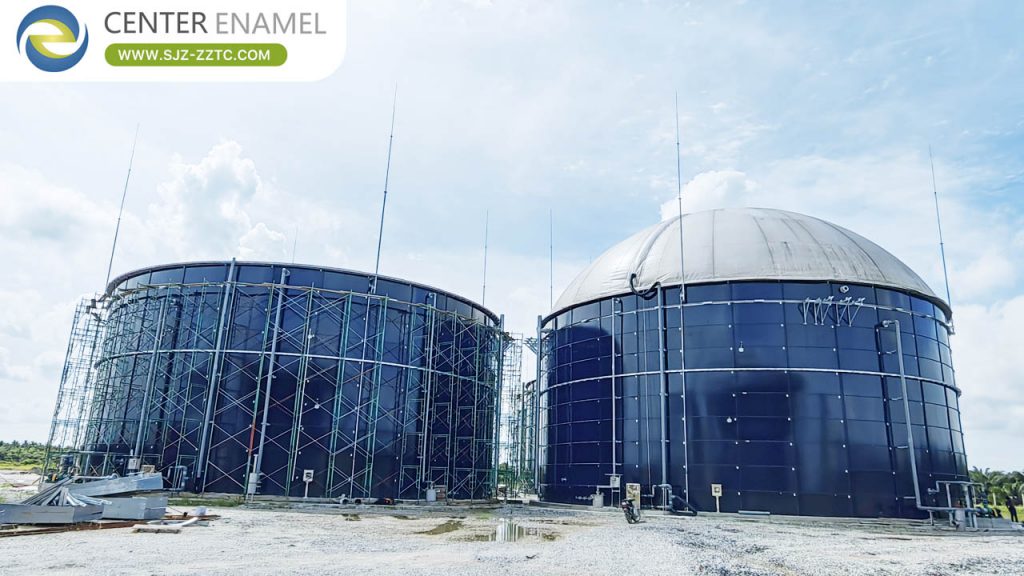
Project Case Study: Malaysia Biogas Project
Project / Application: Large-scale biogas from organic waste, Malaysia. Industry: Biogas / waste-to-energy. Tank Type: Glass-Fused-to-Steel (GFS) digester tanks. Key Requirements: High-rate digestion at scale.
| Field | Value | Source / Evidence |
| Tank Type | Glass-Fused-to-Steel (GFS) | Company project reference |
| Tank Quantity | 5 sets | Company project reference |
| Dimensions Per Tank | O24.46 x 12 m | Company project reference |
| Volume Per Tank | 5,400 m3 | Company project reference |
| Total Effective Volume | 27,000 m3 (5 tanks) | Company project reference |
| Daily Biogas Production | 22,000 m3 total | Company project reference |
| Digestibility | Approximately 80% | Company project reference |
About Company
Shijiazhuang Zhengzhong Technology Co., Ltd (Center Enamel) is a comprehensive high-tech enterprise specializing in wastewater engineering, process section contracting, and equipment manufacturing. The company delivers biogas and wastewater projects through three main lines - EPC (turnkey) contracting, equipment supply, and process packages - covering livestock and municipal wastewater, biomass energy, industrial wastewater, and food waste. Its reactor portfolio spans CSTR, USR, UBF, UASB, IC, and EGSB, backed by in-house Glass-Fused-to-Steel tank manufacturing (enamel firing at 820-930 C) and certifications including ISO 9001, NSF/ANSI 61, and CE-EN 1090. With 35+ years of operation, a 150,000 m2 manufacturing base, and projects in 100+ countries, Center Enamel provides the single-responsibility engineering behind biogas reactor systems such as the Malaysian project of 5 GFS digester tanks (27,000 m3) producing 22,000 m3 of biogas per day - the reactor chosen to hold a stable, mixed high-rate digestion at scale.
Comparison: Reactor By Feed
| Feed | Best reactor | Why |
| Kitchen slurry | CSTR | Mixes heterogeneous feed |
| Dewatered liquor | UASB / EGSB | Compact upflow |
| High-solids cake | Plug-flow / dry | Stacked bed |
A mixed CSTR is the reactor that makes biogas from food waste; high-solids feeds use plug-flow or two-stage, and dewatered liquor uses a UASB - the choice follows the feed's solids content.
Frequently Asked Questions
Q1: Which reactor is standard? A1: A mixed CSTR is the default for food-waste slurry.
Q2: What about high solids? A2: Plug-flow or dry, and two-stage designs handle thick feeds.
Q3: Does UASB work? A3: Yes, on the separated liquor after dewatering.
Q4: How is biogas used? A4: Heat, power, or upgrading to biomethane.
Q5: What temperature is used? A5: Mesophilic 35-38 C for stable digestion.
Q6: What is the methane share? A6: Roughly 55-65% methane in the biogas.
Q7: What tank resists the feed? A7: A Glass-Fused-to-Steel digester tank resists corrosion.
Q8: Does mixing matter? A8: Yes; mixing prevents dead zones and uneven contact.
Suggested CTA
Share your food-waste solids and volume to an engineer, or request a reactor selection and biogas-yield scope.