
What Straws Are Used for Biogas? A Complete Guide to Feedstock Options
Biogas production has emerged as a cornerstone of the renewable energy transition, offering a sustainable way to convert organic waste into clean energy. Among the most abundant and underutilized feedstocks for biogas are agricultural residues-specifically, straw. With billions of tons of straw generated globally each year, this resource presents a massive opportunity for energy recovery. But not all straw is created equal for biogas production, and understanding which types are suitable-and how to process them-is essential for successful project development.
The Challenge and Promise of Straw as a Biogas Feedstock
Straw is the main by-product of agricultural grain production and has significant untapped potential for energy utilization. Unlike manure or food waste, straw is lignocellulosic-meaning it contains lignin, cellulose, and hemicellulose that form a rigid structure resistant to biological breakdown. This has historically made straw challenging for anaerobic digestion. However, modern pre-treatment technologies have unlocked this potential, making straw a viable and increasingly popular feedstock for biogas plants worldwide.
Types of Straw Suitable for Biogas Production
Nearly any type of straw can be used for biogas production, provided it undergoes appropriate pre-treatment. The most commonly utilized types include:
Cereal Straws:
Wheat Straw: The most widely available and commonly used straw for biogas. Wheat straw contains high lignocellulose content but responds well to pre-treatment.
Rye Straw: Similar to wheat straw, suitable for anaerobic digestion after processing.
Barley Straw: Another cereal straw with good biogas potential.
Other Agricultural Residues:
Rice Straw and Paddy Straw: Abundant in rice-growing regions, these materials are highly suitable for biogas, especially in countries like India, China, and Southeast Asian nations.
Corn Stover: The stalks and leaves left after corn harvest, rich in organic matter.
Sunflower Straw and Husks: A valuable residue with good biogas yields.
Rapeseed Straw: Suitable for biogas production, adding diversity to feedstock options.
Sugar Cane Bagasse: The fibrous residue left after juice extraction, widely available in tropical regions.
Other Lignocellulosic Materials:
Sawdust and Wood Chips: While more challenging to digest, these materials can also be processed with steam explosion pre-treatment.
Sunflower Husks: A by-product of oil extraction, suitable for biogas.
Straw Pre-Treatment Technologies
The key to successful biogas production from straw lies in effective pre-treatment. Untreated straw is not digested at all in conventional reactors. Two primary technologies enable the use of 100% straw as a feedstock:
Steam Explosion: This process breaks down the lignin structure and opens up the fibrous material, significantly increasing the surface area available for microbial action. After steam explosion, straw can be processed in biogas reactors similarly to maize silage.
Pelleting: A thermal pressing process that removes the lignin "carcass" from fibers, making the cellulose more accessible to microorganisms.
High-Load Reactors (HLR): This specialized reactor technology can work with 100% straw at total solid concentrations of 16–18%, one of the few systems capable of handling pure straw feedstocks.
Biogas Yields from Straw
With proper pre-treatment, straw can achieve impressive biogas yields. For example, wheat straw treated with pelleting and processed in high-load reactors can produce approximately 430–450 cubic meters of raw biogas from 1 tonne of straw. Research data shows wheat straw achieving a methane potential of 228 mL CH₄ per gram of volatile solids, making it a competitive feedstock.
Global Opportunities for Straw-to-Biogas
Straw-based biogas production is particularly attractive in countries where straw is abundant, cheap, and not used for other purposes such as animal bedding or heating. Regions with hot climates-such as Spain, Greece, Egypt, Turkey, Brazil, and India-are ideal, as straw can be stored outdoors and there is less competition for its use as a winter fuel.
Center Enamel: Biogas Storage Solutions for Straw-Based Projects
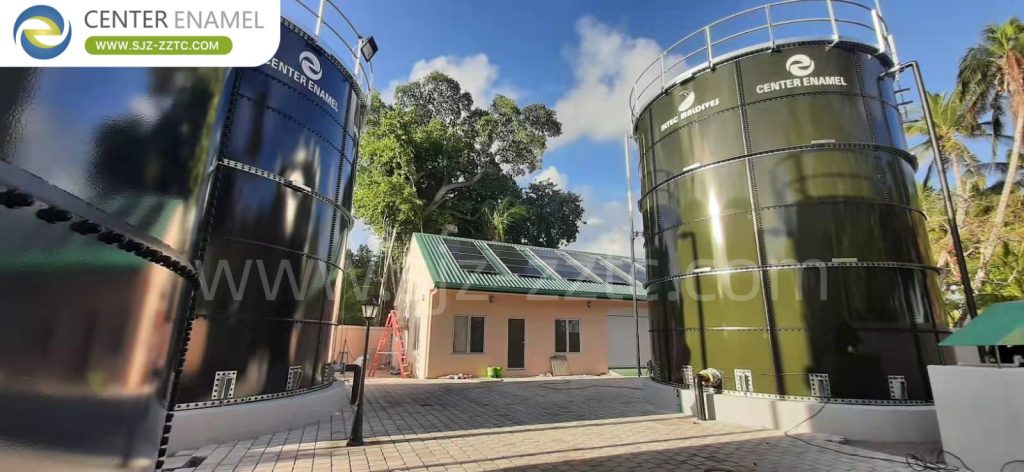
For any straw-to-biogas project, reliable infrastructure is essential. Center Enamel, with over 36 years of experience and more than 500 successful projects worldwide, provides industry-leading Glass-Fused-to-Steel (GFS) tanks and comprehensive EPC services for biogas facilities.
Glass-Fused-to-Steel (GFS) Tanks
GFS tanks are the preferred choice for biogas storage due to their exceptional durability and performance characteristics:
Superior Corrosion Resistance: The glass coating withstands the corrosive environment of biogas, including hydrogen sulfide (H₂S) and organic acids, ensuring a 30–50 year service life.
Gas-Tightness: Precision sealing prevents methane leakage, maximizing energy recovery and ensuring safety.
Modular Bolted Design: Rapid on-site assembly reduces construction time and costs, especially valuable in remote agricultural locations.
pH Resistance: GFS tanks handle a wide pH range, from acidic to alkaline, making them suitable for diverse biogas processes.
Scalability: Tanks can be engineered to capacities from a few thousand to tens of thousands of cubic meters.
Integrated Biogas Storage Solutions
Center Enamel offers integrated GFS tanks with Double Membrane Gasholders, creating a complete biogas storage system. The double membrane design operates on a constant-pressure principle, ensuring stable gas delivery to CHP engines or upgrading units. The outer membrane protects the inner membrane from weather, while the inner membrane adjusts volume based on gas production, maintaining consistent pressure for optimal energy generation.
Comprehensive EPC Services
As an experienced EPC Contractor, Center Enamel provides turnkey solutions covering design, procurement, construction, and commissioning. Our services include:
Customized Engineering: Tailored tank designs meeting AWWA D103, ISO 28765, and Eurocode standards.
Ancillary Equipment: Gas holders, desulfurization units, and gas utilization systems.
Global Support: Projects completed in over 90 countries, with local installation and commissioning support.
Case Studies: GFS Tanks in Action
Case1: Biogas Project in France
Process: CSTR
Tank dimensions: φ18.33 m × 8.4 m (H) (1 unit)
Total volume: 2,215 m³ (1 unit)
Completion year: 2021
Case2: Biogas Project in Canada
Tank dimensions: φ8.4 m × 7.2 m (H) (2 units)
Total volume: 798 m³
Completion year: 2024
Straw represents a vast, underutilized resource for biogas production. With modern pre-treatment technologies, wheat straw, rice straw, corn stover, and other agricultural residues can be efficiently converted into renewable energy. Center Enamel’s Glass-Fused-to-Steel tanks and comprehensive EPC services provide the durable, reliable infrastructure needed to make straw-to-biogas projects successful-delivering long-term performance, safety, and energy recovery for operators worldwide.
FAQs
Q: Can any type of straw be used for biogas production?
A: Yes, nearly any type of straw can be used for biogas production, including wheat straw, rice straw, rye straw, sunflower straw, rapeseed straw, and corn stover. However, all straw requires pre-treatment before anaerobic digestion, as the lignocellulosic structure resists biological breakdown.
Q: What pre-treatment is needed to make straw suitable for biogas?
A: Common pre-treatment methods include steam explosion, which breaks down lignin and opens up fibrous structures, and pelleting, a thermal pressing process that removes lignin barriers. After pre-treatment, straw can be processed in high-load reactors designed for high-solid feedstocks.
Q: How do GFS tanks support straw-based biogas projects?
A: GFS tanks provide gas-tight, corrosion-resistant storage for biogas, with a service life exceeding 30 years. Their modular bolted design enables rapid installation and scalability, making them ideal for biogas plants in agricultural areas. Center Enamel offers complete EPC services for turnkey project delivery.