
What Technologies Are Needed for a Biogas Project? The Complete Technology Stack Guide
A commercial biogas project is a multi-unit process train, not a single machine. Five technology blocks must work together: feedstock pre-treatment, the anaerobic digestion reactor, gas cleaning, gas upgrading, and energy conversion. Each block has 2–5 proven technology options, and the final selection determines project CAPEX, uptime, and payback.
Why the Technology Stack Matters: One Weak Block Weakens the Whole Plant
Biogas plants fail financially far more often from poor technology integration than from feedstock shortage. Digester performance depends on consistent feed quality; CHP engines depend on clean gas; upgrading units depend on stable raw gas composition. A 2% hydrogen sulfide slip can destroy a gas engine within 2,000 operating hours, while oversized upgrading capacity burns electricity for no revenue.
For a 2026-era project, the smartest design principle is modularity with buffer capacity: each block sized at 105–110% of nominal flow, with redundant pumps and a gas storage buffer of at least 4–8 hours. This adds 3–5% to equipment cost but typically lifts annual availability from 85% to 95%+.
The Five Technology Blocks Every Biogas Project Needs
Block 1 — Feedstock Pre-treatment: macerators, screw presses, pasteurizers, and mixing tanks condition the feed to a pumpable slurry at 8–12% total solids. Pasteurization at 70°C for 1 hour is mandatory for food waste in EU and many US jurisdictions.
Block 2 — Anaerobic Digestion: the core reactor. Options include CSTR (the 90% market default), plug-flow for high-solids feedstock, covered lagoon digesters for low-cost dairy manure, and dry/batch digesters for municipal solid waste. Working volumes run from 500 m³ (farm-scale) to 10,000+ m³ (industrial).
Block 3 — Gas Cleaning: H₂S removal (biological desulfurization with micro-air injection, iron chloride dosing, or activated carbon), moisture removal via chilling/condensation, and siloxane removal for landfill gas. Target: H₂S below 200 ppm for CHP, below 5 ppm for upgrading.
Block 4 — Gas Upgrading (optional but high-value): PSA, membrane, water scrubbing, cryogenic, or amine scrubbing raise methane from 50–65% to 96–98%. Upgrading multiplies the gas value by 1.5–2x versus raw-biogas CHP.
Block 5 — Energy Conversion: combined heat and power (CHP) gas engines at 35–42% electrical efficiency, or biogas boilers where only heat is needed. A 1 MW₎ plant typically pairs a 1,063 kWe engine with a flue-gas heat recovery skid.
Comparative Data Table: Technology Options by Process Block
| Process Block | Technology Options | Typical CAPEX Share | Key Selection Driver |
| Pre-treatment | Macerator / screw press / pasteurizer | 8–12% | Feedstock solids and contamination |
| Digestion | CSTR / plug-flow / covered lagoon / dry batch | 30–40% | Feedstock type, TS content, budget |
| Gas cleaning | Biological desulfurization / iron dosing / activated carbon | 5–8% | H2S and siloxane levels in raw gas |
| Gas storage | Double-membrane dome / low-pressure holder / high-pressure bottles | 4–8% | Engine demand profile and buffer needs |
| Upgrading | PSA / membrane / water scrubbing / cryogenic / amine | 15–22% | Target CH4 purity and scale (Nm3/h) |
| Energy conversion | CHP gas engine / micro-turbine / boiler / biomethane injection | 15–25% | Electricity price vs gas-injection tariff |
How Much Does the Technology Stack Cost?
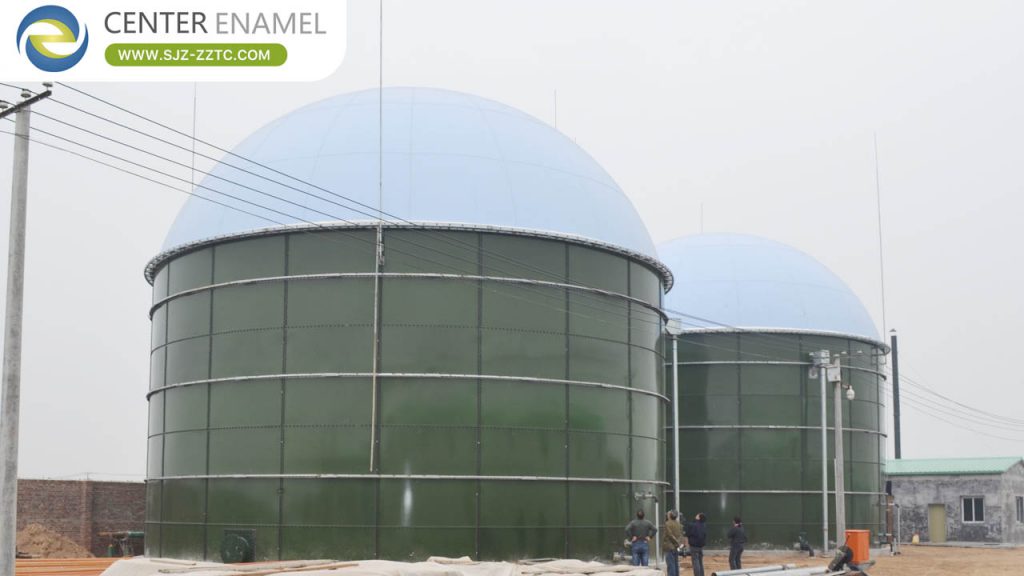
Turnkey biogas plant CAPEX in 2026 ranges from €800 to €1,600 per Nm³/h of raw gas capacity for digestion-only plants, and €1,300 to €2,400 per Nm³/h when upgrading to biomethane is included. Digester tanks dominate the budget at 30–40%, which is why bolted steel tanks with glass-fused-to-steel coating (GFS) have become the global default—they deliver 25–35-year corrosion life at roughly half the installed cost of site-welded concrete alternatives.
Frequently Asked Questions (FAQ)
Q1: Can a small farm biogas project use a simplified technology set?
A: Yes. A 50–200 kW farm plant can operate with just four blocks: mixing pit, CSTR or covered lagoon, basic desulfurization, and a small CHP engine—skipping upgrading entirely. This cuts CAPEX to roughly €600–900 per Nm³/h while keeping payback at 5–7 years.
Q2: What is the single most important technology choice in a biogas project?
A: The digester type and its material. It carries 30–40% of CAPEX, sets the plant’s 20-year service life, and is nearly impossible to swap later. Most engineers choose CSTR in GFS bolted steel tanks as the low-risk default.
Q3: How do I know if I need gas upgrading?
A: Choose upgrading when you can sell biomethane or green-gas certificates at a premium, when your electricity grid limits CHP feed-in, or when you operate above 500 Nm³/h of raw gas. Below that, CHP usually delivers the better internal rate of return (IRR).