
When Is Aerobic Treatment Better Than Anaerobic?
Aerobic treatment is better than anaerobic when the wastewater is low-strength (COD below roughly 2,000 mg/L), the discharge permit demands very low residual BOD/COD or ammonia, the flow or load is highly variable, or biogas recovery is not the priority. Under those conditions aerobic processes reach stricter effluent quality faster and with simpler operation, while anaerobic digestion only pays off when there is enough organic load to make the captured methane worth the extra complexity.
What Each Process Actually Does
Aerobic treatment feeds dissolved oxygen to microbes that oxidize organics to carbon dioxide and biomass. Anaerobic treatment runs without oxygen, converting the same organics into methane, carbon dioxide, and a small amount of sludge. The energy balance is the clearest difference: aerobic aeration consumes about 0.5–1.5 kWh per kg of COD removed, whereas anaerobic digestion needs almost no external energy and instead produces 0.30–0.45 m³ of biogas per kg of COD removed (about 60% methane) — an energy credit, not a cost.
Decision Framework: When Aerobic Wins
Choose aerobic treatment when one or more of these conditions hold. First, the COD is low (below ~2,000 mg/L) so there is little methane to recover and the digester would sit under-fed. Second, the permit sets tight limits on BOD, COD, ammonia, or pathogens that only biological oxidation or polishing can meet. Third, the flow is small, intermittent, or seasonal, so a simpler start-stop process is safer than a sensitive digester culture. Fourth, the site is remote or too small to use biogas economically. In all four cases aerobic wins on reliability and effluent quality.
When Anaerobic Is the Better Call
Anaerobic digestion is the stronger choice for high-strength wastewater (COD above ~2,000 mg/L, and especially above 5,000 mg/L) where energy recovery is a goal, the process can use waste heat, and the flow is large and steady — dairies, breweries, palm-oil mills, and food processors. A concentrated stream means more methane per cubic metre and a faster payback on the digester. Many plants run both: anaerobic for bulk COD and energy, aerobic polishing for the final discharge limit.
Comparative Data Table: Aerobic vs Anaerobic
| Criterion | Aerobic treatment | Anaerobic digestion |
| Energy use | 0.5–1.5 kWh/kg COD (consumes) | near-zero; 0.30–0.45 m³ biogas/kg COD |
| Best COD range | < 2,000 mg/L | > 2,000 mg/L (ideal > 5,000) |
| Effluent quality | very low BOD/COD, nitrified | moderate; needs polishing |
| Sludge yield | higher (0.4–0.6 kg/kg COD) | low (0.05–0.10 kg VSS/kg COD) |
| Footprint | smaller reactor, more O2 gear | larger digester, gas train |
| Start-up / stability | fast, robust | slower, temperature-sensitive |
| Best use | discharge compliance, low COD | energy recovery, high COD |
Advantages and Limitations
Aerobic treatment is fast, easy to operate, and delivers the lowest residual organics and ammonia — but it is energy-hungry and generates more excess sludge. Anaerobic digestion is energy-positive and produces little sludge, yet it is slower to start, sensitive to toxins and temperature, and leaves a COD-rich effluent that usually needs a polishing step. Neither is universally superior; the right pick follows the COD, the permit, and the energy goal.
Best Practices / How to Choose
Size the decision on three inputs: measured COD and flow, the discharge limit, and whether biogas can be used on site. For low COD plus strict limits, go aerobic. For high COD plus an energy target, go anaerobic first and add aerobic polishing only where the permit demands it. A combined train (UASB or CSTR followed by aerobic) is the most common industrial answer because it captures methane yet still meets tight effluent rules.
Conclusion
Aerobic beats anaerobic for low-strength, tightly permitted, or variable streams; anaerobic beats aerobic wherever the COD is high enough to make recovered biogas worth capturing. Match the process to the load, not to habit.
Frequently Asked Questions (FAQ)
Q1: When is aerobic treatment better than anaerobic?
A: When the wastewater is low-strength (COD below ~2,000 mg/L), the permit demands very low BOD/COD or ammonia, the load is variable, or biogas use is impractical. Aerobic then gives better effluent with simpler operation.
Q2: When should I choose anaerobic instead?
A: Choose anaerobic for high-strength wastewater (COD above ~2,000 mg/L, ideally above 5,000), a steady large flow, and an energy-recovery goal — dairies, breweries, palm-oil, and food plants are typical fits.
Q3: Which process handles low COD better?
A: Aerobic handles low COD far better. Below ~2,000 mg/L there is too little organic load to feed a digester economically, while aerobic oxidation still meets discharge limits efficiently.
Q4: Does aerobic need less space than anaerobic?
A: Usually yes for the reactor itself, but aerobic adds blowers, tanks, and sludge handling, while anaerobic adds a digester and gas train. Total footprint depends on whether biogas recovery and polishing are required.
Q5: Can I combine both?
A: Yes — a hybrid train (anaerobic UASB or CSTR for bulk COD and energy, then aerobic polishing) is the most common industrial design because it captures methane yet still meets tight effluent rules.
Q6: Is anaerobic more sustainable?
A: For high-strength streams, yes: it is energy-positive and produces little sludge. For low-strength streams the aeration energy of aerobic treatment can outweigh its simplicity, so sustainability follows the COD, not the label.
Project Case Reference
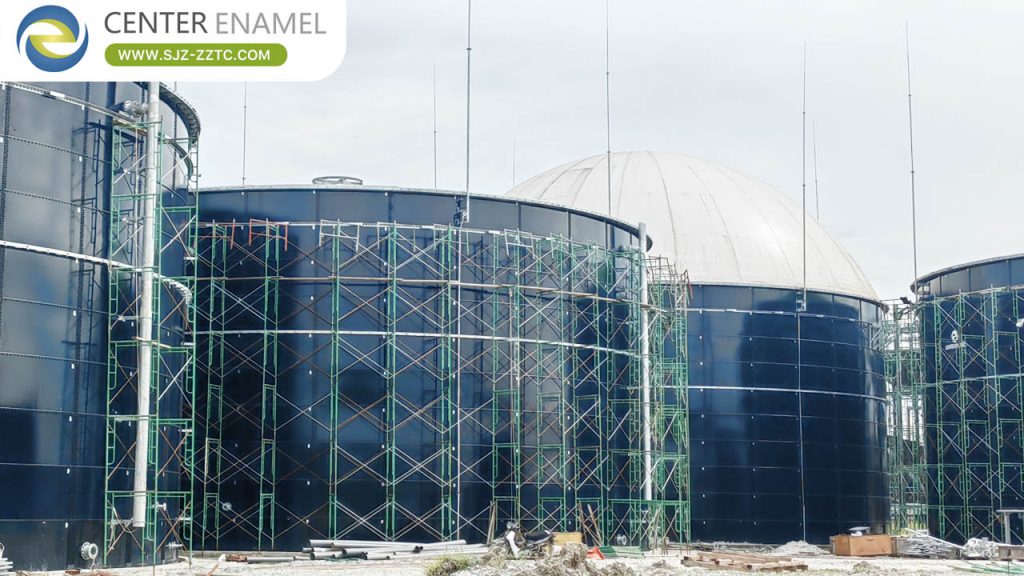
Malaysia Biogas Project — Malaysia · 2026
5 GFS Tanks · 27,000 m³ Total Volume · 22,000 m³ Biogas/Day
A large-scale biogas project in Malaysia featuring 5 Glass-Fused-to-Steel (GFS) tanks. The project achieves approximately 80% digestibility, with each single tank producing about 4,400 m³ of biogas daily, totaling 22,000 m³ per day across all 5 tanks.
Technical Specifications
Single Tank Volume: 5,400 m³ (Ø24.46 × 12 m)
Total Effective Volume: 27,000 m³ (5 tanks)
Daily Biogas Production: 22,000 m³ total
Digestibility: ≈ 80%
Gas Production Rate: 0.45 m³ / kg COD removed
Tank Type: Glass-Fused-to-Steel (GFS)
Water Quality Data
| Parameter | Inlet Water | Effluent |
| COD | ≥ 60,000 mg/L | ≥ 12,000 mg/L |
| BOD | ≤ 25,000 mg/L | ≤ 5,000 mg/L |