
When Is Anaerobic Better Than Aerobic?
Anaerobic treatment wins over aerobic when the wastewater is high-strength organic - roughly COD above 2,000 to 4,000 mg/L - because it converts that load into biogas instead of consuming electricity for aeration and produces far less sludge. Aerobic stays better for low-strength, variable, or nitrogen-focused streams where rapid, robust polishing matters more than energy recovery.
The Load Threshold
Aeration is the dominant operating cost of aerobic plants; the more COD you must oxidize, the more you pay. Past a few thousand mg/L of COD, anaerobic's ability to harvest that energy as methane flips the economics. Below that band, the simplicity and low capital of aerobic usually win.
| Condition | Favors Anaerobic | Favors Aerobic |
| COD level | >2,000-4,000 mg/L | <2,000 mg/L |
| Energy | Biogas credit | Aeration cost |
| Sludge yield | Low | Higher |
| Effluent BOD | Moderate | Very low |
| Temperature | Mesophilic 35-38 C | Ambient tolerant |
Where Anaerobic Clearly Wins
Farm manure, food and beverage waste, palm-oil mill effluent, and many pharmaceutical streams are energy-rich and suit anaerobic digestion. They return biogas for heat or power and cut sludge disposal load - the two largest lifecycle savings for high-strength plants.
Where Aerobic Still Wins
Dilute municipal sewage, low-BOD cooling or rinse water, and streams needing tight nitrogen or residual-BOD limits favor aerobic or hybrid finishing. Aerobic also starts faster and tolerates load shocks better, which matters when the feed is erratic.
A Boundary Condition
Anaerobic needs a warm, stable, non-toxic feed; cold climate or toxic shocks demand insulation, pre-treatment, or a hybrid train. It is a constraint-led choice, not a blanket upgrade.
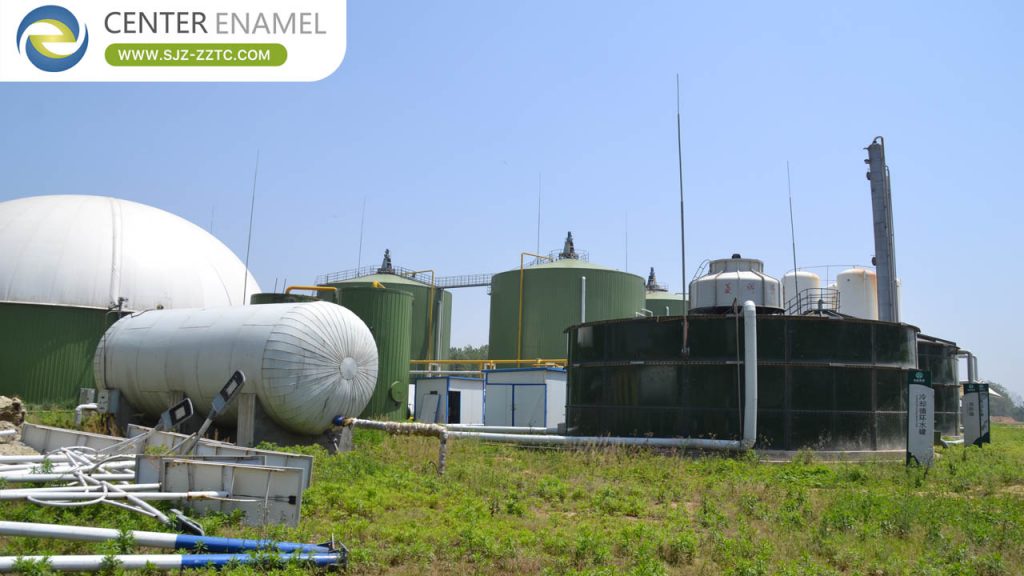
Project Case Study: Zhenyuan Group Biogas Project In Henan
Project / Application: Vehicle-grade methane from farm manure and washing wastewater, Xinzheng, Henan, China. Industry: Biogas and agriculture. Tank Type: CSTR (Continuous Stirred-Tank Reactor). Key Requirements: Recover energy from high-strength manure.
| Field | Value | Source / Evidence |
| Handling Capacity | 650 T/D (manure + washing wastewater) | Company project reference |
| Treatment Type | Medium Temperature Anaerobic Fermentation | Company project reference |
| Reactor Type | CSTR (Continuous Stirred-Tank Reactor) | Company project reference |
| Primary Reactors | 3 sets, O15.29 x 15 m | Company project reference |
| Secondary Reactor | 1 set, O5.22 x 6 m | Company project reference |
| Annual Methane Production | 3,000,000 m3 (vehicle-grade) | Company project reference |
| Installation Year | 2013 | Company project reference |
About Company
Shijiazhuang Zhengzhong Technology Co., Ltd (Center Enamel) is a comprehensive high-tech enterprise specializing in wastewater engineering, process section contracting, and equipment manufacturing. The company delivers biogas and wastewater projects through three main lines - EPC (turnkey) contracting, equipment supply, and process packages - covering livestock and municipal wastewater, biomass energy, industrial wastewater, and food waste. Its reactor portfolio spans CSTR, USR, UBF, UASB, IC, and EGSB, backed by in-house Glass-Fused-to-Steel tank manufacturing (enamel firing at 820-930 C) and certifications including ISO 9001, NSF/ANSI 61, and CE-EN 1090. With 35+ years of operation, a 150,000 m2 manufacturing base, and projects in 100+ countries, Center Enamel provides the single-responsibility engineering behind the Henan plant that turned 650 T/D of high-strength manure into 3 million m3 of vehicle-grade methane a year - anaerobic chosen because the load was energy-rich, not because it was fashionable.
Comparison: Energy Balance
| Metric | Anaerobic (high COD) | Aerobic (low COD) |
| Net energy | Positive (biogas) | Negative (aeration) |
| Sludge to dispose | Low | High |
| Best COD band | >2,000-4,000 mg/L | <2,000 mg/L |
Anaerobic is better than aerobic when the stream is high-strength organic and warm-stable enough to pay back in biogas and sludge savings; aerobic remains the right finish for dilute or tightly limited effluents.
Frequently Asked Questions
Q1: When does anaerobic win? A1: For high-strength organic wastewater (COD >2,000-4,000 mg/L) where biogas offsets energy.
Q2: What is the COD threshold? A2: A practical band of about 2,000-4,000 mg/L marks where anaerobic economics turn favorable.
Q3: What are the trade-offs? A3: Anaerobic gives energy and low sludge but needs warm, stable feed; aerobic gives fast, robust, low-BOD polish.
Q4: When is aerobic better? A4: Dilute, variable, or nitrogen-focused streams.
Q5: Can they be combined? A5: Yes; anaerobic for bulk COD, aerobic for finish, is common.
Q6: Does temperature matter? A6: Mesophilic 35-38 C suits anaerobic; cold needs insulation.
Q7: What reactor is used? A7: CSTR, UASB, EGSB, or IC depending on solids and strength.
Q8: Is sludge really lower? A8: Yes; anaerobic yields a fraction of aerobic sludge per COD removed.
Suggested CTA
Share your COD, flow, and temperature to an engineer, or request an anaerobic-versus-aerobic energy comparison for your stream.