
Which Digester Suits Manure Water?
Choose a manure-water digester by total solids and scale: a wet CSTR suits slurry and cold climates, UASB/EGSB suits soluble high-strength streams, and USR fits solid-rich manure — all run at mesophilic 35–38°C and sized to hydraulic retention time. The right digester turns manure water into steady biogas instead of an odor and pollution problem.
Match Digester to Solids Content
CSTR (Continuously Stirred-Tank Reactor) handles pumpable slurry with moderate solids and is the standard for cattle and pig manure; UASB/EGSB fits more soluble, warm, high-strength wastewater with very low sludge yield; USR (Upflow Solids Reactor) tolerates higher solids. Solids content — not animal type — leads the choice.
CSTR — The Slurry Workhorse
CSTR keeps uniform mixing, tolerates grit and fibers, and performs in cold climates with insulation and heat recovery. It is the most common manure digester and scales from farm to centralized plants. Its tanks dominate capital and must resist H₂S.
| Digester | Best feed | Solids | HRT | Climate |
| CSTR | slurry manure | medium | 15–30 days | cold-capable |
| UASB/EGSB | soluble high-strength | low | 6–12 h | warm |
| USR | solid-rich manure | high | 20–40 days | moderate |
Cold-Climate and Scale Factors
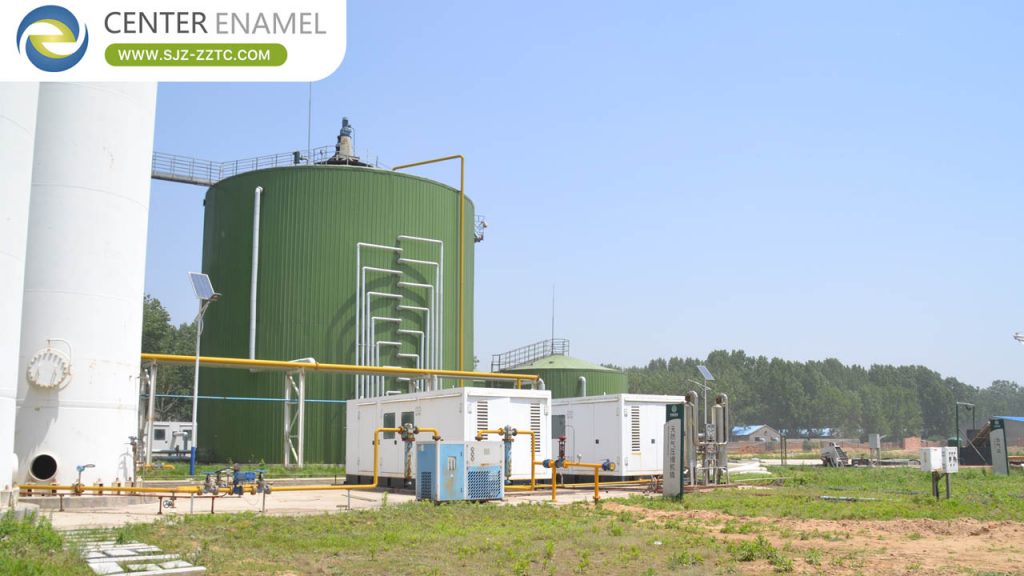
In cold regions specify insulation, heat recovery from the engine/boiler, and a longer design margin; the Inner Mongolia plants exemplify CSTR built for −20°C ambient. Scale sets tank count: a centralized plant may run several CSTR in parallel, each a bolted GFS tank.
Technical Considerations
Tank material decides service life in H₂S-rich manure liquor: Glass-Fused-to-Steel (glass fused at 820–930°C) gives an inert, impermeable, H₂S-resistant barrier. Size by COD/VS load, keep 35–38°C, and plan mixing that prevents grit settling and scum.
How to Size a Manure Digester
Confirm daily manure-water volume and TS/COD, pick the digester by solids, set mesophilic 35–38°C, size by HRT (CSTR 15–30 days), and specify corrosion-rated GFS tankage. Co-digest crop residue to lift yield and balance C:N 20–30:1 if available.
Project Case Study
Zhaqi Biogas Project in Inner Mongolia. A mesophilic CSTR biogas plant processing 900 m³/day of farm animal manure and agricultural waste (grass straw), equipped with 4 CSTR reactors (Ø25.98 × 8.4 m) and producing 20,000 m³ of biogas daily — a documented manure-water digester selection in a cold climate.
| Project | Zhaqi Biogas Project in Inner Mongolia |
| Location | Xing'an, Inner Mongolia, China |
| Industry | Agriculture / Farm Biogas |
| Application | Manure + agricultural waste digestion |
| Product | 4 CSTR anaerobic reactors (GFS) |
| Capacity | 900 m³/D feedstock |
| Quantity | 4 sets (Ø25.98 × 8.4 m) |
| Output | 20,000 m³ biogas/day |
| Status | Delivered 2017 |
About Center Enamel
Center Enamel is defined by its manufacturing capability in bolted Glass-Fused-to-Steel digester tanks — the structural core of a manure-water AD plant. The company manufactures GFS panels in a controlled process (glass fused to steel at 820–930°C) to ISO 28765 / AWWA D103 and CE-EN 1090 where applicable, shipping flat-pack for fast on-site erection. The Zhaqi 4×CSTR installation above is one of many farm digester projects the company has delivered.
Advantages and Limitations
CSTR gives robust, cold-capable manure digestion; UASB/EGSB give compact, low-sludge treatment of soluble streams; USR handles solids. Limits: CSTR needs mixing energy and longer HRT; UASB needs soluble, warm feed. Match digester to solids, not habit.
Comparison: CSTR vs UASB vs USR
| Attribute | CSTR | UASB/EGSB | USR |
| Feed solids | medium | low | high |
| HRT | 15–30 days | 6–12 h | 20–40 days |
| Cold climate | yes (insulated) | poor | moderate |
| Sludge yield | normal | very low | low |
For manure water, pick the digester by solids and climate: CSTR for slurry and cold regions, UASB/EGSB for soluble high-strength, USR for solid-rich. Run at 35–38°C, size by HRT, and use corrosion-rated GFS tankage. Send your volume and solids and we will select and size the digester.
Frequently Asked Questions (FAQ)
Q1: Which digester suits manure water?
A: CSTR for slurry/cold, UASB/EGSB for soluble high-strength, USR for solid-rich — all at 35–38°C.
Q2: Is CSTR good in cold climates?
A: Yes, with insulation and heat recovery; Inner Mongolia plants run CSTR at −20°C ambient.
Q3: What HRT does CSTR need?
A: Typically 15–30 days for wet mesophilic manure digestion.
Q4: What tank capacity is available?
A: Center Enamel supplies GFS digester tanks from 200 m³ to 60,000 m³.
Q5: What standards apply?
A: GFS tanks built to ISO 28765 / AWWA D103, CE-EN 1090 where applicable, under ISO 9001.
Q6: What project experience exists?
A: Zhaqi Inner Mongolia: 4 CSTR (Ø25.98×8.4 m), 900 m³/D feedstock, 20,000 m³ biogas/day.
Send your manure-water volume, solids, and climate. We will select CSTR, UASB, or USR, size it to HRT, and quote corrosion-rated GFS digester tankage.