
Which Feedstock Suits Anaerobic Digestion?
The feedstocks that suit anaerobic digestion best are wet, biodegradable organics: animal manures, food waste, sewage sludge, and agricultural residues such as energy crops, straw, and palm residues. The practical sweet spot is a C:N ratio near 20–30:1 and a biochemical methane potential (BMP) of roughly 0.20–0.60 m³ CH₄ per kg volatile solids, with co-digestion used to balance weak or strong single feeds.
What Makes a Feed Suitable
A good AD feed is high in biodegradable volatile solids, low in toxins and grit, and wet enough to pump (typically 2–15% TS for wet AD). It should sit near C:N 20–30:1 so microbes have both energy (carbon) and growth nitrogen without ammonia inhibition.
Common Suitable Feedstocks
Cattle/pig/poultry manure, source-separated food waste, fats/oils/grease, sewage sludge, and agri residues (corn silage, straw, POME, napier grass) all digest well. Methane potential varies: food waste 0.35–0.60, manure 0.20–0.30, sludge 0.20–0.35 m³/kg VS.
| Feedstock | BMP (m³/kg VS) | Notes |
| Food waste | 0.35–0.60 | high yield, watch fats/salts |
| Cattle manure | 0.20–0.30 | stable, NH₃ watch |
| Pig/manure mix | 0.20–0.35 | strong, dilute |
| Sewage sludge | 0.20–0.35 | steady, low TS |
| Agri residue | 0.20–0.45 | lignin can limit |
The C:N Ratio Rule
Too much carbon (straw, wood) slows digestion; too much nitrogen (manure, food waste) risks ammonia inhibition. Targeting C:N 20–30:1 keeps both kinetics and microbial growth healthy. Manure alone often sits ~20:1; adding carbon-rich residue lifts a too-nitrogenous mix.
Co-Digestion
Mixing complementary feeds—manure with food waste, or straw with sludge—balances C:N, dilutes inhibitors, and boosts total yield. Co-digestion is the standard way plants hit stable, high gas output from single feeds that would underperform alone.
What Does NOT Suit AD
Heavily lignified wood, landfilled mixed waste, high-salt or high-heavy-metal streams, and large inorganic/grit loads digest poorly or harm the process. These need other routes or pre-treatment and exclusion of the problem fraction.
Technical Considerations
Characterize feed TS/VS, BMP, and C:N before design; plan grit removal for manures; manage ammonia if protein-rich; size the digester from HRT and feed volume. Wet AD needs pumpable feed; dry AD tolerates higher solids.
How to Select Feedstock
Rank by availability, BMP, C:N, and contaminants. Default to a local, steady base (manure or sludge) and co-digest a high-yield supplement (food waste). Confirm with BMP testing, not assumptions.
Project Case Study
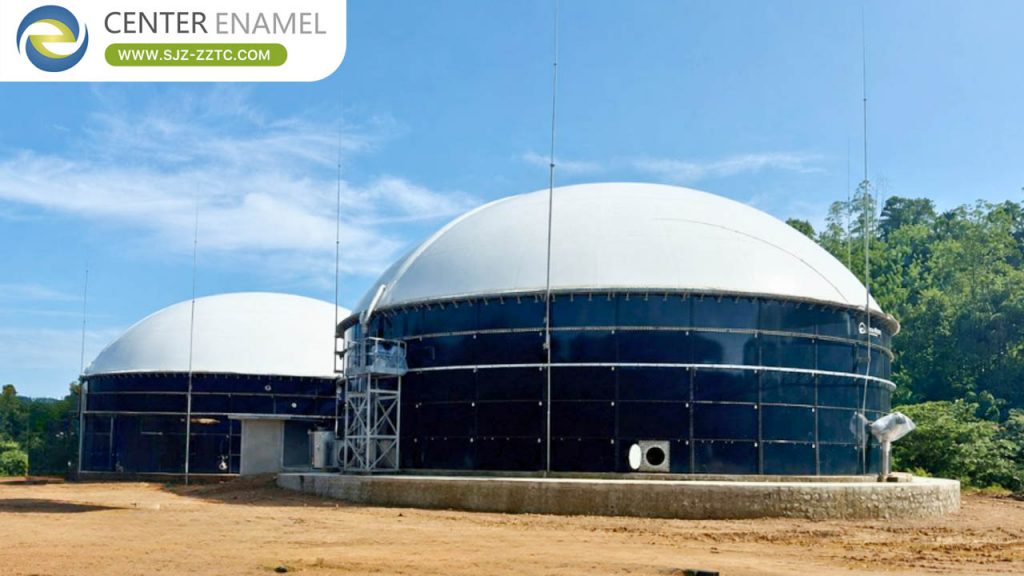
Pakistan Biogas Project. A CSTR waste-to-energy plant converting food waste and napier grass (Pennisetum purpureum) into 100 m³/day of biogas. It is a direct co-digestion example: a high-yield food waste blended with a carbon-rich grass to balance the feed and lift methane output.
| Project | Pakistan Biogas Project |
| Location | Pakistan |
| Industry | Waste-to-Energy / Biogas |
| Application | Food waste + napier grass co-digestion |
| Product | CSTR anaerobic digester system |
| Capacity | 100 m³/day biogas |
| Quantity | CSTR process, grass co-substrate |
| Material | Glass-Fused-to-Steel (GFS) |
| Standards | ISO 28765, AWWA D103 |
| Status | Delivered reference project |
About Center Enamel
Center Enamel demonstrates industry application experience across these exact feedstocks: cattle and pig manure digestion in China, palm residues (POME) in Southeast Asia, food waste co-digestion in Pakistan, and municipal sludge treatment—each specifying GFS digester and storage tanks matched to the feed’s corrosivity and solids. The company’s reference base shows the same bolted, enamel-fired tank technology (ISO 9001, ISO 28765, AWWA D103, CE/EN 1090) adapted from manure to food waste to sludge without redesign churn.
Advantages and Limitations
AD suits a wide wet-organic menu and rewards co-digestion, but feed variability is the real risk: contaminants, grit, and ammonia must be managed. The right tank and pre-treatment keep a variable feed stable.
Comparison: Single vs Co-Digestion
| Approach | Pros | Cons |
| Single feed | simple logistics | C:N/inhitibition risk |
| Co-digestion | balanced C:N, higher yield | more handling |
Feedstocks that suit AD are wet, biodegradable organics—manures, food waste, sludge, agri residues—best near C:N 20–30:1 with BMP 0.20–0.60 m³/kg VS. Co-digestion balances weak feeds and lifts yield; characterize and test before you commit.
Frequently Asked Questions (FAQ)
Q1: Which feedstock suits anaerobic digestion?
A: Wet biodegradable organics—manure, food waste, sludge, and agri residues; best near C:N 20–30:1.
Q2: What is the best feedstock?
A: Food waste has the highest BMP (0.35–0.60 m³/kg VS); manure is the steady, reliable base.
Q3: What is the C:N ratio rule?
A: Target 20–30:1; too much carbon slows it, too much nitrogen risks ammonia inhibition.
Q4: Can I mix feeds?
A: Yes—co-digestion balances C:N and boosts yield; it is standard practice for stable gas.
Q5: What does not suit AD?
A: Heavy wood/lignin, mixed landfilled waste, high-salt or metal streams, and grit loads.
Q6: How do I confirm a feed?
A: Test TS/VS, BMP, and C:N; Center Enamel sizes GFS digesters to your confirmed feed.
List your available feeds, volumes, and contaminants. We will model C:N and BMP, recommend co-digestion, and specify GFS digester and storage tanks suited to your feed mix.