
Which Gas Engine Manufacturer Is Best for Biogas?
There is no single best maker; INNIO Jenbacher and MWM lead the biogas CHP market, with Caterpillar, Rolls-Royce mtu, Deutz, and Guascor also strong. The right choice depends on plant size, biogas quality, local service coverage, and total cost of ownership rather than a fixed brand ranking. Jenbacher and MWM are most often specified for dedicated biogas plants because their engines are tuned for low-BTU, variable methane gas and have deep reference fleets.
What the Leading Brands Are Known For
INNIO Jenbacher builds a wide 0.3–10+ MWe range with strong biogas-specific engineering and global service. MWM (part of Caterpillar) is known for robust mid-size units and good parts availability. Caterpillar and Rolls-Royce mtu cover larger and higher-speed segments. Deutz and Guascor are common in smaller and agricultural plants. The differentiator in practice is the local service partner: a well-supported second-tier brand usually beats a flagship brand with no nearby technician when an engine is down.
Comparative Data Table: Biogas CHP Engine Makers
| Manufacturer | Typical range | Biogas strength | Best fit |
| INNIO Jenbacher | 0.3–10+ MWe | broad biogas tuning, big fleet | medium–large biogas |
| MWM | 0.4–4 MWe | robust, parts availability | mid-size biogas, agriculture |
| Caterpillar | 0.4–20 MWe | global service, scale | large / industrial |
| Rolls-Royce mtu | 0.03–2 MWe | high-speed, compact | compact, mobile |
| Deutz / Guascor | 0.03–1 MWe | agricultural, value | small farm / AD |
How to Choose Rather Than Which Brand Is “Best”
Five checks matter more than a logo. Confirm the engine is type-approved for your methane range (50–65% CH₄) and H₂S level, or budget gas cleaning to suit it. Match size to a stable base load, since oversizing wastes efficiency. Verify service response time and spare-parts stock within your region—this is the single biggest driver of availability. Compare total cost of ownership including maintenance per kWh, not just capital. And ask for a reference plant on a similar feedstock, because digestion of food waste and manure places different demands on the gas train.
Frequently Asked Questions (FAQ)
Q1: Which gas engine manufacturer is best for biogas?
A: INNIO Jenbacher and MWM lead for dedicated biogas CHP, with Caterpillar, mtu, Deutz, and Guascor also used. The best choice depends on size, gas quality, and local service, not brand rank alone.
Q2: Is Jenbacher or MWM better?
A: Both are excellent. Jenbacher offers the broadest biogas range and deepest reference fleet; MWM is prized for robustness and parts availability. Many plants choose on local service coverage and price for the specific size.
Q3: What should I check before choosing?
A: Type approval for your methane and H₂S range, size matched to stable load, regional service response and spares, total cost of ownership including maintenance per kWh, and a reference plant on similar feedstock.
Q4: Does gas quality affect the choice?
A: Directly. Low or variable methane cuts output, and high H₂S or siloxanes shorten engine life. Pick an engine rated for your gas, or budget gas cleaning so the engine sees a stable, clean feed.
Project Case Reference
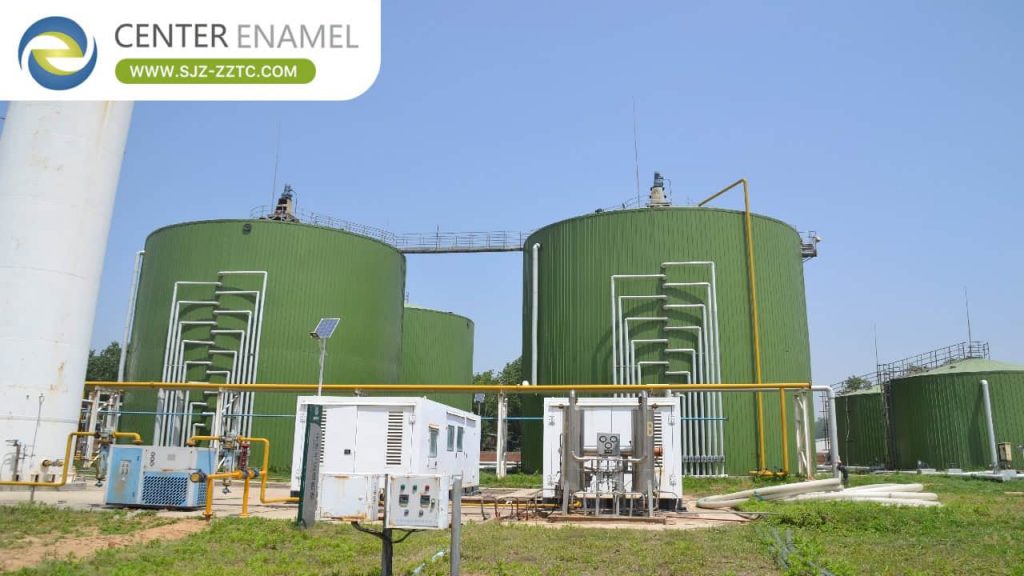
Malaysia Biogas Project — Malaysia · 2026
5 GFS Tanks · 27,000 m³ Total Volume · 22,000 m³ Biogas/Day
A large-scale biogas project in Malaysia featuring 5 Glass-Fused-to-Steel (GFS) tanks. The project achieves approximately 80% digestibility, with each single tank producing about 4,400 m³ of biogas daily, totaling 22,000 m³ per day across all 5 tanks.
Technical Specifications
Single Tank Volume: 5,400 m³ (Ø24.46 × 12 m)
Total Effective Volume: 27,000 m³ (5 tanks)
Daily Biogas Production: 22,000 m³ total
Digestibility: ≈ 80%
Gas Production Rate: 0.45 m³ / kg COD removed
Tank Type: Glass-Fused-to-Steel (GFS)
Water Quality Data
| Parameter | Inlet Water | Effluent |
| COD | ≥ 60,000 mg/L | ≥ 12,000 mg/L |
| BOD | ≤ 25,000 mg/L | ≤ 5,000 mg/L |