
Which Grass is Best for Biogas Production?
As the world seeks sustainable alternatives to fossil fuels, biogas has emerged as a promising renewable energy source. Among the various feedstocks available for anaerobic digestion, grasses offer a particularly attractive option due to their high availability, rapid growth rates, and minimal land-use competition with food crops . But which grass is best for biogas production? This guide examines the leading contenders and explains why Napier grass stands out as the premier choice.
The Growing Interest in Grass as Biogas Feedstock
Grasses are increasingly being explored as a potential feedstock for biogas production because they consume less water than other energy crops and can be grown on non-arable soils without displacing food crops directly . This makes grass-based biogas an environmentally sustainable solution that supports the global transition to renewable energy.
The biochemical methane potential (BMP) of grass is determined by its lignocellulosic composition, which includes cellulose, hemicellulose, and lignin. High cellulose and hemicellulose content—which are readily degradable in anaerobic digesters—is essential for optimal biogas yields . Several perennial grasses, including guinea, ruzi, para, and Napier grass, have been evaluated for biogas production, but one species consistently outperforms the others.
Why Napier Grass is the Best Choice for Biogas
Napier grass (Pennisetum purpureum), also known as elephant grass, is widely recognized as the most valuable of the perennial grasses used as biogas feedstock . Several factors contribute to its superiority:
High Cellulose and Hemicellulose Content: Napier grass contains approximately 80 to 92% cellulose and hemicellulose, which are readily degradable during anaerobic digestion .
Excellent Biomass Yield: It produces up to 75 tons of biomass per hectare annually under favorable conditions .
Perennial Growth: Once established, Napier grass can be harvested multiple times per year for up to 7 years without replanting.
High Adaptability: It thrives in tropical and subtropical climates with temperatures between 25-35°C and annual rainfall of 750-2500 mm .
Resilience: The grass is drought-tolerant, recovers quickly after rainfall, and resists pests effectively .
Research from Bhutan comparing Basil, Bermuda, and Napier grasses confirmed that Napier grass showed the highest potential for methane gas production, with 1L of Napier grass silage yielding 0.81L of biogas .
Biogas Yield from Napier Grass
Biogas yield from Napier grass depends on several factors, including harvesting period, pre-treatment methods, and digestion conditions. The composition of lignocellulosic biomass varies across different harvesting days, affecting lignin, cellulose, hemicellulose, and carbon-to-nitrogen (C/N) ratios. Harvesting at 30-45 days typically provides the optimal balance of these components for bioenergy applications .
Key yield data:
Roadside grass clippings (wet continuous digestion) achieved biogas yields up to 700 Nm³.t⁻¹ DOM with methane content of 49-55% .
Fresh grass cut in spring produced 715.05 ± 26.43 NL kgVS⁻¹ of biogas .
Methane content in Napier grass biogas typically ranges from 55-63.5% .
The Importance of Pre-Treatment
While Napier grass is an excellent feedstock, its complex lignocellulosic structure can limit biogas yields. Pre-treatment is essential to disrupt this structure and enhance microbial access to fermentable sugars .
Effective pre-treatment strategies include:
Physical Pre-treatment: Milling and pulverization increase surface area for microbial activity .
Chemical Pre-treatment: Alkaline treatment has demonstrated methane yield enhancements of up to 70% .
Thermal Pre-treatment: Heat treatment breaks down complex structures, improving digestibility .
Combined Pre-treatment: Multiple methods used together often produce the best results.
Research shows that thermally pre-treated Napier grass produced 70.33 Nml/g·VSadded of biogas, compared to 46 Nml/g·VSadded for raw Napier grass . Co-digestion with other substrates like abattoir waste can further boost yields, with one study achieving up to 117 Nml/g·VSadded at a 50:50 ratio .
Comparing Napier Grass to Other Feedstocks
While this article focuses on identifying the best grass for biogas production, it is worth noting how Napier grass compares to other feedstocks:
| Feedstock Type | Key Advantages | Biogas Potential |
| Napier Grass | High yield, perennial, high cellulose content | Very high |
| Roadside Grass | No land-use competition | Moderate |
| Guinea Grass | Suitable for tropical regions | High |
| Food Waste | High organic load | High |
Napier grass stands out due to its combination of high biomass production, excellent lignocellulosic composition, and minimal resource requirements, making it the preferred choice for large-scale biogas projects.
GFS Tanks: Durable Storage for Biogas Projects
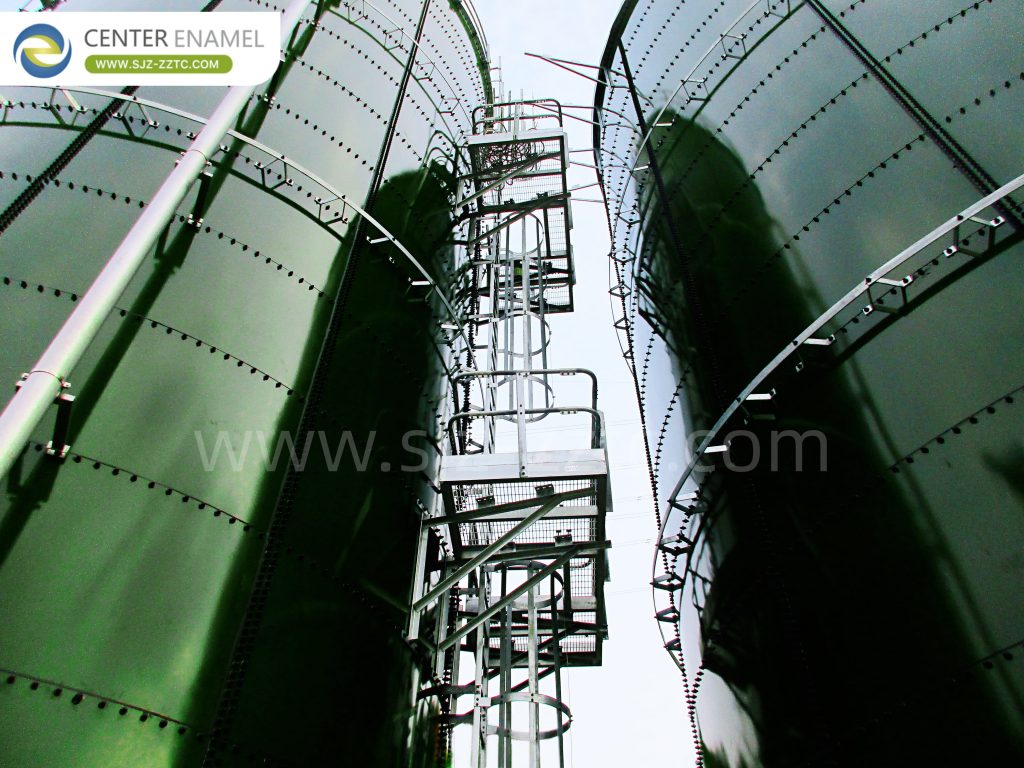
A reliable biogas storage solution is essential for any successful biogas project. Glass-Fused-to-Steel (GFS) tanks are the industry's premier choice for biogas storage, offering unmatched durability and corrosion resistance.
Key advantages of GFS tanks for biogas storage:
Superior Corrosion Resistance: The glass coating, fused to steel at 820°C-930°C, creates an inert barrier that resists the corrosive organic acids and hydrogen sulfide produced during anaerobic digestion .
Gas Tightness: Precision-engineered modular design ensures safe biogas containment with no leakage .
High Durability: Designed to withstand high pressures and demanding operational conditions for decades .
Rapid Installation: The bolted modular design allows for quick on-site assembly, minimizing project timelines .
Scalability: Tanks are available in various sizes and configurations to accommodate project needs from small farms to large industrial installations .
Center Enamel, a global leader in GFS tank manufacturing, has successfully delivered biogas storage projects in over 100 countries . Recent projects include biogas storage tanks in Sweden (5,504 m³ capacity) and food waste biogas projects in Turkey .
Center Enamel: Your Partner in Biogas Solutions
Center Enamel is a trusted provider of comprehensive biogas storage solutions. With over 30 years of expertise in storage tank design and manufacturing, the company offers:
Complete Range of Storage Solutions: GFS tanks, stainless steel tanks, fusion bonded epoxy tanks, and biogas holders .
International Certifications: Tanks meet ISO 9001, CE, NSF/ANSI 61, WRAS, and AWWA D103-09 standards .
Global Track Record: Successful projects in the USA, Australia, Canada, Indonesia, UAE, Brazil, Sweden, Turkey, and many more .
Application Versatility: Solutions for agricultural biogas, industrial biogas, municipal biogas, and waste-to-energy projects .
Center Enamel's commitment to quality, innovation, and sustainability makes it the ideal partner for biogas projects of all scales, supporting the global transition to renewable energy.
FAQ Section
Q1: Which grass produces the highest biogas yield?
A: Napier grass (Pennisetum purpureum) consistently produces the highest biogas yields among perennial grasses due to its high cellulose and hemicellulose content (80-92%), excellent biomass production of up to 75 tons per hectare annually, and adaptability to tropical climates .
Q2: How much biogas can 1 kg of Napier grass produce?
A: Biogas yields from Napier grass vary depending on pre-treatment and digestion conditions. Studies have reported yields of up to 715 NL kgVS⁻¹ under optimal conditions . Pre-treatment methods such as milling and alkaline treatment can enhance yields by up to 70% .
Q3: What are the advantages of GFS tanks for biogas projects?
A: GFS (Glass-Fused-to-Steel) tanks offer superior corrosion resistance against organic acids and hydrogen sulfide, excellent gas tightness for safe containment, high durability for decades of service, rapid installation through modular design, and scalability to meet project requirements .