
Which Reactor Suits Livestock Wastewater?
For livestock wastewater, the right anaerobic reactor follows the solids content of the stream. Thick manure slurry at 8-12% total solids calls for a continuously stirred tank reactor (CSTR) or an upflow solids reactor (USR), while the more soluble fraction after solid-liquid separation is well matched to a UASB. Selection is driven by total solids, COD concentration, and whether the manure is handled as slurry or as separated liquid and solid streams, with co-digestion typically balanced to a C:N ratio of 20-30:1.
Match the Reactor to Total Solids
Livestock wastewater is not one stream. Raw pig or cattle slurry is a thick, high-solids feed that needs full mixing and long retention; separated liquid is low in solids but still high in soluble COD; wash water dilutes everything. The reactor choice is decided first by solids, then by the organic load the system must remove.
Design Parameter Table
| Design parameter | Typical value or range | Why it matters |
| Total solids (slurry) | 8-12% TS | Sets CSTR or USR vs UASB |
| COD concentration | 10,000-60,000 mg/L | Drives digester volume |
| Hydraulic retention | 20-40 days (CSTR) | Long for thick feed |
| Temperature | 35-38°C mesophilic | Stability beats exact setpoint |
| C:N ratio | 20-30:1 (co-digestion) | Avoids nutrient imbalance |
| Limitation to check | Sand and grit in slurry | Abrasion and settling |
Reactor Comparison for Livestock Wastewater
| Factor | CSTR | USR | UASB |
| Best feed | Thick slurry 8-12% TS | High solids, low mixing | Soluble fraction |
| Mixing | Mechanical, continuous | Sludge blanket, mild | None, upflow + gas lift |
| Retention | 20-40 days | 15-30 days | Hours (6-12 h) |
| Biogas | 0.30-0.45 m³/kg COD | Similar yield | 0.30-0.45 m³/kg COD |
Project Case Study
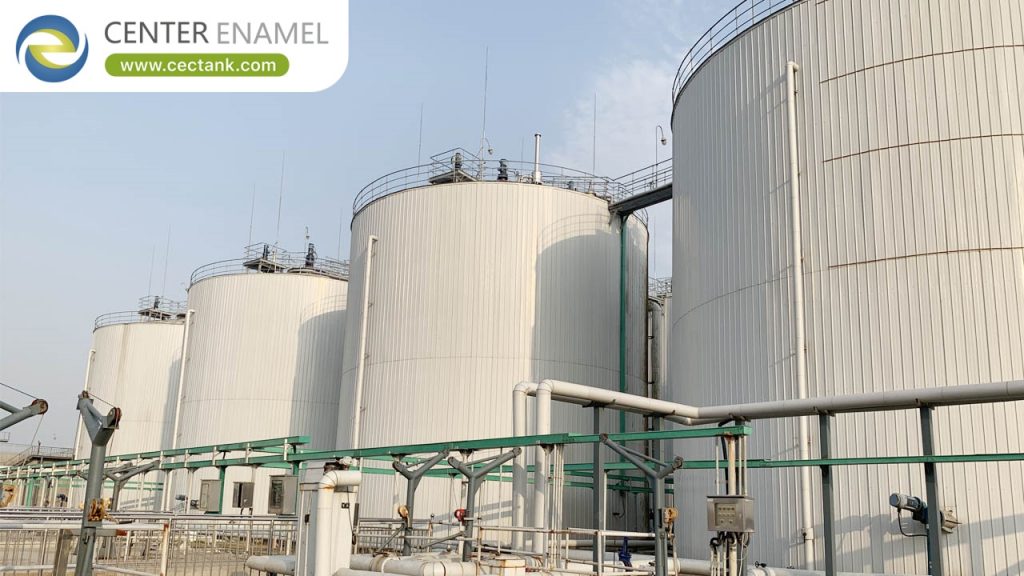
Zhaqi Biogas Project, Inner Mongolia. A medium-temperature anaerobic fermentation plant processes 900 m³/day of farm animal manure and agricultural waste, including grass straw, through four CSTR reactors (Ø25.98 × 8.4 m each), producing 20,000 m³ of biogas daily. The project shows how a CSTR is sized for cold-climate livestock slurry.
| Project | Zhaqi Biogas Project, Inner Mongolia |
| Location | Xing'an, Inner Mongolia, China |
| Industry | Livestock / Farm Manure |
| Application | Medium-temperature CSTR anaerobic digestion |
| Product | 4 × CSTR tanks (Ø25.98 × 8.4 m) |
| Result | 900 m³/D feed, 20,000 m³ biogas/day |
| Status | Delivered 2017 |
About Shijiazhuang Zhengzhong Technology Co., Ltd (Center Enamel)
Shijiazhuang Zhengzhong Technology Co., Ltd (Center Enamel) supplies the customization and product range that lets a livestock plant pick the right reactor: bolted Glass-Fused-to-Steel (GFS) CSTR, USR, and UASB tanks are engineered for wet, H₂S-bearing, abrasive manure duty, with the enamel fused at 820-930°C for an inert barrier, built to ISO 28765 / AWWA D103 and CE-EN 1090. Tank size, roof, and mixing penetrations are engineered per feed solids rather than off the shelf.
Choose a CSTR or USR for thick manure slurry and a UASB for the separated soluble fraction; keep the C:N ratio near 20-30:1 and run at 35-38°C. Send your total solids, COD, and flow and we will size the reactor and the gas holder.
Frequently Asked Questions (FAQ)
Q1: What reactor handles manure slurry best?
A: A CSTR or USR, because thick slurry at 8-12% TS needs full mixing and 20-40 days retention; a UASB would wash out under that solids load.
Q2: Is UASB good for livestock wastewater?
A: Only for the soluble fraction after solid-liquid separation, where COD exceeds 1,500-2,000 mg/L; raw slurry is unsuited to UASB.
Q3: What is the difference between CSTR and USR?
A: CSTR mixes continuously with mechanical agitators; USR relies on a gentle upflow of solids-rich feed and is simpler but less mixed.
Q4: How does total solids affect reactor choice?
A: Above roughly 5-8% TS, CSTR/USR are required; below that, UASB or other high-rate systems become viable.
Q5: What biogas yield can a livestock reactor reach?
A: About 0.30-0.45 m³ of biogas per kg COD removed, at 55-65% methane, under mesophilic digestion.
Q6: Why balance C:N at 20-30:1?
A: Outside that range, ammonia inhibition or nutrient shortage slows the digesting microbes and cuts gas yield.
Share your manure total solids, COD, and daily flow. We will recommend CSTR, USR, or UASB and return a sized GFS reactor and gas-holder package.