
Which Treatment Train Fits the Effluent Limit?
The treatment train is selected by reading the effluent limit from the top down: anaerobic treatment alone removes bulk COD, an anaerobic-plus-aerobic train (such as A²O) adds nitrogen and phosphorus removal, and an advanced polishing step is added only when the limit is strict. Matching the train to the limit avoids both under-treatment and paying for capacity you do not need.
Read the Limit, Then Build the Train
A limit that asks only for COD and BOD is met by anaerobic and secondary treatment. If ammonia and total nitrogen appear, an anoxic-aerobic zone is required. If total phosphorus is capped, biological or chemical precipitation is added. Each addition is a deliberate response to a line in the permit.
Design Parameter Table
| Limit driver | Typical value or range | Train response |
| COD / BOD only | ≤ 100 / ≤ 30 mg/L | Anaerobic + secondary |
| Ammonia / TN | ≤ 10 / ≤ 15 mg/L | Add anoxic-aerobic (A²O) |
| Total phosphorus | ≤ 0.5-2 mg/L | Add P precipitation |
| Strict reuse | Near-zero discharge | Add advanced polishing |
| Limitation to check | Shock loads | Equalization first |
Train Comparison by Limit
| Train | Removes | Best when |
| Anaerobic only | Bulk COD, recovers biogas | High-strength industrial |
| Anaerobic + A²O | COD, N, P | Municipal + nutrient limit |
| + Advanced polishing | Trace and reuse | Strict or reuse limit |
Project Case Study
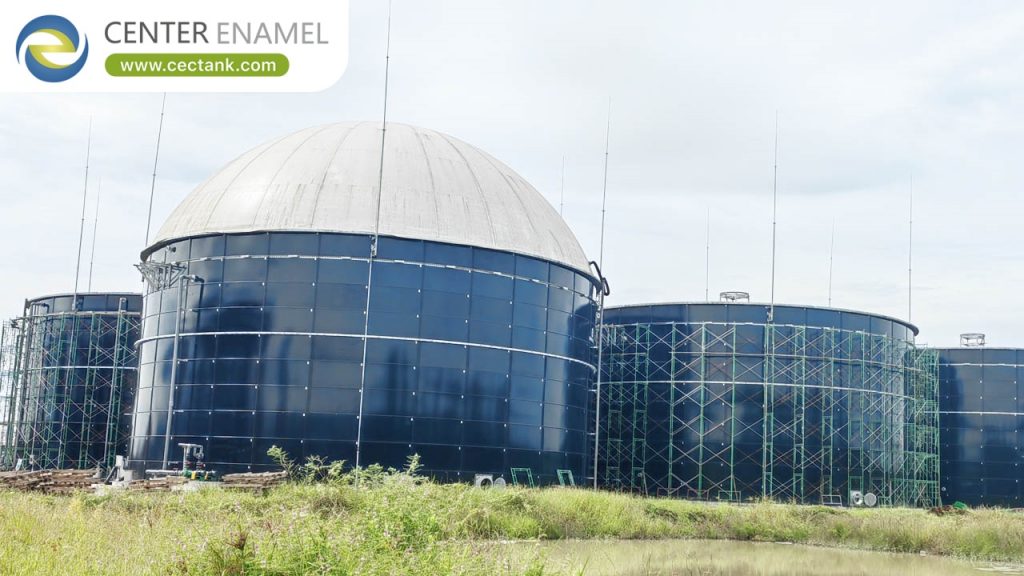
Domestic Sewage Treatment Project, Ghana. The plant pairs a UBF (Upflow Blanket Filter) anaerobic stage with A²/O (Anaerobic-Anoxic-Oxic) aerobic stages to meet a nutrient-bearing limit: influent COD 1,000 mg/L drops to 100 mg/L, BOD 500 to 25, ammonia 30 to 10, and total phosphorus 10 to 2 mg/L, a clear example of limit-driven train selection.
| Project | Domestic Sewage Treatment Project, Ghana |
| Location | Ghana |
| Industry | Municipal / Domestic Sewage |
| Application | UBF + A²/O nutrient removal |
| Product | UBF Ø11.46 × 9.6 m, A²/O 2 × Ø20.64 × 6.6 m |
| Result | COD 1,000→100, NH₃ 30→10, TP 10→2 mg/L |
| Status | Delivered 2021 |
About Shijiazhuang Zhengzhong Technology Co., Ltd (Center Enamel)
Shijiazhuang Zhengzhong Technology Co., Ltd (Center Enamel) supports the installation and project delivery of limit-driven trains: bolted GFS tanks serve as UBF, A²/O, equalization, and sludge units, with enamel fused at 820-930°C for an inert barrier, built to ISO 28765 / AWWA D103 and CE-EN 1090. Tank geometry and penetrations are matched to the chosen train rather than generic.
Pick the train by the strictest line in the permit: anaerobic for COD, A²O for nitrogen and phosphorus, and polishing for strict limits. Send your effluent limit and we will propose the matching train.
Frequently Asked Questions (FAQ)
Q1: Which train removes only COD?
A: Anaerobic plus secondary treatment handles COD and BOD; A²O or comparable aerobic stages complete suspended solids removal.
Q2: How do you add nitrogen removal?
A: An anoxic-aerobic zone (as in A²O) denitrifies and nitrifies, typically bringing ammonia under 10 mg/L.
Q3: When is phosphorus removal needed?
A: Whenever the permit caps total phosphorus, usually via biological uptake plus chemical precipitation.
Q4: What train meets a strict limit?
A: Anaerobic + A²O plus an advanced polishing step (filtration or membrane) for near-zero or reuse discharge.
Q5: Why equalize before the train?
A: Equalization absorbs shock loads so the biological stages see steady feed and hold their removal efficiency.
Q6: Does anaerobic recovery help the train?
A: Yes, it removes bulk COD and recovers biogas, cutting the load and energy cost of the downstream aerobic stages.
Suggested CTA
Send your effluent limit and influent profile. We will map it to a train and return a GFS tankage layout for each stage.