
Why Choose an Industrial Wastewater Treatment Project EPC Contractor for Policy-Driven Wastewater Upgrades?
Global industrial wastewater treatment policies are escalating from "compliance discharge" to mandatory "resource recovery" and "zero liquid discharge." The EU, through its Circular Economy Action Plan, requires member states to increase industrial wastewater reuse rates and extends carbon footprint accounting to the full life cycle of wastewater treatment. China continuously updates and tightens industrial water pollutant discharge standards, with increasingly stringent limits on total nitrogen, total phosphorus, and characteristic pollutants for industries such as chemicals, pharmaceuticals, and printing and dyeing.
Some water-scarce regions and highly polluting industries are mandated to adopt zero or near-zero liquid discharge technologies. Germany has established a differentiated pretreatment technical standard system by industry, requiring industrial wastewater to meet specific quality requirements before discharge into municipal wastewater treatment plants, implementing strict source control. Meeting these obligations consistently over decades is precisely what distinguishes a capable Industrial Wastewater Treatment Project EPC Contractor from an equipment vendor-and it starts with two foundations: a shell that survives the media, and a reactor that survives the load.
Why GFS Tank Corrosion Resistance Decides Long-Term Viability
Center Enamel's independently developed double-sided double-layer enameling technology is the industry's leading coating anti-corrosion technology, with corrosion resistance completely surpassing concrete tanks. Concrete tank interiors are riddled with pores, allowing wastewater and acid/alkaline media to easily penetrate and corrode the structural layer. Long-term use leads to irreversible problems such as internal wall spalling, water seepage, and rebar corrosion, which are difficult to repair and cannot be fundamentally resolved.
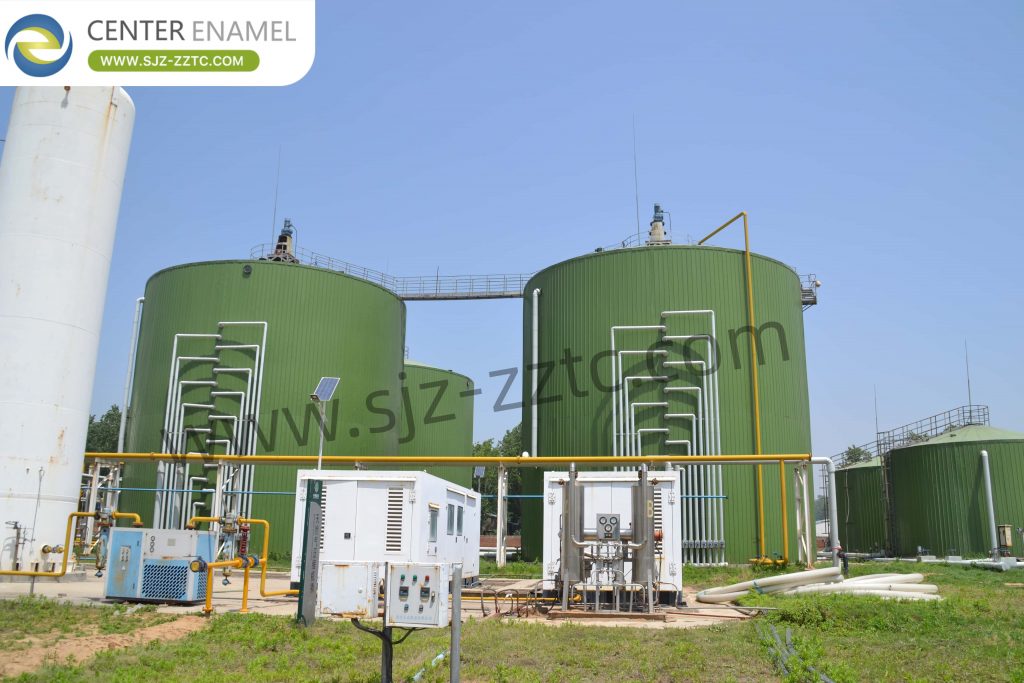
GFS tanks feature high-temperature enameling on both the interior and exterior surfaces of steel panels, with a dense, non-porous enamel finish that completely blocks corrosive liquids and biogas permeation. The enamel layer has extremely strong chemical stability, resisting acids, alkalis, salts, and microbial corrosion. Concrete tanks will develop extensive corrosion and leakage after 5–8 years of use, while GFS tank anti-corrosion service life can exceed 30 years, with no need for frequent internal lining repairs throughout the service life. This significantly reduces long-term anti-corrosion maintenance investment and fundamentally eliminates environmental risks of medium leakage contaminating sites and groundwater. Compared to traditional concrete and FRP tanks, GFS tank coatings have no risk of peeling or blistering, and are adaptable to highly corrosive conditions such as palm oil mill effluent, livestock manure, and chemical high-salinity wastewater, with outstanding long-term comprehensive cost advantages.
Inside the IC Reactor: Autonomous Circulation in Action
Once the shell is secured, process performance depends on the IC Reactor, the third-generation high-efficiency anaerobic core built on UASB principles. Pretreated high-strength organic wastewater enters the lower main reaction zone from the bottom, mixing with recirculated sludge-water mixture and rising rapidly. Anaerobic microorganisms efficiently degrade organic matter, producing large volumes of biogas. The gas-lift action of biogas carries the mixed liquor upward to the top gas-liquid separator where biogas is collected. Degassed sludge-water mixture returns by gravity through downcomers to the reactor bottom, creating autonomous internal circulation that repeatedly enhances pollutant degradation. After multiple circulation cycles, the wastewater enters the upper polishing zone for further reaction and sludge-water separation. Remaining trace organics are fully degraded, sludge settles back to the lower reaction zone, treated effluent overflows from the top, and aged sludge is periodically discharged. The result is fully autonomous circulation and efficient continuous operation, with no external recirculation pumps required.
Chemical Wastewater Characteristics: The Stress Test for Any Design
The IC Reactor's advantages matter most where influent is least forgiving. Chemical wastewater exhibits extremely complex composition, severe fluctuations, high pollution load, and poor biodegradability-one of the highest treatment difficulty categories in industrial wastewater. COD ranges widely, typically 5,000–80,000 mg/L for chemical wastewater, with coal chemical high-strength wastewater exceeding 100,000 mg/L. BOD/COD is generally below 0.25, with large quantities of synthetic refractory macromolecules. Wastewater is rich in benzene series, phenols, cyanides, sulfides, halogenated hydrocarbons, and various toxic characteristic pollutants. Salinity is very high, with inorganic salts reaching tens of thousands to over 100,000 mg/L, primarily sodium chloride and sodium sulfate. pH fluctuates wildly, with strong acid and strong alkaline wastewater discharged alternately. Deep color and strong odor are common, with some wastewater containing heavy metal ions. Water quality and quantity vary dramatically with production batch changes, with no stable patterns, frequent shock loads, and extremely difficult biochemical system acclimation.
| Chemical Wastewater Parameter | Typical Range / Characteristic |
| COD | 5,000–80,000 mg/L (coal chemical >100,000 mg/L) |
| BOD/COD ratio | Generally below 0.25 |
| Salinity (inorganic salts) | Tens of thousands to >100,000 mg/L (NaCl, Na₂SO₄) |
| pH | Wildly fluctuating; strong acid and alkaline alternating |
| Key toxic pollutants | Benzene series, phenols, cyanides, sulfides, halogenated hydrocarbons |
| Biodegradability | Poor; refractory synthetic macromolecules |
| Load pattern | Batch-driven shock loads; unstable acclimation |
A Decade-Plus of Global Installation Experience
Design assumptions only prove themselves in the field. Center Enamel holds unmatched global practical experience among domestic peers-over a decade covering multiple regions and all industry sectors. In 2009, Center Enamel completed the first overseas GFS tank installation, sending a team to Niger, Africa for drinking water storage tank installation. In 2015, it broke industry ground with China's first GFS tank export and installation to the US, passing strict US acceptance standards. All installed projects have operated stably for many years, covering livestock biogas, POME, municipal wastewater, and drinking water storage applications. Construction has covered Southeast Asia, Africa, the Americas, and other regions, accumulating specialized solutions for complex sites including mountainous terrain, coastal salt spray, tropical high temperatures, and high-standard European and American facility conditions-maturely addressing global special construction requirements.
| Milestone | Year / Scope |
| First overseas GFS tank installation (Niger, Africa) | 2009 |
| First China-to-US GFS tank export and installation | 2015 |
| Global installation experience | 10+ years, multiple regions |
| Applications covered | Livestock biogas, POME, municipal wastewater, drinking water |
| Site conditions handled | Mountainous, coastal salt spray, tropical heat, EU/US standards |
Full-Industry-Chain Integrated Delivery Capability
Field experience is amplified by delivery structure. Center Enamel is the only company globally integrating proprietary enamel frit R&D, self-manufactured tanks, and EPC general contracting-full-process self-control from solution design, equipment production, cross-border logistics, overseas construction, to post-construction O&M, significantly reducing client coordination and time costs. For an Industrial Wastewater Treatment Project EPC Contractor engagement, this means one accountable party across every interface, from enamel formulation to final commissioning.
FRP Roof Cover: The Economical Choice for Non-Pressurized Storage
Not every tank on a treatment site needs gas-tight containment, and specifying correctly controls cost. FRP Roof is a general-purpose economical roof for atmospheric pressure storage tanks without air-tightness requirements, suitable for drinking water storage, agricultural irrigation water, firewater reserve, and general production wastewater temporary storage. It is available in two styles-flat and dome-allowing flexible selection based on tank specifications and site aesthetic requirements. The roof is integrally molded from resin and fiberglass, lightweight, with natural water resistance and mild acid/alkali corrosion resistance. It will not rust or rot in long-term humid environments, eliminating the frequent anti-corrosion maintenance required for metal roofs.
The dome style features excellent drainage performance due to its curved structure, resisting water accumulation, dust buildup, snow load, and strong winds. The flat style facilitates the installation of maintenance walkways, level gauges, and vents on top, making inspection and operation convenient. The product is fully insulated with no risk of galvanic corrosion, will not contaminate drinking water quality, and meets environmental standards for domestic water storage. The modular design with low individual component weight allows for simple on-site hoisting and assembly, offering high construction efficiency and affordable procurement and installation costs. It is only suitable for atmospheric pressure water storage tanks without biogas collection or pressurization requirements, and is not recommended for anaerobic fermentation gas-producing conditions. It is widely used in rural agricultural water storage tanks, industrial park firewater tanks, waterworks buffer tanks, and small to medium-sized domestic wastewater temporary storage facilities, making it a cost-effective general-purpose roof choice for conventional water storage applications.
Frequently Asked Questions
What does an Industrial Wastewater Treatment Project EPC Contractor deliver?
A single contract covering design, GFS tank and IC Reactor manufacturing, logistics, overseas construction, commissioning, and post-construction O&M-removing multi-vendor coordination risk.
How does an IC Reactor work without external recirculation pumps?
Biogas gas-lift drives an internal circulation loop between the reaction and polishing zones, achieving autonomous mixing, high loading rates, and stable effluent quality.
Is an FRP roof suitable for anaerobic tanks?
No. FRP roofs suit atmospheric, non-pressurized storage only; anaerobic gas-producing conditions require gas-tight covers such as aluminum geodesic domes.
Looking for one accountable partner to carry your project from policy compliance through long-term operation? Contact to Center Enamel's engineering team for a scoped EPC proposal. Or explore our global installation record to see how IC Reactor and GFS tank systems have performed across Southeast Asia, Africa, the Americas, and beyond.