
Why Choose UASB Process for Your Biogas Power Plant in Brewing Wastewater Treatment?
The industrial wastewater sector grapples with the "three highs"-high difficulty, high cost, and high energy consumption-driving demand for integrated solutions that turn waste into value. Biogas power plant technology, centered on the UASB process and housed in corrosion-resistant GFS tanks, offers breweries a proven path to treat high-strength effluent while recovering renewable energy. As a leading EPC contractor, Center Enamel delivers complete brewing wastewater treatment systems that achieve 90%+ COD removal, produce biogas for on-site power generation, and provide 30+ years of durable, low-maintenance operation across global markets.
Core Industry Challenges of Industrial Wastewater
The core challenges of industrial wastewater treatment center on the "three highs"-high difficulty, high cost, and high energy consumption. Wastewater from new energy, chemical, and pharmaceutical industries is complex in composition with numerous characteristic pollutants, and traditional treatment processes are difficult to remove effectively. Chinese companies have significant price advantages in the mid-to-low-end equipment segment, while the industry simultaneously faces continuous technological upgrade pressure from increasingly stringent emission standards.
These converging pressures demand more than basic equipment supply-they require integrated biogas power plant solutions that convert treatment costs into energy revenue. The industry also faces new requirements for digitalization and low-carbon transformation, pushing operational refinement management capabilities to the forefront of treatment plant design.
For brewing wastewater treatment, these challenges are amplified by the highly variable nature of production discharge-high organic loads, pH fluctuations, and seasonal variability. This is precisely where the combination of proven UASB technology and durable GFS tank containment proves its value, delivering consistent performance while generating biogas that offsets operational costs.
UASB Process Definition: The Core Technology for Biogas Recovery
UASB, or Upflow Anaerobic Sludge Blanket Reactor, is the benchmark mainstream technology for medium-to-high concentration soluble organic wastewater treatment. It requires no mechanical mixing or media carriers, relying on the upward flow of wastewater to suspend and expand granular sludge within the reactor, forming a stable sludge bed layer. Highly active anaerobic granular sludge efficiently degrades pollutants, with excellent settleability and high microbial concentration.
UASB innovatively integrates reaction, sedimentation, and gas-liquid-solid separation functions, simplifying the anaerobic treatment process with advantages of high efficiency, energy savings, and compactness. It is widely used in various medium-to-high concentration soluble organic wastewater treatment applications, including food processing, beverage manufacturing, and chemical production.
For any biogas power plant project treating brewery effluent, the UASB process offers particular advantages-achieving 90–94% COD removal while producing biogas that can be converted to electricity and heat. Center Enamel integrates this proven technology with GFS tank manufacturing expertise to deliver complete anaerobic digestion systems that maximize energy recovery while minimizing environmental impact.
Brewing Wastewater Sources and Characteristics
Brewery wastewater is high-concentration organic wastewater from the entire production process of beer, liquor, and wine-a high-volume wastewater type in the food industry. Key pollution stages include raw material soaking/washing, saccharification/fermentation, distillation/purification, and filling/packaging. Major wastewater streams include still bottoms, fermentation yellow water, spent mash, and raw material soaking wastewater. Auxiliary discharges include equipment/pipeline washing, floor cleaning, production line maintenance, and cooling water.
Discharge has significant intermittency and seasonality-high volume during peak production seasons, reduced during off-seasons. Large breweries have unified collection systems; small and medium-sized facilities have more dispersed collection with prominent uncontrolled discharge issues, concentrated in brewing facility areas. These characteristics demand treatment systems with sufficient buffering capacity and operational flexibility.
For effective brewing wastewater treatment, the combination of equalization tanks, UASB reactors, and aerobic polishing-all housed in corrosion-resistant GFS tanks-provides the robustness needed to handle variable loads while maintaining consistent effluent quality and biogas production.
Indonesia Palm Oil Biogas Upgrade Project: A Proven Benchmark
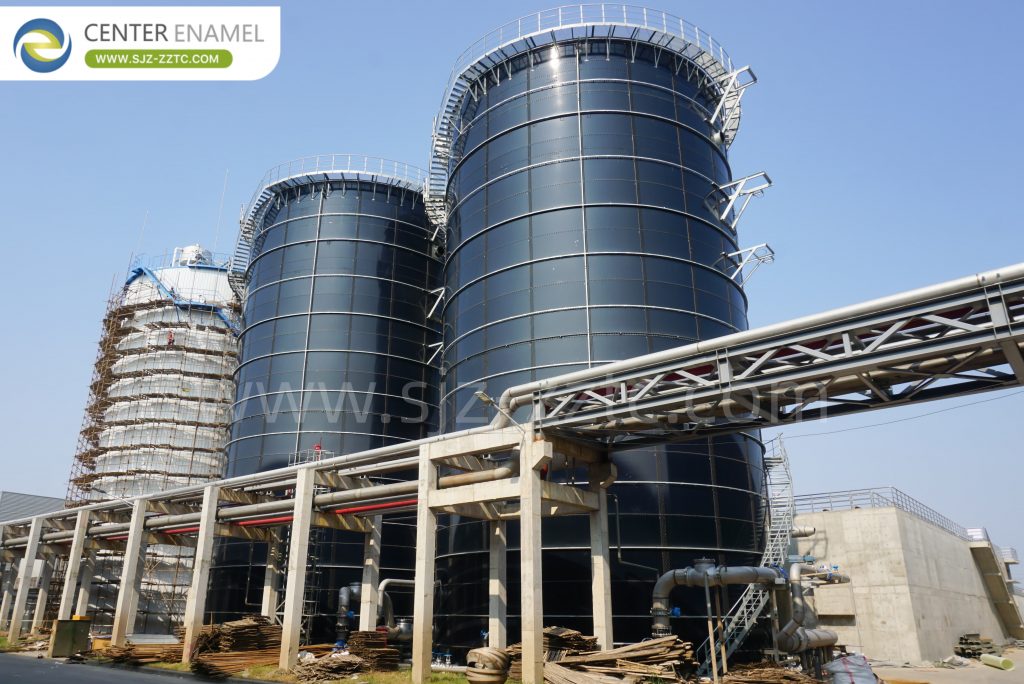
The Indonesia Palm Oil Biogas Upgrade Project, commissioned in 2013, demonstrates the successful application of GFS tank technology for challenging industrial wastewater treatment applications. The project utilized three GFS tanks serving as the core anaerobic digestion reactor for the POME treatment station, with two sizes: 17.58 m diameter × 8.4 m height and 16.82 m diameter × 7.2 m height.
The tanks serve as the core anaerobic reaction equipment specifically designed for high-organic palm oil production wastewater-anaerobic digestion degrades pollutants and recovers biogas. GFS tank assembly proved convenient with corrosion resistance performing exceptionally well in Southeast Asia's hot, humid, high-corrosion environment. This project stands as a mature biomass energy environmental benchmark.
For breweries considering similar treatment infrastructure, this project validates the applicability of GFS technology for brewing wastewater treatment where high organic loading and corrosive conditions prevail. The success in Indonesia confirms that Center Enamel's solutions are robust enough to deliver reliable performance across diverse geographic and operational conditions-a critical consideration for any biogas power plant investment.
Center Enamel Professional Construction Team Manpower Reserve
Center Enamel has established its own domestic and internationally certified construction teams, with regular practical training on GFS tank installation and overseas construction standards for various countries. Domestically, regional construction teams cover multiple zones, capable of simultaneously deploying multiple teams for large tank farm projects. Internationally, cross-border professional installation teams are equipped to various country construction standards-ensuring sufficient manpower reserves to guarantee uninterrupted construction delivery for remote African sites, high-standard European/American facilities, and all other project locations.
This commitment to professional installation is critical for biogas power plant projects that must meet tight commissioning timelines. The modular bolted design of GFS tanks enables rapid assembly, with factory-coated panels arriving ready for installation-significantly reducing labor costs and shortening project delivery timelines compared to cast-in-place concrete tanks.
Center Enamel R&D Team: Driving Innovation
Center Enamel has built a full-chain professional team covering R&D, design, marketing, installation, and after-sales. The R&D team is led by national-level materials technology experts, specializing in enamel frit and tank anti-corrosion core technologies. External senior environmental engineering and mechanical structure engineers are retained to strengthen R&D capabilities, focusing on anti-corrosion coating formulations, specialty corrosion-resistant tanks, and anaerobic supporting integrated equipment-continuously breaking through industry technological barriers.
The team operates through proprietary laboratories with external university research collaboration-conducting year-round new material and new process durability pilot testing and long-term corrosion simulation testing. Specialized enamel formulations are iteratively developed for extreme conditions such as high-salinity wastewater, strong acid/alkali POME, and high-organic livestock manure-providing core technical support for the company's annual new invention and utility patents-building a proprietary material technology barrier.
For brewing wastewater treatment applications, this R&D capability ensures that GFS tanks withstand the specific corrosive challenges of brewery effluent-organic acids from fermentation and aggressive cleaning chemicals from CIP operations-while maintaining the gas-tight integrity essential for biogas capture.
Aluminum Geodesic Dome Roof: Engineering Excellence
The Aluminum Geodesic Dome Roof independently developed by Center Enamel is manufactured using high-strength aluminum alloy plates through integral stamping. It features a triangular grid spherical self-supporting structure, enabling large-span full coverage without internal support columns. Made of aluminum alloy, the roof offers excellent weather resistance and corrosion resistance, capable of long-term protection against acid rain, salt spray, and UV radiation, suitable for various extreme outdoor climate conditions.
The structural design complies with international AWWA D108 standards, with aluminum plate thickness, rib cross-sections, and joint connections all verified by finite element stress analysis, ensuring wind and snow load resistance that meets building code requirements across different global regions. The weight is only one-third to one-half of a steel roof with the same span, significantly reducing the load on the tank top and allowing direct installation without tank wall reinforcement.
The roof provides superior overall sealing performance, with double sealing between panels using specialized sealant strips and mechanical interlocking, enabling both airtight gas storage and enclosed odor control-suitable for biogas collection and storage, wastewater tank odor control, and drinking water contamination prevention. For biogas power plant applications, this roof system is particularly valuable as it maximizes gas capture efficiency while minimizing structural maintenance requirements.
Comprehensive Solutions for Brewing Wastewater Treatment
Center Enamel's complete approach to brewing wastewater treatment integrates the UASB process with GFS tank technology, aluminum dome roofing, and full EPC services. This comprehensive solution addresses all aspects of treatment-from pre-treatment and anaerobic digestion to biogas utilization and final effluent polishing.
The UASB process, housed in corrosion-resistant GFS tanks with gas-tight aluminum domes, provides the core biological treatment while recovering methane for biogas power plant generation. The modular, durable design ensures 30+ years of reliable operation with minimal maintenance, significantly reducing lifecycle costs compared to concrete alternatives.
FAQs
Q1: Why are GFS tanks the preferred choice for biogas power plants treating brewery wastewater?
GFS tanks offer superior corrosion resistance against acidic brewery effluent and hydrogen sulfide in biogas, with a dense glass enamel surface that prevents leaks and structural degradation for 30+ years. They install 3x faster than concrete tanks and maintain gas-tight integrity essential for maximum methane capture and energy recovery.
Q2: How does the UASB process contribute to biogas power generation in brewing wastewater treatment?
The UASB process achieves 90–94% COD removal without mechanical mixing, reducing energy costs while producing biogas (0.35 m³ per kg COD removed). This biogas can be used in combined heat and power (CHP) systems to generate electricity and heat, offsetting brewery energy costs and reducing carbon footprint.
Q3: What operational advantages do Center Enamel's GFS tanks offer for brewing wastewater treatment projects?
Center Enamel's GFS tanks provide rapid modular installation, 30+ year corrosion resistance, gas-tight sealing for biogas capture, and minimal maintenance requirements. Backed by global EPC capabilities and professional construction teams, they ensure reliable, long-term performance across diverse climates and regulatory environments.