
Why Co-Digest on Farms?
Farms co-digest to balance the carbon-to-nitrogen ratio toward 20-30:1, raise biogas yield, and dilute inhibitors, because manure alone is often nutrient-rich but carbon-limited and uneven; blending it with a carbon-rich co-substrate keeps the digester stable and productive. Co-digestion is a feedstock-design choice layered on the same CSTR or USR, not a different reactor.
1. The C:N Problem with Manure
Manure sits near a 20-30:1 carbon-to-nitrogen window, but single-stream manure can drift low on carbon or high on ammonia, which slows the biology. Adding a carbon-rich co-substrate (corn silage, grass, food waste, glycerin) lifts the C:N back into the productive band and feeds the methanogens more energy per unit nitrogen.
2. What Co-Digestion Buys
| Benefit | Mechanism | Result |
| C:N balance | Add carbon-rich feed | Stable 20-30:1 |
| Higher yield | More degradable VS | More biogas per kg |
| Diluted inhibitors | Spread toxins | Fewer upsets |
| Steady feed | Smooth supply | Less variance |
3. Choosing Co-Substrates
Good farm co-substrates are locally available and consistent: crop residues, spoiled silage, food-process waste, and fats within limits. Avoid materials with high ammonia, long fibers that mat, or salts that accumulate. The blend should keep TS at 8-12% for a CSTR/USR and hold 35-38 C mesophilic operation with a 20-40 day retention.
Project Case Study
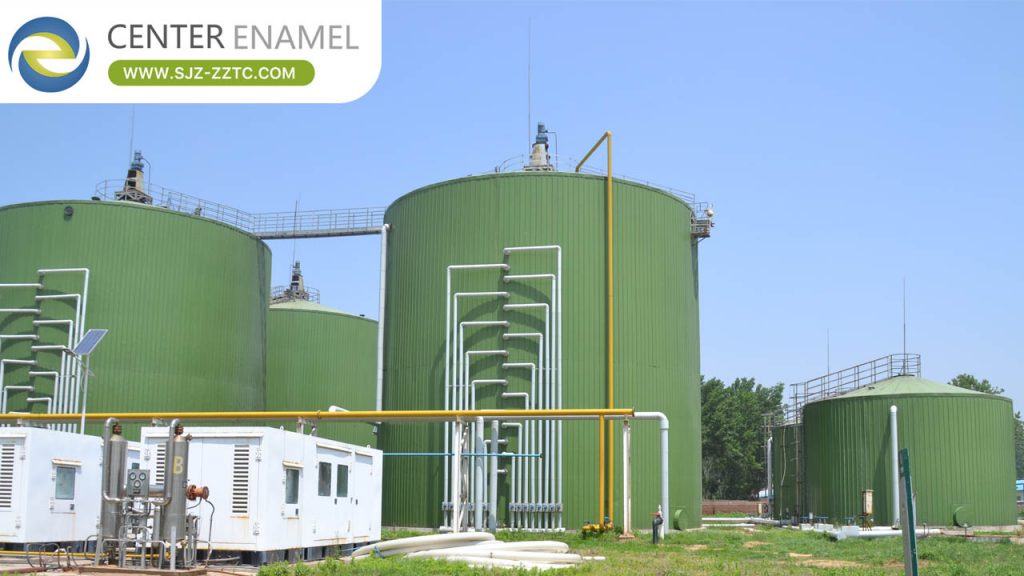
Zhaqi Biogas Project in Inner Mongolia. A mesophilic AD plant processing 900 m3/day of farm animal manure and agricultural waste including grass straw, producing 20,000 m3 of biogas daily across 4 CSTR reactors - a delivered example where manure is blended with a carbon-rich crop residue to feed the digester.
| Project | Zhaqi Biogas Project in Inner Mongolia |
| Location | Xing'an, Inner Mongolia, China |
| Industry | Agriculture / Renewable Energy |
| Application | Farm manure + crop residue co-digestion |
| Product | 4 CSTR reactors (25.98 x 8.4 m, GFS) |
| Output | 20,000 m3 biogas/day |
| Status | Delivered 2017 |
About Shijiazhuang Zhengzhong Technology Co., Ltd (Center Enamel)
Shijiazhuang Zhengzhong Technology Co., Ltd (Center Enamel) supports co-digestion with installation and technical support: beyond factory-built GFS digester tanks, the team provides flat-pack shipment, on-site assembly supervision, and commissioning input so the tankage integrates with the feed-handling and mixing packages the co-digestion blend requires.
Comparison: Mono vs Co-Digestion
| Criterion | Mono manure | Co-digestion |
| C:N control | Limited | Adjustable |
| Biogas yield | Baseline | Higher |
| Feed stability | Variable | Smoother |
Co-digest to hold C:N at 20-30:1 and lift yield; blend manure with a consistent carbon-rich co-substrate at 8-12% TS. Send your manure type and available residues and we will size the GFS CSTR or USR and feed system for co-digestion.
Frequently Asked Questions (FAQ)
Q1: Why co-digest manure?
A: To balance C:N toward 20-30:1, raise yield, and dilute inhibitors for a steadier digester.
Q2: What is the target C:N ratio?
A: About 20-30:1 for stable mesophilic anaerobic digestion.
Q3: What co-substrates suit farms?
A: Crop residues, spoiled silage, food-process waste, and limited fats.
Q4: Does co-digestion raise biogas?
A: Yes, by adding degradable volatile solids and improving biology.
Q5: What retention time applies?
A: About 20-40 days at 35-38 C for manure blends.
Q6: What tank capacity is available?
A: GFS digester tanks from 200 m3 to 60,000 m3.
Suggested CTA
Send your manure type and available residues. We will size the GFS digester and feed system for farm co-digestion.