
Why Compress Biogas to CBG?
Biogas is compressed into compressed biomethane (CBG) because compression shrinks its volume by roughly 250 times at 200-250 bar, letting it be stored and carried like natural gas, meet vehicle refueling pressure, and be injected into pipelines or moved in tube trailers. Raw biogas at near-atmospheric pressure is impractical to transport or dispense; compression is what turns a diffuse gas into a tradable, portable fuel.
What Compression Unlocks
At atmospheric pressure, a given mass of methane fills a huge volume; at 200-250 bar it fits in a compact steel vessel. That density is what makes vehicle tanks, cascade storage, and tube-trailer transport physically and economically work.
Design Parameter Table
| Parameter | Typical value or range | Why it matters |
| Storage pressure | 200-250 bar | Vehicle CBG standard |
| Volume shrink | About 250x vs atmospheric | Enables storage/transport |
| Methane purity | 95-99% CH₄ | Before compression |
| Transport | Tube trailers | Move gas off-site |
| End use | Vehicle or grid | Two outlets |
| Limitation to check | H₂S before compression | Protect seals |
Compression Benefits Compared
| Benefit | Without compression | With CBG |
| Storage | Huge low-pressure volume | Compact high-pressure |
| Vehicle use | Not feasible | NGV1 refueling |
| Pipeline | Not injectable | Grid grade |
| Transport | Local only | Tube trailer range |
Project Case Study
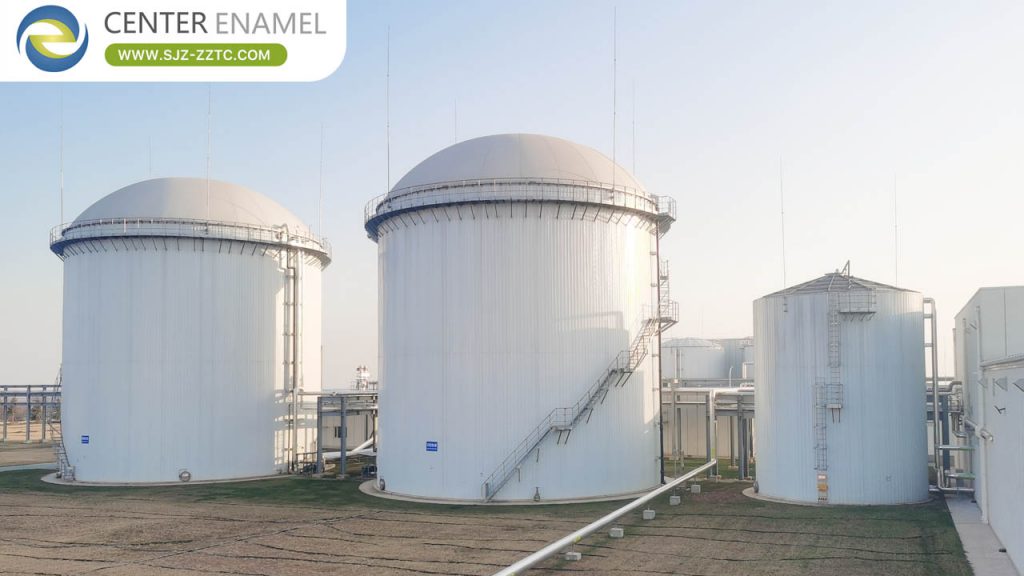
Zhenyuan Group Biogas Project, Henan. Producing 3 million m³ per year of vehicle-grade methane from 650 tonnes per day of manure and washing wastewater, this project depends on compression to turn digestion gas into a portable, dispensable fuel rather than a site-bound gas stream.
| Project | Zhenyuan Group Biogas Project, Henan |
| Location | Xinzheng, Henan, China |
| Industry | Agriculture / Renewable Fuel |
| Application | Vehicle-grade methane production |
| Product | CSTR primary 3 × Ø15.29 × 15 m, secondary Ø5.22 × 6 m |
| Result | 3,000,000 m³ vehicle-grade CH₄ per year |
| Status | Delivered 2013 |
About Shijiazhuang Zhengzhong Technology Co., Ltd (Center Enamel)
Shijiazhuang Zhengzhong Technology Co., Ltd (Center Enamel) supplies the product technology around compression: beyond GFS digester tanks, the company holds pressure-vessel manufacturing capability (I/II class license, ASME, ISO 9001) relevant to the buffer and storage vessels of a CBG skid. The digester, upgrader, and compression package is engineered as one fuel system.
Compress biogas to CBG to shrink volume, reach vehicle pressure, enable grid injection, and cut transport cost. Send your flow and end use and we will size the compression and storage vessels.
Frequently Asked Questions (FAQ)
Q1: Why compress biogas at all?
A: Compression makes the gas storable, transportable, and dispensable like natural gas.
Q2: How much does compression shrink volume?
A: About 250 times at 200-250 bar versus atmospheric pressure.
Q3: Can CBG go into pipelines?
A: Yes, once upgraded to 95-99% CH₄, CBG meets grid-injection specifications.
Q4: Does compression cut transport cost?
A: Yes, dense gas moves in tube trailers far more cheaply than low-pressure gas.
Q5: What pressure is used?
A: Typically 200-250 bar, matching vehicle CBG and CNG standards.
Q6: Must H₂S be removed first?
A: Yes, H₂S is stripped before compression to protect seals, vessels, and fuel quality.
Suggested CTA
Send your biomethane flow and end use. We will size the compression stage and storage vessels for your CBG skid.