
Why Does UASB Have Low Sludge Yield?
A UASB has a low sludge yield because anaerobic biomass has a very small net growth yield - only about 0.05-0.10 kg VSS per kg COD removed - so most of the organic load is converted to methane gas rather than to new cell mass, and the granular blanket holds that small amount of biomass inside the reactor instead of washing it out. Aerobic systems, by contrast, oxidize the same load to CO2 and build roughly 0.3-0.6 kg VSS per kg COD of sludge.
1. Yield Coefficient, Not Magic
The yield coefficient Y is the mass of new biomass per mass of substrate consumed. Methanogens and acidogens grow slowly and split the electron flow to methane, so far less carbon ends up as cells. In a UASB the small amount that does grow is captured as dense granules, not lost to the effluent, which is why the measured sludge production stays low.
2. Where the Mass Goes
| Path | Anaerobic (UASB) | Aerobic |
| To methane | Most COD | None |
| To biomass | 0.05-0.10 kg VSS/kg COD | 0.3-0.6 kg VSS/kg COD |
| To CO2 | Some | Most |
3. Why the Granules Help
In a UASB the biomass is not suspended sludge that must be wasted; it is a retained granular bed at 20-40 g/L VSS that stays put. Because the reactor keeps the biology, it does not need continuous sludge wastage to maintain activity, and the small net growth is balanced by natural decay. The result is a digester that makes biogas while making almost no disposal burden.
Project Case Study
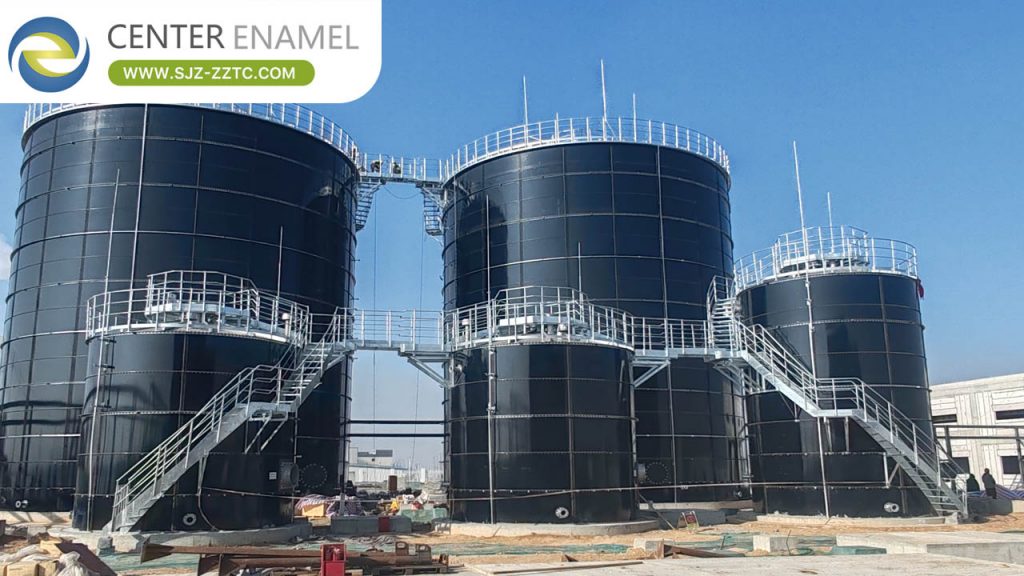
Pharmaceutical Wastewater Treatment in Jiangdong. A facility in Hangzhou using 6 granular-sludge anaerobic reactors (12.66 x 24 m) treating high-salinity mixed wastewater, achieving at least 70% COD removal - a delivered example of the granular anaerobic principle that keeps biomass retained and sludge yield low.
| Project | Pharmaceutical Wastewater Treatment in Jiangdong |
| Location | Xiaoshan District, Hangzhou, China |
| Industry | Pharmaceutical / Industrial |
| Application | Granular anaerobic - low sludge yield |
| Product | 6 granular sludge anaerobic reactors |
| COD removal | >= 70% |
| Status | Delivered 2019 |
About Shijiazhuang Zhengzhong Technology Co., Ltd (Center Enamel)
Shijiazhuang Zhengzhong Technology Co., Ltd (Center Enamel) contributes the engineering capability behind low-sludge anaerobic: the granular anaerobic reactor tanks are engineered with the internal hydraulics - inlet distribution, three-phase separation, and gas collection - that let the biomass stay retained at 35-38 C. That engineering is what turns a low yield coefficient into a low-disposal plant.
Comparison: Sludge per kg COD
| System | Sludge yield | Main product |
| UASB anaerobic | 0.05-0.10 kg VSS/kg COD | Methane |
| Aerobic | 0.3-0.6 kg VSS/kg COD | Biomass + CO2 |
UASB sludge is low because anaerobic biology converts most COD to methane and the granular bed retains the small remainder. Expect about 0.05-0.10 kg VSS per kg COD versus 0.3-0.6 aerobically. Send your COD load and we will engineer the GFS granular anaerobic reactor to retain the biomass.
Frequently Asked Questions (FAQ)
Q1: Why does UASB make little sludge?
A: Anaerobic biomass has a low net growth yield, so most COD becomes methane, not cells.
Q2: What is the UASB sludge yield?
A: About 0.05-0.10 kg VSS per kg COD removed.
Q3: How much does aerobic make?
A: Roughly 0.3-0.6 kg VSS per kg COD removed.
Q4: Why do granules matter?
A: They retain 20-40 g/L VSS inside the reactor, so biomass is not wasted or washed out.
Q5: What temperature does it need?
A: Mesophilic 35-38 C for stable granule activity.
Q6: What standards apply to the tanks?
A: GFS tanks follow ISO 28765 and AWWA D103; ISO 9001 quality system.
Suggested CTA
Send your COD load and stream type. We will engineer the GFS granular anaerobic reactor to retain the biomass and minimize sludge.