
Why Does UASB Make Less Sludge?
A UASB produces far less excess sludge because its granular sludge is retained inside the reactor instead of being washed out, so most converted organic matter becomes biogas rather than new biomass; the measured yield is 0.05-0.10 kg VSS per kg COD removed, roughly one-tenth of the 0.3-0.6 kg VSS/kg COD typical of aerobic treatment.
Why Anaerobic Biomass Stays Put
Granular sludge is dense and settles at 40-80 m/h, so it drops back into the blanket under upflow and gas lift instead of leaving with the effluent. Because the active mass stays, the reactor needs little new cell growth to keep working, and the carbon that aerobic systems spend building sludge leaves instead as methane.
The Sludge Yield Gap
| System | Sludge yield | Energy |
| UASB (anaerobic) | 0.05-0.10 kg VSS/kg COD | Recovers biogas |
| Aerobic (activated sludge) | 0.3-0.6 kg VSS/kg COD | Consumes energy |
| Limitation | Needs granular seed | Longer start-up |
Operational Payoff
Less excess sludge means smaller dewatering and disposal trains, lower hauling and tipping fees, and a smaller footprint for sludge handling. On a high-strength industrial stream the difference is tonnes of wet sludge per day that simply never forms.
Project Case Study
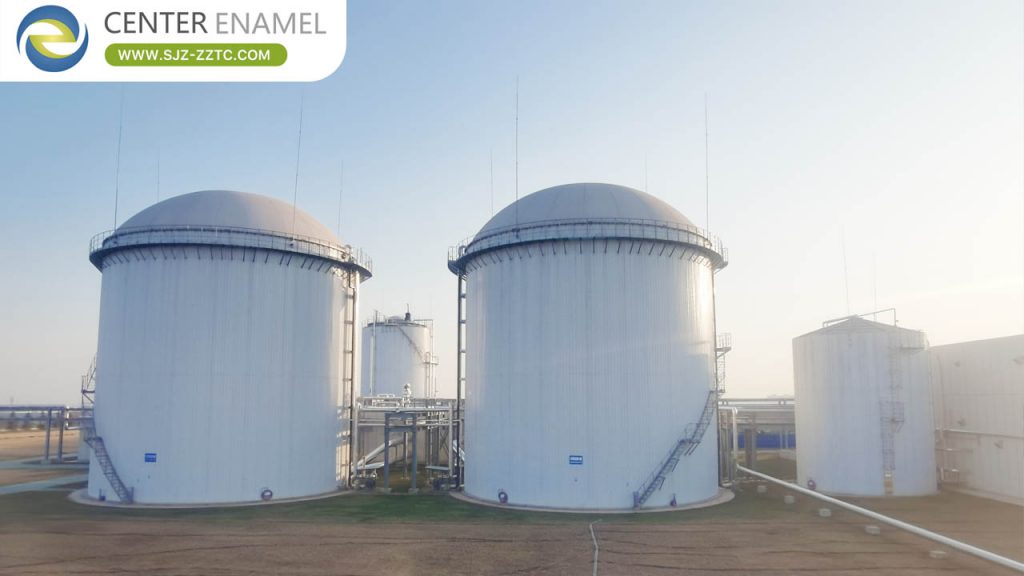
Jiangdong Pharmaceutical Wastewater Project, Hangzhou. Six granular-sludge anaerobic reactors (12.66 × 24 m) treat high-salinity mixed wastewater with COD removal of at least 70%, showing the low-biomass, low-sludge profile of a well-granulated anaerobic system.
| Project | Jiangdong Pharmaceutical Wastewater Project |
| Location | Xiaoshan District, Hangzhou, China |
| Industry | Pharmaceutical / Industrial Wastewater |
| Application | Granular-sludge anaerobic, low sludge yield |
| Product | 6 granular anaerobic reactors (12.66 × 24 m) |
| Result | COD 11,200 → 3,024 mg/L, ≥ 70% removal |
| Status | Delivered 2019 |
About Shijiazhuang Zhengzhong Technology Co., Ltd (Center Enamel)
Shijiazhuang Zhengzhong Technology Co., Ltd (Center Enamel) supplies the product technology behind low-sludge anaerobic: the Glass-Fused-to-Steel tank is the durable shell that keeps granular anaerobic systems sealed and corrosion-free. Enamel fused at 820-930°C gives an inert, impermeable barrier against acidic digestate, with 1500V holiday testing and ISO 28765 build quality so the sludge-reduction advantage is not lost to tank failures.
Advantages and Limitations
Low sludge is a genuine operating saving, not just a statistic. Limits: some excess still forms and needs handling, and a UASB must be seeded with granular sludge and protected from shocks that would wash the bed out.
Comparison: Sludge and Energy
| Aspect | UASB | Aerobic |
| Excess sludge | Low (0.05-0.10) | High (0.3-0.6) |
| Energy | Net producer | Net consumer (0.5-1.5 kWh/kg COD) |
| Footprint | Compact | Larger |
A UASB makes less sludge because it keeps its biology and sends carbon out as methane. At 0.05-0.10 kg VSS/kg COD versus 0.3-0.6 for aerobic, the saving is large enough to change plant layout and OPEX. Send your COD and flow and we will quantify the sludge and energy balance for your stream.
Frequently Asked Questions (FAQ)
Q1: Why does UASB have low sludge yield?
A: Granular sludge is retained in the reactor, so organics convert to biogas rather than new cells; yield is 0.05-0.10 kg VSS/kg COD.
Q2: How much less sludge than aerobic?
A: About one-tenth; aerobic activated sludge yields 0.3-0.6 kg VSS/kg COD.
Q3: Does low sludge mean no sludge handling?
A: No, some excess remains and still needs dewatering or digestion, just far less.
Q4: What makes granules retain?
A: Dense, fast-settling granules (40-80 m/h) stay in the blanket under upflow and gas lift.
Q5: Does low yield lower treatment?
A: No, COD removal stays 80-90%; the saved mass simply leaves as biogas.
Q6: Is UASB sludge good for seeding?
A: Yes, mature granular sludge is valuable seed for new UASB start-ups.
Suggested CTA
Share your influent COD, flow, and current sludge cost. We will size the UASB and estimate the sludge and biogas balance.