
Why Is Dry Biomass Poor for AD?
Dry biomass is poor for conventional wet anaerobic digestion because the anaerobic consortium lives in water — above roughly 15% total solids (TS) there is no continuous liquid phase to transport nutrients and metabolites, hydrolysis slows, and fibrous material forms floating scum mats that defeat mixing. A standard wet CSTR therefore runs at 8–12% TS; drier feed must move to a dry or solid-state system, not a liquid digester.
Anaerobic Microbes Need a Liquid Phase
Methanogens and acidogens are aquatic organisms. Below 10–15% TS they move freely, exchange enzymes, and keep pH near 7.0; above it, mass transfer collapses and localized acid accumulation inhibits the culture. The digester tank is, physically, a stirred aqueous reactor.
High Total Solids Slow Hydrolysis
Dry, lignocellulosic biomass hydrolyzes slowly because water access to cellulose is limited. Mesophilic wet digestion (35–38°C) already needs 15–30-day HRT; pushing TS higher lengthens it further and lowers volumetric gas productivity per tank volume.
Fiber Mats Choke Mixing
Straw and dry yard waste float and mat at the surface, forming an impermeable scum layer that traps biogas and shields feed from microbes. In a bolted GFS CSTR this means poor contact, dead zones, and unstable gas output — the central reason dry feed is a poor fit for wet tanks.
| Total solids | Suitable system | Mixing | Typical HRT |
| < 12% TS | Wet CSTR (liquid) | mechanical/easy | 15–30 days |
| 12–15% TS | Wet CSTR (edge) | hard | 20–30 days |
| 15–40% TS | Dry / solid-state AD | periodic | 20–60 days |
| > 40% TS | Composting / dry AD | turning | weeks |
Technical Considerations
For wet AD, keep feed at 8–12% TS, size particle length under 5 cm, and specify a digester (Glass-Fused-to-Steel) with reliable mixing and scum-breaking. Glass fused at 820–930°C gives the inert, H₂S-resistant barrier wet digesters need. If feed is intrinsically dry, design a dry AD or pre-dilute with process water or manure slurry.
How to Decide Wet vs Dry AD
Ask: is the feed naturally wet (manure, wastewater, food slurry)? Then wet CSTR. Is it dry straw or yard waste with no liquid? Then dry/solid-state AD or co-digestion with a wet substrate. Matching system to moisture avoids the mixing and hydrolysis failures that make dry biomass poor for AD.
Project Case Study
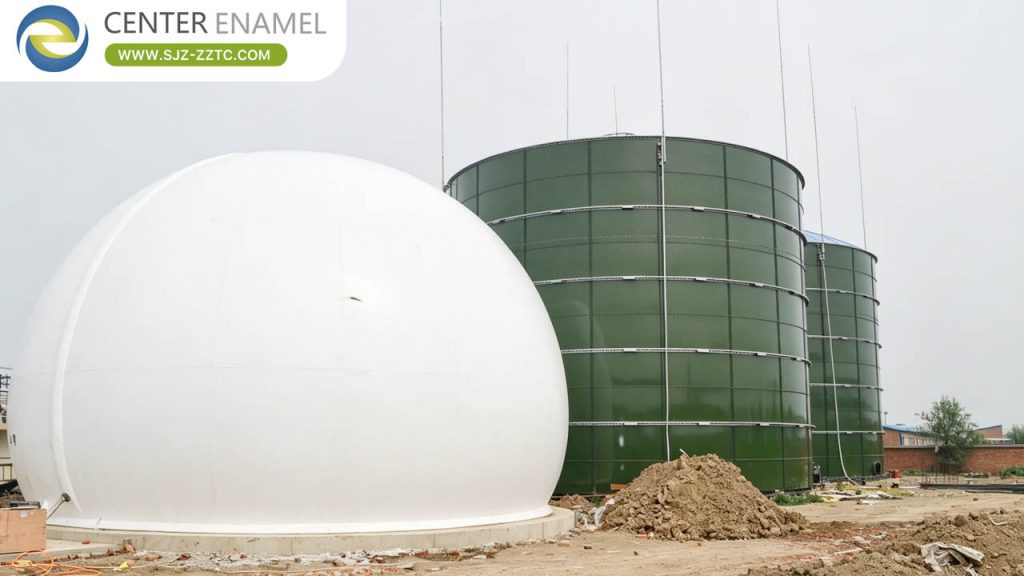
Inner Mongolia Wushenqi Cattle Farm. A CSTR biogas project running on cattle manure (a wet, pumpable substrate) with a dedicated insulation system for cold-climate operation, demonstrating that a liquid-medium GFS digester performs reliably when feed moisture is correct — the contrast to dry-biomass failure.
| Project | Inner Mongolia Wushenqi Cattle Farm |
| Location | Ordos City, Inner Mongolia, China |
| Industry | Agriculture / Cattle Farm |
| Application | Cattle manure biogas (wet CSTR) |
| Product | CSTR digester + insulation system |
| Material | Glass-Fused-to-Steel (GFS) |
| Key feature | Insulation for cold climate |
| Status | Delivered 2013 |
About Center Enamel
Center Enamel demonstrates its product technology in Glass-Fused-to-Steel tank systems built specifically for wet anaerobic digestion. The glass-to-steel enamel is fused at 820–930°C, producing a hard, inert, impermeable lining that resists the H₂S and acidic condensate of biogas liquors — the exact barrier a wet CSTR needs when feed must stay in the 8–12% TS liquid range.
Advantages and Limitations
Wet CSTR tanks give excellent mixing and high volumetric gas rates for liquid feed. Limitations: they cannot accept dry biomass directly, and fibrous feed needs sizing. Dry AD handles solids but at lower rate and more labor. Choose by feed moisture, not by convenience.
Comparison: Wet vs Dry AD
| Attribute | Wet CSTR (8–12% TS) | Dry / solid-state AD |
| Feed moisture | liquid | 15–40% TS |
| Mixing | continuous | periodic turning |
| Gas rate / volume | high | lower |
| Best feed | manure, slurry | straw, yard waste |
Dry biomass is poor for wet AD because microbes require a liquid phase, high TS slows hydrolysis, and fiber mats defeat mixing; a wet CSTR wants 8–12% TS. Keep feed liquid or move to dry AD — and specify an inert GFS digester lining for continuous wet duty.
Frequently Asked Questions (FAQ)
Q1: Why is dry biomass poor for AD?
A: Anaerobic microbes need liquid; above ~15% TS mass transfer and hydrolysis fail and fiber mats choke mixing in a wet tank.
Q2: What TS works for wet AD?
A: A wet CSTR runs best at 8–12% total solids; 12–15% is the practical edge.
Q3: Can dry biomass be digested at all?
A: Yes, in dry or solid-state AD at 15–40% TS, or by co-digesting with a wet substrate like manure.
Q4: What tank material suits wet AD?
A: Glass-Fused-to-Steel with enamel fused at 820–930°C resists H₂S and acidic biogas liquor.
Q5: How do you stop scum mats?
A: Keep TS low, size fiber under 5 cm, and use reliable mixing with scum-breaking in the CSTR.
Q6: What capacity is available?
A: Center Enamel supplies GFS digester tanks from 200 m³ to 60,000 m³ for wet AD.
Describe your feed moisture and total solids. We will recommend wet CSTR or dry AD, size the GFS digester lining for H₂S duty, and confirm capacity and delivery for your project.