
Why Is High-Strength Wastewater Good for Biogas?
High-strength wastewater is good for biogas because every cubic metre carries far more biodegradable organic matter, so each cubic metre yields far more methane. Anaerobic digestion converts roughly 0.30–0.45 m³ of biogas per kg of COD removed (about 60% methane) — so a 30,000 mg/L stream contains roughly 60 times the methane potential of a 500 mg/L one, turning a disposal liability into a dense, on-site energy source.
The COD-to-Methane Relationship
COD is, in effect, a measure of how much “food” is available to methanogenic bacteria. The stoichiometry is straightforward: about 0.35 m³ of methane is theoretically recoverable per kg of COD destroyed, and real plants achieve 0.30–0.45 m³ of biogas (mix of CH₄ and CO₂) per kg COD removed. Raise the inlet COD and you raise the biogas per cubic metre almost linearly — which is why concentrated streams are the most valuable feedstock.
Why It Becomes Energy-Positive
Anaerobic treatment needs almost no aeration energy, unlike aerobic which consumes 0.5–1.5 kWh/kg COD. The biogas it produces can run a combined heat and power (CHP) unit at 35–45% electrical efficiency (80–90% total), cover the plant’s own heat and power, and still export surplus. A high-strength stream therefore flips treatment from a net energy cost to a net energy gain — the economic heart of industrial biogas.
Comparative Data Table: Methane Potential by COD
| Inlet COD (mg/L) | Biogas per m³ (m³)* | Note |
| 500 (municipal) | ~0.15–0.20 | too dilute for economical AD |
| 5,000 | ~1.5–2.0 | marginal but workable |
| 20,000 | ~6–9 | strong biogas feed |
| 50,000 (POME) | ~15–22 | excellent energy density |
| * at 0.30–0.45 m³ biogas / kg COD removed |
Application and Operating Conditions
The best results come from warm (mesophilic 35–38°C), steady, biodegradable streams — exactly what dairies, breweries, and palm-oil mills produce. Holding temperature and feed rate stable protects the methanogenic culture and sustains high COD removal (typically 80–90%). A covered digester plus gas holder captures all the methane that would otherwise escape as a potent greenhouse gas.
Advantages and Limitations
The upside is obvious: dense energy, low operating energy, small sludge yield (0.05–0.10 kg VSS/kg COD), and avoided emissions. The limits are that very high COD often arrives with fat, salt, or ammonia that can inhibit the culture, and the effluent still needs polishing. High strength helps biogas, but it does not remove the need for good process design.
Best Practices / How to Capture the Value
Confirm biodegradability with a BMP test, then size the digester to the organic load (kg COD/day), not the flow. Capture all gas, use CHP for on-site power and heat, and route the digestate to land or further treatment. Keep the carbon-to-nitrogen ratio near 20–30:1 by co-digesting if the stream is too rich in one element.
Conclusion
High-strength wastewater is ideal for biogas because concentration equals methane density: more COD per cubic metre means more recoverable energy, and anaerobic digestion turns that load into a net power gain instead of an aeration bill.
Frequently Asked Questions (FAQ)
Q1: Why is high-strength wastewater good for biogas?
A: Because it packs more biodegradable COD per cubic metre, so each m³ yields more methane. At 0.30–0.45 m³ biogas per kg COD removed, a 30,000 mg/L stream has ~60× the potential of a 500 mg/L one.
Q2: How much methane comes from COD?
A: About 0.35 m³ methane per kg COD is theoretical; real plants see 0.30–0.45 m³ of biogas (mix of CH₄/CO₂, ~60% methane) per kg COD removed.
Q3: What makes it energy-positive?
A: Anaerobic treatment needs almost no aeration energy while producing biogas for CHP at 35–45% electrical efficiency, so the plant can power and heat itself and export the rest.
Q4: Which streams give the most biogas?
A: The most concentrated, steady, biodegradable ones — POME (~50,000 mg/L), manure, and dairy/brewery streams — deliver the highest methane density per cubic metre.
Q5: Can COD be too high?
A: Very high COD can bring fat, salt, or ammonia that inhibits the culture, and the effluent still needs polishing. Design and co-digestion manage those limits; the energy value remains.
Q6: Does it cut emissions too?
A: Yes. Capturing methane that would otherwise escape as a greenhouse gas, and displacing grid power with on-site biogas, is a double climate benefit on top of the energy saving.
Project Case Reference
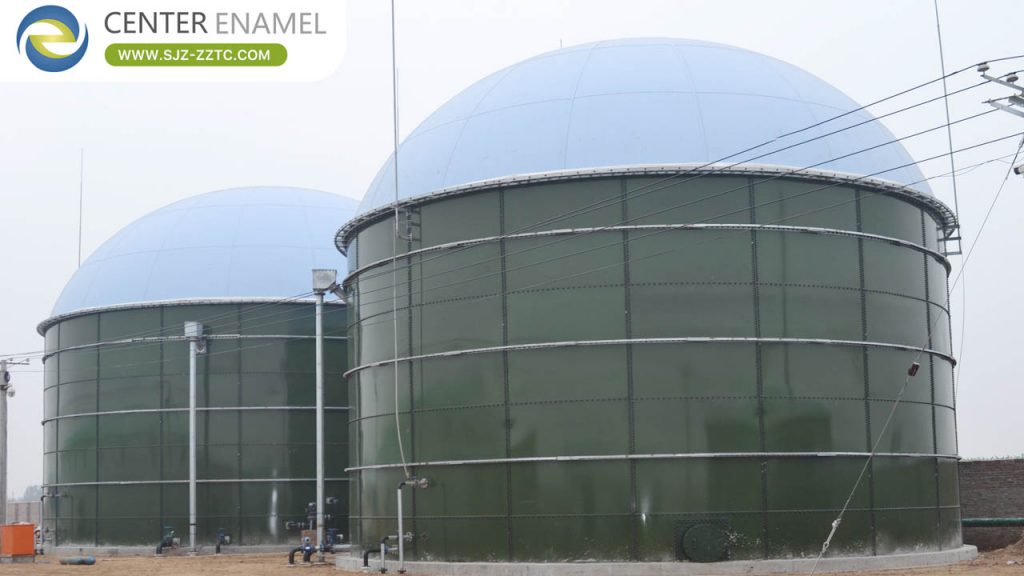
Malaysia Biogas Project — Malaysia · 2026
5 GFS Tanks · 27,000 m³ Total Volume · 22,000 m³ Biogas/Day
A large-scale biogas project in Malaysia featuring 5 Glass-Fused-to-Steel (GFS) tanks. The project achieves approximately 80% digestibility, with each single tank producing about 4,400 m³ of biogas daily, totaling 22,000 m³ per day across all 5 tanks.
Technical Specifications
Single Tank Volume: 5,400 m³ (Ø24.46 × 12 m)
Total Effective Volume: 27,000 m³ (5 tanks)
Daily Biogas Production: 22,000 m³ total
Digestibility: ≈ 80%
Gas Production Rate: 0.45 m³ / kg COD removed
Tank Type: Glass-Fused-to-Steel (GFS)
Water Quality Data
| Parameter | Inlet Water | Effluent |
| COD | ≥ 60,000 mg/L | ≥ 12,000 mg/L |
| BOD | ≤ 25,000 mg/L | ≤ 5,000 mg/L |