
Why Is Manure Good for Anaerobic Digestion?
Manure is a good anaerobic digestion feedstock because it is rich in biodegradable volatile solids that yield about 0.20-0.30 m3 of biogas per kg VS, it carries a near-ideal carbon-to-nitrogen ratio near 25:1, and its own alkalinity buffers pH during digestion, so the biology stays stable without heavy chemical dosing. Manure is, in effect, a pre-mixed feed that already contains the microbes and the nutrients the digester needs.
1. Volatile Solids Are the Fuel
The part of manure that makes biogas is the volatile solids (VS), the organic, degradable fraction. Cattle and pig manure typically yield 0.20-0.30 m3 per kg VS at 55-65% methane. The higher the VS and the better the C:N, the more gas per tonne. That is why manure from dairy and beef cattle, with moderate VS and good nutrient balance, is a workhorse feedstock.
2. C:N and Buffering
| Property | Manure value | Why it helps |
| Volatile solids | High, degradable | Fuel for biogas |
| C:N ratio | Near 25:1 | In the productive band |
| Alkalinity | Native | Buffers pH at 35-38 C |
| Microbes | Present | Seeds the digester |
3. Limits to Respect
Manure is good, not unlimited. Too much bedding dilutes VS, sand adds inert mass that must be managed, and high ammonia from some streams can inhibit methanogens if the C:N drifts. The practical envelope is 8-12% total solids for a CSTR/USR at 35-38 C with a 20-40 day retention, and co-digestion tightens the C:N when single-stream manure is off-band.
Project Case Study
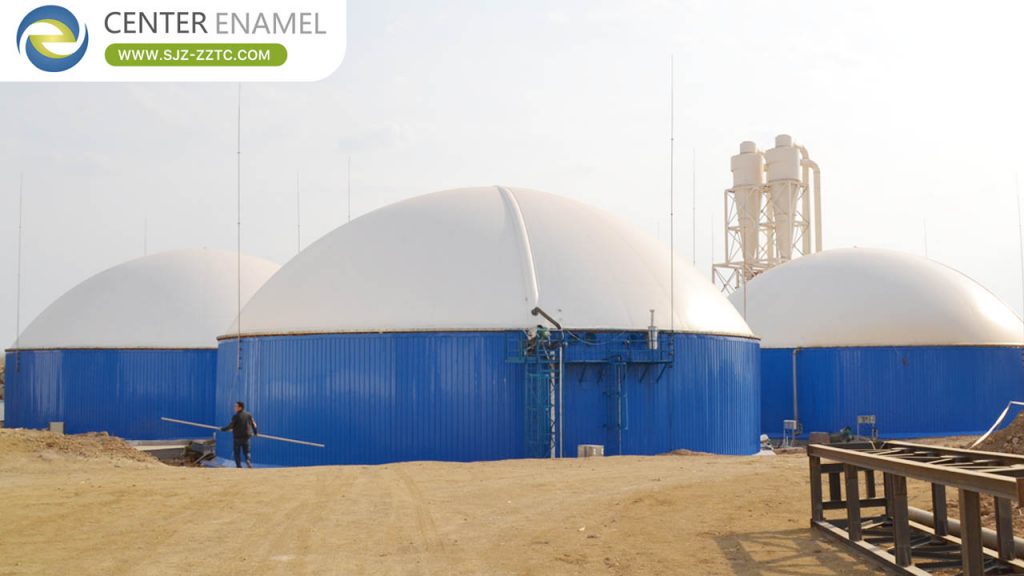
Inner Mongolia Cattle Farm Biogas Project (Wushenqi). A cattle-manure biogas plant in Ordos using a CSTR with an insulation system, with cattle manure as the feedstock - a delivered example of manure used directly as the digester feedstock in a cold climate.
| Project | Inner Mongolia Cattle Farm Biogas Project |
| Location | Ordos City, Inner Mongolia, China |
| Industry | Livestock / Cattle Farm |
| Application | Manure as AD feedstock - CSTR |
| Product | CSTR reactor with insulation system |
| Feedstock | Cattle manure |
| Status | Delivered 2013 |
About Shijiazhuang Zhengzhong Technology Co., Ltd (Center Enamel)
Shijiazhuang Zhengzhong Technology Co., Ltd (Center Enamel) delivers the manufacturing capability behind the digester: bolted GFS tanks are fused at 820-930 C to form an inert, impermeable barrier against corrosive, H2S-bearing digestate, built to ISO 28765 and AWWA D103, shipped flat-pack, and assembled on site - the durable shell that turns manure into steady biogas.
Comparison: Manure vs Other Feedstocks
| Feedstock | Biogas per kg VS | C:N |
| Cattle manure | 0.20-0.30 m3 | Near 25:1 |
| Food waste | 0.35-0.60 m3 | Lower (N-rich) |
| Crop residues | 0.30-0.45 m3 | Higher (C-rich) |
Manure suits AD because its volatile solids, near-25:1 C:N, and native buffering make a stable, productive feed. Keep TS at 8-12% and retention 20-40 days at 35-38 C. Send your manure type and volume and we will size the GFS digester for your farm.
Frequently Asked Questions (FAQ)
Q1: Why is manure good for AD?
A: High degradable VS, near-ideal C:N near 25:1, and native pH buffering make a stable feed.
Q2: How much biogas does manure yield?
A: About 0.20-0.30 m3 per kg VS at 55-65% methane for cattle manure.
Q3: What is manure C:N?
A: Typically near 25:1, inside the productive 20-30:1 band.
Q4: What are the limits?
A: Bedding dilutes VS, sand adds inert mass, and high ammonia can inhibit if C:N drifts.
Q5: What retention applies?
A: About 20-40 days at mesophilic 35-38 C for manure.
Q6: What tank capacity is available?
A: GFS digester tanks from 200 m3 to 60,000 m3.
Suggested CTA
Send your manure type and daily volume. We will size the GFS digester and confirm the feed envelope for your farm.