
Why Is UASB Efficient for High-Strength Wastewater?
UASB is efficient for high-strength wastewater because it turns a problem into a resource with almost no energy input: no mechanical mixing, high organic loading of 5–15 kg COD/m³·day, very low sludge production (about 0.05–0.10 kg VSS per kg COD removed), a small footprint, and full biogas energy recovery. For streams above roughly 1,500–2,000 mg/L COD, it removes 80–90% of the load while producing methane instead of consuming power.
The Energy and Sludge Advantage
Compared with aerobic activated sludge, the difference is stark. Aerobic treatment blows air into the water and consumes 0.5–1.5 kWh per kg COD removed; UASB is anaerobic, so it needs no aeration energy and instead yields 0.30–0.45 m³ of biogas per kg COD removed. Sludge production is roughly one-tenth of the aerobic route, so dewatering, hauling, and disposal costs collapse. For a food or brewery plant, that biogas often covers a large share of site heat or power.
Comparative Data Table: UASB vs Activated Sludge (High-Strength)
| Metric | UASB (anaerobic) | Activated sludge (aerobic) |
| Energy balance | net energy producer | net energy consumer |
| Aeration energy | none | 0.5–1.5 kWh/kg COD |
| Sludge yield | 0.05–0.10 kg VSS/kg COD | 0.3–0.6 kg VSS/kg COD |
| COD removal | 80–90% | 85–95% |
| Footprint | small | large (clarifiers, blowers) |
| Best feed COD | > 1,500–2,000 mg/L | any, but costly if high |
Where the Efficiency Comes From, and Its Limits
Five features stack up: no mixing pumps, high biomass concentration in the granular bed, short hydraulic retention, minimal sludge handling, and on-site energy recovery. The limits are real, though. UASB needs warm feed (around 25–38 °C) and low suspended solids, because inert solids dilute the blanket and fine particles wash out. Very low-strength or cold wastewater gives little gas and poor economics, and toxic or variable feeds can stall granulation. In those cases a hybrid or aerobic stage is added downstream.
Frequently Asked Questions (FAQ)
Q1: Why is UASB efficient for high-strength wastewater?
A: It needs no aeration energy, loads 5–15 kg COD/m³·day, produces only 0.05–0.10 kg VSS per kg COD of sludge, occupies a small footprint, and recovers energy as biogas—removing 80–90% of COD while making methane.
Q2: Does UASB actually save energy?
A: Yes. Aerobic treatment consumes 0.5–1.5 kWh per kg COD in blowers; UASB consumes almost none and instead yields 0.30–0.45 m³ biogas per kg COD removed, often covering much of a plant’s heat or power.
Q3: How much sludge does UASB produce?
A: About 0.05–0.10 kg VSS per kg COD removed—roughly one-tenth of the aerobic route—so sludge dewatering, hauling, and disposal costs are dramatically lower.
Q4: When is UASB not suitable?
A: For low-strength (<1,500 mg/L COD), cold, or high-suspended-solids, toxic, or highly variable feeds, where granulation stalls or gas yield is too low to justify the reactor. Hybrids or aerobic polishing are then added.
Project Case Reference
Malaysia Biogas Project — Malaysia · 2026
5 GFS Tanks · 27,000 m³ Total Volume · 22,000 m³ Biogas/Day
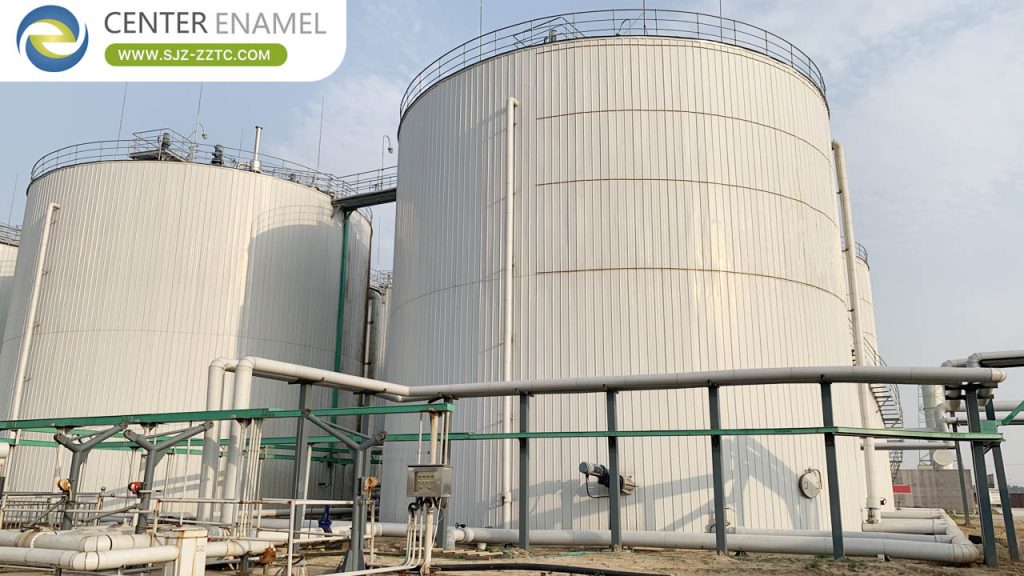
A large-scale biogas project in Malaysia featuring 5 Glass-Fused-to-Steel (GFS) tanks. The project achieves approximately 80% digestibility, with each single tank producing about 4,400 m³ of biogas daily, totaling 22,000 m³ per day across all 5 tanks.
Technical Specifications
Single Tank Volume: 5,400 m³ (Ø24.46 × 12 m)
Total Effective Volume: 27,000 m³ (5 tanks)
Daily Biogas Production: 22,000 m³ total
Digestibility: ≈ 80%
Gas Production Rate: 0.45 m³ / kg COD removed
Tank Type: Glass-Fused-to-Steel (GFS)
Water Quality Data
| Parameter | Inlet Water | Effluent |
| COD | ≥ 60,000 mg/L | ≥ 12,000 mg/L |
| BOD | ≤ 25,000 mg/L | ≤ 5,000 mg/L |