
Struggling with livestock manure? Why not choose an EPC Contractor for CBG Plant with GFS Tanks?
This article examines global livestock manure management trends, bolted GFS tank construction advantages, UASB process fundamentals, livestock wastewater characteristics, and a landmark Indonesian palm oil biogas project. It highlights how a professional EPC Contractor for CBG Plant integrates these technologies to deliver sustainable waste-to-energy solutions. With over 30,000 projects across 100+ countries, the discussion emphasizes the modularity, corrosion resistance, and cost-effectiveness of GFS tanks paired with the high-efficiency UASB Process for medium-to-high concentration organic wastewater. The content also showcases Center Enamel's R&D capabilities and proprietary material innovations that ensure long-term performance in challenging environments like POME and livestock manure treatment.
Regional Development Status of Livestock Manure
Global livestock inventories such as swine remain stable. The US has developed technical models represented by integrated crop-livestock systems with on-field application and Comprehensive Nutrient Management Plans; Denmark, the Netherlands, and others have developed centralized biogas projects with digestate application systems. China's large-scale farms still have considerable room for improvement in supporting biogas project coverage, and digestate resource utilization rates lag behind advanced European levels. Greenhouse gas emissions from livestock account for a significant proportion of total global anthropogenic emissions, making manure management a critical battleground for agricultural carbon reduction. Latin American countries started later in manure management but are accelerating relevant infrastructure development.
These regional disparities create growing demand for standardized, scalable treatment infrastructure. As an EPC Contractor for CBG Plant, Center Enamel bridges the technology gap by delivering integrated solutions that combine robust GFS tanks with proven biological processes to meet diverse regulatory and operational requirements worldwide.
GFS tanks Bolted Assembly Construction
GFS tanks are assembled on-site from prefabricated panels, with short construction periods and support for expansion, relocation, and reuse-advantages distinctly different from immovable concrete tanks. Concrete tank pouring requires formwork, rebar tying, pouring, and long curing periods, with a single tank construction taking months. Rain, snow, and low temperatures force work stoppages and delays. Once poured, they are permanent fixed structures that cannot be dismantled, expanded, or relocated-project relocation means complete abandonment.
GFS tank panels are all factory-prefabricated, transported to site, and directly assembled in panels with simple procedures. Construction can proceed even in low-temperature, light-rain conditions, with installation time only one-third that of concrete tanks-construction schedules are controllable. For expansion, additional steel panels can be installed to increase volume; for plant relocation, tanks can be fully disassembled with panels transported to new sites for reassembly and reuse, significantly reducing material and construction costs for new construction and reconstruction. This is ideally suited for short-term environmental projects, phased expansion projects, and relocated construction projects.
For any EPC Contractor for CBG Plant, this modularity translates into predictable project timelines and future flexibility. When these GFS tanks are specified as core components, clients gain the confidence that their investment remains adaptable to changing production scales or site conditions.
What Is a UASB Process?
UASB, or Upflow Anaerobic Sludge Blanket Reactor, is the benchmark mainstream technology for medium-to-high concentration soluble organic wastewater treatment. It requires no mechanical mixing or media carriers, relying on the upward flow of wastewater to suspend and expand granular sludge within the reactor, forming a stable sludge bed layer. Highly active anaerobic granular sludge efficiently degrades pollutants, with excellent settleability and high microbial concentration. UASB innovatively integrates reaction, sedimentation, and gas-liquid-solid separation functions, simplifying the anaerobic treatment process with advantages of high efficiency, energy savings, and compactness. It is widely used in various medium-to-high concentration soluble organic wastewater treatment applications.
The UASB Process is particularly valuable when integrated into a complete CBG plant design. As a seasoned EPC Contractor for CBG Plant, Center Enamel often pairs UASB pretreatment with GFS tanks for digestate storage, creating a synergistic system that maximizes biogas recovery while minimizing footprint and operational complexity.
Livestock Wastewater Sources Analysis
Livestock wastewater is the core agricultural pollution wastewater from large-scale poultry, livestock, and aquaculture operations, generated primarily during farming operations and facility cleaning. Poultry and livestock wastewater is the main component, including wash water from pig, cattle, and poultry housing, manure and urine seepage, and facility washdown-rich in livestock metabolic residues. Aquaculture wastewater comes from periodic pond water exchange and pond cleaning, with feed residues and metabolic waste as pollutants. Wastewater is primarily generated in peri-urban and rural farming areas. Small-scale farmers lack adequate collection facilities, with wastewater discharged directly to land and water. Large-scale farms have collection systems for centralized treatment, with water production varying with production cycles and cleaning frequency.
Understanding these source characteristics is essential for any EPC Contractor for CBG Plant designing tailored solutions. The combination of GFS tanks for collection and equalization, followed by the UASB Process for primary digestion, effectively addresses the high organic loads and seasonal variability typical of livestock operations.
Indonesia Palm Oil Biogas Project
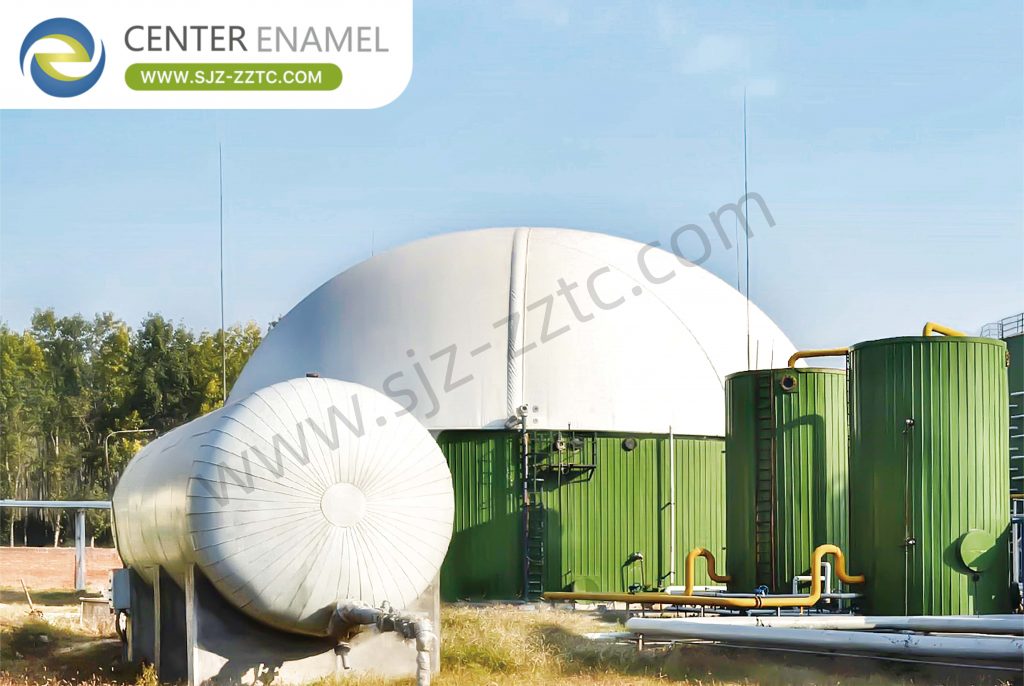
Specifically designed for high-concentration palm oil wastewater treatment with 3 GFS fermentation tanks, each 19.86 m diameter × 8.4 m height. Installation began November 2009 with only 7 construction personnel, completing all tank assembly in 40 days-highly efficient and time-saving. Tanks are fitted with dual-membrane gas storage covers for POME anaerobic digestion-degrading organics and recovering biogas energy while eliminating palm industry pollution. This is an early benchmark POME biogas treatment project in Southeast Asia.
This Indonesian case exemplifies how a competent EPC Contractor for CBG Plant can execute complex projects in challenging tropical environments. The rapid deployment of GFS tanks and successful application of the UASB Process for POME treatment demonstrate the replicable model that Center Enamel continues to refine across global biogas projects.
Center Enamel R&D Team
Center Enamel has built a full-chain professional team covering R&D, design, marketing, installation, and after-sales. The R&D team is led by national-level materials technology experts, specializing in enamel frit and tank anti-corrosion core technologies. External senior environmental engineering and mechanical structure engineers are retained to strengthen R&D capabilities, focusing on anti-corrosion coating formulations, specialty corrosion-resistant tanks, and anaerobic supporting integrated equipment-continuously breaking through industry technological barriers.
The team operates through proprietary laboratories with external university research collaboration-conducting year-round new material and new process durability pilot testing and long-term corrosion simulation testing. Specialized enamel formulations are iteratively developed for extreme conditions such as high-salinity wastewater, strong acid/alkali POME, and high-organic livestock manure-providing core technical support for the company's annual new invention and utility patents-building a proprietary material technology barrier.
This dedicated R&D capability directly benefits clients seeking a reliable EPC Contractor for CBG Plant. Innovations in GFS tanks coatings extend service life beyond 30 years, while process improvements enhance UASB Process efficiency-ensuring that every project incorporates the latest advancements in materials and biological treatment.
Center Enamel Innovative Material Technology
Center Enamel has independently developed over 200 anti-corrosion enamel formulations, with proprietary double-sided double-layer enameling technology-GFS tank anti-corrosion service life exceeds 30 years-far surpassing concrete and ordinary equipment-suitable for global high-corrosion wastewater and biogas fermentation conditions.
Such material leadership is what distinguishes a top-tier EPC Contractor for CBG Plant. When combined with GFS tanks and the UASB Process, these corrosion-resistant solutions deliver unmatched durability and performance-making Center Enamel the partner of choice for livestock, palm oil, and industrial wastewater projects across all continents.
FAQ
Q1: Why choose an EPC Contractor for CBG Plant instead of separate vendors?
An integrated EPC contractor manages design, procurement, construction, and commissioning as a single responsibility. This reduces coordination risks, shortens project timelines, and ensures that GFS tanks, the UASB Process, and auxiliary systems work seamlessly together-delivering guaranteed performance and cost certainty.
Q2: How do GFS tanks improve biogas project economics compared to concrete tanks?
GFS tanks are factory-prefabricated and bolted on-site in one-third the time of concrete tanks. They support future expansion and full relocation, avoiding the permanent-structure drawback. Their 30+ year corrosion resistance minimizes maintenance, while modular assembly reduces labor and weather-related delays-lowering both capital and operating costs.
Q3: What types of wastewater are best suited for the UASB Process in CBG plants?
The UASB Process excels with soluble medium-to-high concentration organic wastewater, including livestock manure washwater, palm oil mill effluent (POME), and food/beverage processing streams. It is not suitable for high-solids or viscous wastes. When paired with GFS tanks for equalization and digestate storage, it forms a robust, low-cost treatment train for biogas recovery.