
Pairing the A²O Process with GFS Tanks for Durable Municipal Wastewater Treatment
Municipal wastewater treatment is under structural strain from three directions at once. Collection networks remain incomplete, with combined sewer separation proving slow and expensive. Low-carbon operation targets collide with the reality that treatment is an energy-intensive business-utilities must cut carbon and pursue energy self-sufficiency while still meeting discharge limits. And emerging contaminant removal has not yet reached cost-effective scale, leaving upgrade costs enormous. Energy price volatility adds further pressure, compounded by market-oriented reforms that squeeze utility margins.
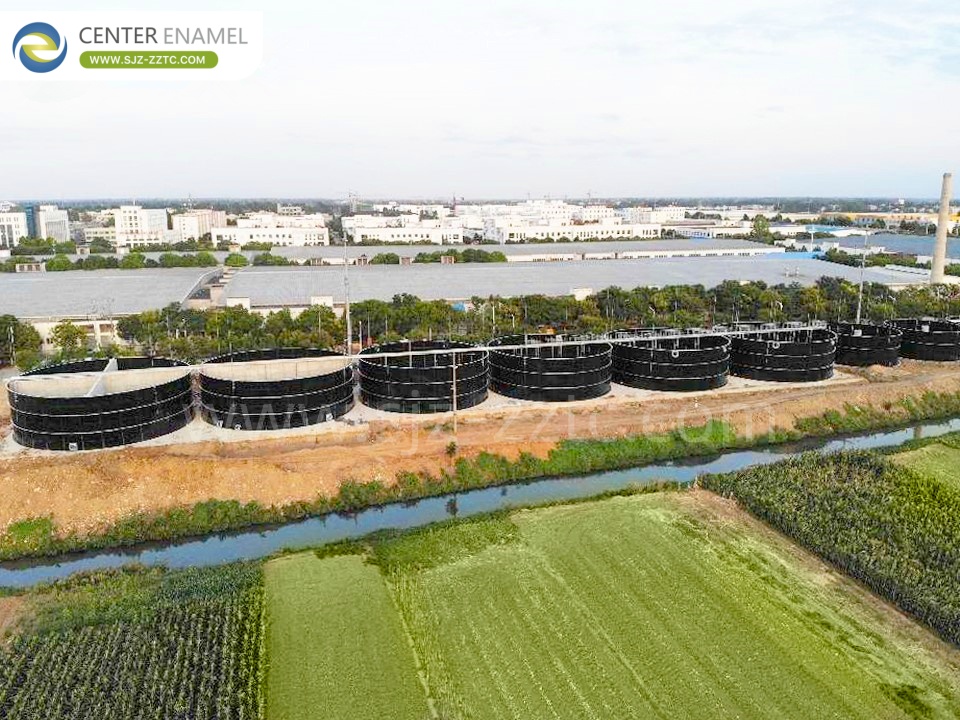
Against this backdrop, technology selection becomes a long-term financial decision. The biological process must deliver reliable nitrogen and phosphorus removal with minimal operational complexity, and the containment system must survive decades of immersion without demanding frequent repair. That combination-the A²O Process housed in GFS Tanks-addresses both halves of the problem.
Why Concrete Fails Municipal Service
Concrete tank interiors are inherently porous. Wastewater and acid/alkaline media penetrate the matrix and attack the structural layer from within, producing internal wall spalling, seepage, and rebar corrosion. These failures are difficult to repair and cannot be fundamentally resolved. In aggressive municipal service, concrete tanks typically develop extensive corrosion and leakage within five to eight years.
Center Enamel's GFS Tanks solve this at the material level. Steel panels are enameled on both interior and exterior surfaces at high temperature, producing a dense, non-porous glass finish that blocks corrosive liquids and biogas permeation. The enamel layer offers strong chemical stability against acids, alkalis, salts, and microbial corrosion. Anti-corrosion service life exceeds 30 years with no need for frequent internal lining repairs-eliminating the recurring maintenance investment and the environmental risk of leakage contaminating soil and groundwater. Compared with concrete and FRP alternatives, the coating carries no risk of peeling or blistering, and adapts to highly corrosive conditions including palm oil mill effluent, livestock manure, and chemical high-salinity wastewater.
| Parameter | GFS Tanks | Concrete Tanks |
| Corrosion Service Life | 30+ years | 5–8 years before major repair |
| Lining Maintenance | None required | Frequent relining |
| Leakage Risk | Sealed glass barrier | Pores and cracks propagate |
| Adaptation | Highly corrosive media | Limited |
Inside the A²O Process: Simple, Mature, Effective
The A²O Process-anaerobic, anoxic, and oxic zones in series-is the core biological train for municipal domestic wastewater. It suits large-scale plants in cities, counties, and townships treating low-concentration, high-flow combined sewage. Where simultaneous nitrogen and phosphorus removal is required to combat eutrophication, A²O is the established choice. It also fits residential communities, schools, and industrial park domestic streams, as well as light industrial combined and domestic-industrial mixed wastewater. It serves as the core process for river intercepting sewage and plant upgrades. It is not intended for high-concentration, high-solids industrial wastewater-its focus is municipal purification and aquatic ecosystem restoration.
Mechanically, the train is straightforward. Anaerobic and anoxic tanks use submersible mixers to prevent sludge settling and maintain oxygen-free conditions. Oxic tanks use fine-bubble diffusers and blowers for continuous aeration. Internal nitrate recycle and sludge return pumps sustain bacterial circulation, while online DO, pH, and ammonia monitors control each zone precisely. Screens, equalization tanks, and secondary clarifiers complete pretreatment and sludge-water separation. Every component is mature and broadly applicable.
Low O&M Cost: The Scale Advantage
Municipal wastewater ranks among the most economical of the five major wastewater types, and the A²O Process reinforces that advantage. The flow is concise and mature-no complex pretreatment or advanced treatment steps are required. Only small quantities of flocculants and disinfectants are needed, keeping chemical costs very low. Operating conditions are stable with low failure rates, so routine maintenance suffices for long-term operation. Repair and replacement costs stay low, and no high-end specialized O&M personnel are required. Gentle water quality fluctuations mean no frequent process parameter adjustments, reducing labor demands. Economies of scale lower unit treatment costs, and sludge and biogas recovery offset operating expenses.
| O&M Factor | Municipal Wastewater Profile |
| Chemical Cost | Very low-small flocculant/disinfectant doses |
| Process Complexity | Concise, mature, no advanced steps |
| Failure Rate | Low; routine maintenance sufficient |
| Labor Requirement | Low; no specialized specialists needed |
| Resource Recovery | Sludge and biogas offset costs |
Delivering Municipal Projects Anywhere
A sound process design only matters if it can be built and commissioned on schedule. Center Enamel pioneered Chinese GFS equipment exports and now covers installation service in over 100 countries and regions, with full delivery capability across climates, regulations, and geographies. Coverage spans Southeast Asia-Vietnam, Thailand, Malaysia, Indonesia, Cambodia, Bangladesh, Nepal-Africa-Ghana, South Africa, Mali, Guinea, Zambia, Kenya, Pakistan-Europe and the Americas including Sweden, the USA, and Russia, plus the Middle East and Latin America. The teams adapt to tropical rainy high-salt spray, high-altitude mountainous terrain, Nordic severe cold, and high-standard European and American facility conditions.
The delivery model combines own cross-border construction teams with overseas local agent coordination. Whether a client sits in a developed market or a remote developing region, the service scope covers on-site survey, on-site installation, process commissioning, and operator training. This complete coverage extends across biogas engineering, municipal wastewater, industrial wastewater, livestock manure, and drinking water storage-full capability to undertake large-scale tank farm projects in any country.
Modular GFS Tanks assembly shortens construction periods and allows dismantling and reuse, which suits overseas short-term projects, phased expansions, and relocation needs. Full-lifecycle after-sales O&M support protects long-term stable client operations.
| Service Dimension | Capability |
| Installation Coverage | 100+ countries and regions |
| Delivery Model | Own construction teams + local agents |
| Service Scope | Survey, installation, commissioning, training |
| Project Types | Biogas, municipal, industrial, livestock, drinking water |
Roofing for Atmospheric Storage
Not every tank on a municipal site requires gas-tight containment. For drinking water storage, agricultural irrigation, firewater reserve, and general production wastewater temporary storage, the FRP Roof Cover offers an economical solution. Available in flat and dome styles, the integrally molded resin-and-fiberglass roof is lightweight, naturally water-resistant, and mildly resistant to acid and alkali corrosion. It will not rust or rot in humid environments, eliminating the frequent anti-corrosion maintenance metal roofs demand.
The dome style drains effectively against water accumulation, dust buildup, snow load, and strong winds. The flat style simplifies walkway, level gauge, and vent installation. The product is fully insulated with no galvanic corrosion risk and will not contaminate drinking water quality. Modular components keep individual weights low, allowing simple on-site hoisting and assembly at affordable cost. It is suitable only for atmospheric pressure tanks without biogas collection or pressurization, and is not recommended for anaerobic gas-producing conditions.
FAQ
Q: When is the A²O Process the right choice?
A: A²O suits municipal and domestic wastewater needing simultaneous nitrogen and phosphorus removal-city, county, and township plants, community systems, and river intercepting projects. It is not designed for high-concentration, high-solids industrial streams.
Q: How do GFS Tanks reduce municipal maintenance costs?
A: The fused glass barrier resists H₂S, acids, and salts, eliminating the relining concrete tanks need within 5–8 years. With a 30-year service life and no peeling risk, GFS Tanks cut long-term anti-corrosion spending and leakage risk.
Q: Can Center Enamel deliver and commission projects overseas?
A: Yes. Own construction teams plus local agents cover 100+ countries, providing survey, installation, commissioning, and operator training across tropical, mountainous, cold, and high-standard regulatory environments.
Share your design flow, influent quality, and discharge targets with our engineers for a tailored A²O and tank configuration review. Discover how Center Enamel's A²O Process and GFS Tanks can deliver compliant, low-maintenance municipal treatment for your next project.