
Dry Straw to Biogas in Vietnam: Durable GFS Tanks and Double Membrane Roof Biogas Solutions
Vietnam, one of the world's leading rice producers and exporters, generates approximately 43-47 million tonnes of rice straw annually from its vast paddy fields . The Mekong River Delta, the country's rice bowl, alone produces over 24 million tonnes of rice straw each year . While this biomass represents an enormous renewable resource, it presents a significant environmental and logistical crisis for farmers and communities.
The challenge is particularly acute in the Mekong Delta, where approximately 54% of farmers still practice open-field burning of rice straw . Each tonne of rice straw burned releases more than 1.5 tonnes of CO₂ equivalent, along with particulate matter and other pollutants that contribute to seasonal smog and severe respiratory health issues . Research conducted in the Red River Delta region, including Hanoi, estimated that straw combustion during a single crop season released approximately 542,077 tonnes of CO₂ and 42,832 tonnes of CO . Beyond air pollution, burning depletes valuable nutrients: each tonne of rice straw contains approximately 400 kg of carbon, along with nitrogen, phosphorus, potassium, and sulfur that could otherwise enrich the soil . Smallholder farms, which make up 79.5% of Vietnam's 8.5 million rice-farming households with less than 2.0 hectares each, face particular challenges in managing this waste efficiently .
How Dry Straw is Converted into Biogas
The transformation of dry straw into clean, renewable energy occurs through a natural biological process known as anaerobic digestion. This process harnesses nature's recycling system, where complex organic materials are broken down by microorganisms in an oxygen-free environment.
The journey from dry straw to biogas proceeds through four key stages: hydrolysis, acidogenesis, acetogenesis, and methanogenesis. During hydrolysis, the complex cellulose and hemicellulose structures in dry straw are broken down into simpler sugars. These are then converted into volatile fatty acids, which are ultimately consumed by methanogenic archaea to produce biogas—a methane-rich gas that can be captured and utilized for electricity generation, heating, or as a vehicle fuel. The residual material, called digestate, emerges as a nutrient-rich byproduct that serves as an excellent organic fertilizer, completing the cycle of sustainability .
The Core Technology: The CSTR Process
To efficiently convert dry straw and other agricultural waste into biogas, robust and reliable technology is essential. The Continuous Stirred-Tank Reactor (CSTR) stands as the core processing unit designed for this purpose. The CSTR is an advanced anaerobic treatment technology where fermentation materials and microorganisms are maintained in a completely mixed state inside a sealed tank, operating at a constant, optimal temperature .
This continuous mixing, typically achieved through a mechanical stirring device, ensures that the solids from dry straw and other feedstocks remain suspended in constant contact with the microbial population. This design is crucial for preventing the formation of floating scum layers or the settling of heavy solids, both of which can significantly reduce biogas output. By maintaining a homogeneous environment, the CSTR process effectively degrades organic matter and produces a stable, high yield of biogas . This technology is particularly well-suited for Vietnam's tropical climate, which supports stable year-round microbial activity.
Center Enamel: Your Trusted EPC Contractor for Biogas Solutions
With over 36 years of experience, Center Enamel has established itself as a global leader in the water, wastewater, and biogas industries. As a full-service EPC Contractor, Center Enamel goes far beyond equipment supply, providing comprehensive, customized Biogas Solutions for projects across the globe. The company has been committed to delivering high-quality engineering and construction services, culminating in successful project completions in over 100 countries.
Their expertise encompasses the entire project lifecycle, from initial design and manufacturing to installation, commissioning, and after-sales support. Center Enamel owns Asia's largest GFS Tanks production base and holds over 200 enamel patents, ensuring independent supply of all core biogas equipment. With extensive experience in Southeast Asia, the company understands Vietnam's rural terrain, environmental regulations, and construction nuances, making them an ideal partner for Vietnamese Biogas Projects. Center Enamel is well-positioned to support Vietnam's ambitious "Sustainable Development of One Million Hectares of High-Quality, Low-Emission Rice Farming" project, which aims to collect about 70% of rice straw for other purposes and reduce GHG emissions by over 10% compared to traditional cultivation .
Durable Storage: GFS Tanks and the Double Membrane Roof
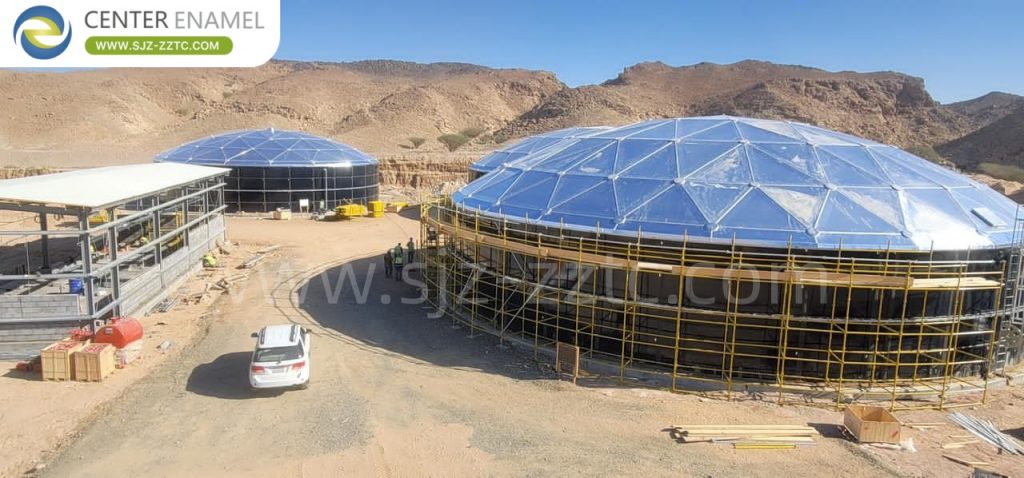
At the heart of any successful Biogas Project lie the storage and digestion vessels. Center Enamel's GFS Tanks (Glass-Fused-to-Steel) are the gold standard for biogas applications. These tanks are manufactured using advanced technology where glass is fused to steel at over 820°C, creating an inert, durable, and corrosion-resistant surface. This makes them ideal for the demanding, acidic environment of anaerobic digestion and well-suited for Vietnam's humid, tropical climate.
Complementing the tank body is the innovative Double Membrane Roof. This roof system is a perfect choice for a Biogas Project because it offers both cost-effectiveness and space efficiency. By integrating the gas holder directly on top of the digester, it eliminates the need for a separate, ground-mounted gas holder, saving valuable land area and reducing foundation costs. The inner membrane of the roof rises and falls in proportion to the biogas produced, providing a reliable and airtight seal that optimizes gas collection and storage—critical for maximizing energy recovery from Vietnam's agricultural waste.
Diverse Tank Cover Solutions for Every Need
While the Double Membrane Roof is often the preferred choice for biogas applications, Center Enamel offers a range of other high-quality roof solutions to meet different project requirements:
Aluminum Geodesic Dome Roof: Offers superior corrosion resistance and minimal maintenance, ideal for projects in coastal or high-humidity regions of Vietnam.
Glass-Fused-to-Steel Roof: Provides excellent corrosion resistance for harsh chemical environments and pressurized structures.
Aluminum Alloy Trough Deck Roof: A cost-effective solution for potable water and wastewater storage applications.
Stainless Steel Roof: Delivers super anti-corrosion performance and long service life, suitable for challenging environments.
FRP Roof: Lightweight and cost-effective for applications where airtightness is not a primary concern.
Comprehensive Supporting Equipment for a Complete System
A fully functional biogas plant requires more than just a digester and roof. Center Enamel provides a complete suite of biogas project equipment to ensure seamless operation:
Dehydration and Desulfurization Tanks: Essential for removing moisture and corrosive hydrogen sulfide gas from the biogas produced in the digester and stored under the Double Membrane Roof.
Torch System: Provides a safe means to burn off excess biogas during maintenance or emergencies.
Solid-Liquid Separator: Critical for processing the digestate, separating the liquid fraction for use as fertilizer from the solid fraction that can be further processed.
Screw Sludge Dewatering Machine: Offers an efficient method for managing and reducing the volume of remaining sludge, making the entire process cleaner and more manageable.
Efficient Installation of GFS Tanks Across Vietnam
Center Enamel's engineering prowess extends to its efficient and practical installation methodology, a critical factor for projects in Vietnam's sometimes challenging rural and remote locations. Key advantages of Center Enamel's installation process include:
Hydraulic Jacking Technology: Utilizes a top-down installation method that removes the need for large cranes or high scaffolding, perfectly adapting to narrow or remote sites where access may be limited.
Zero On-Site Welding: Employs a fully prefabricated, bolted assembly process, avoiding welding defects that can arise from high humidity and monsoon rains prevalent across Vietnam.
Faster Construction Timelines: Eliminates the long curing periods required for concrete tanks, significantly shortening project schedules and accelerating investment returns.
Specialized Local Support: A dedicated after-sales team provides regular maintenance and remote technical guidance to guarantee long-term stable operation for every Biogas Project in Southeast Asia.
Center Enamel: Your Best One-Stop Solution Provider
For a comprehensive and reliable approach to turning dry straw into energy, Center Enamel stands out as the ideal partner. As a leading EPC Contractor, Center Enamel offers a turnkey, one-stop service that simplifies the entire project development process:
Customized Design: Tailoring professional anaerobic solutions and system layouts to match Vietnam's diverse climate zones, dry straw characteristics, and specific regional conditions, including the unique requirements of the Mekong Delta.
Manufacturing Excellence: Owning Asia's largest GFS Tanks production base and holding over 200 enamel patents, ensuring independent supply of all core biogas equipment.
International Quality Standards: All products comply with rigorous standards like ISO 28765, AWWA D103, CE, and NSF61. Every GFS Tank undergoes a 1500V high-voltage spark test to ensure zero defects.
Deep Regional Experience: Possessing extensive experience in Southeast Asia, allowing Center Enamel to effectively navigate Vietnam's rural terrain, environmental regulations, and construction nuances.
Full Lifecycle EPC Service: Covering design, manufacturing, installation, commissioning, and after-sales support, minimizing client risk and coordination workload.
Conclusion
Vietnam stands at a pivotal moment in its renewable energy journey. With an estimated 43-47 million tonnes of agricultural residues produced annually , the country has an enormous opportunity to transform its dry straw and other crop residues into a sustainable energy source. By adopting proven technologies like the CSTR process, leveraging durable GFS Tanks, and utilizing efficient Double Membrane Roof systems, Vietnam can mitigate pollution, reduce reliance on imported fossil fuels, and create economic opportunities in rural communities. Center Enamel, as a trusted EPC Contractor and provider of comprehensive Biogas Solutions, stands ready to support Vietnam's renewable energy ambitions, helping build a cleaner, greener, and more energy-independent future for the nation.
Frequently Asked Questions (FAQ)
Q1: Why are GFS Tanks particularly suitable for Vietnam's climate and biogas applications?
A1: GFS Tanks offer superior corrosion resistance due to their inert glass coating fused to steel at over 820°C. This makes them ideal for the acidic, humid conditions of anaerobic digestion and provides protection against Vietnam's monsoon rains and tropical temperature extremes, ensuring a service life of over 30 years with minimal maintenance.
Q2: How does co-digestion of dry straw with other organic waste improve biogas yield?
A2: Dry straw has a high carbon-to-nitrogen ratio, which can be balanced by co-digesting it with nitrogen-rich materials like livestock manure. This improves microbial activity and enhances methane production, often achieving yields of 305-550 mL CH₄/g VS .
Q3: What pre-treatment methods are recommended for dry straw in a biogas project?
A3: Dry straw contains lignocellulose that can be resistant to microbial breakdown. Effective pre-treatment methods include mechanical grinding, chemical treatment (e.g., ammonia soaking), and biological pre-treatment. These methods increase the surface area, reduce crystallinity, and improve accessibility for microorganisms, potentially increasing methane yields by up to 261% .