
Sustainable Silage Straw Conversion in Turkey: GFS Tanks & Double Membrane Roof Biogas Solutions
Turkey is one of the world's leading agricultural producers, with approximately one-third of its total land area under cultivation . Major crops include wheat, barley, corn, sunflower, and cotton, all of which generate substantial agricultural residues—particularly straw and stover. Wheat straw alone has been identified as the energy crop with the highest biogas potential in Turkey, with an estimated total biogas potential of 156 million m³ per year, equivalent to 733.2 million kWh/year of electrical energy .
Despite this immense potential, a significant portion of agricultural residues in Turkey is disposed of through open burning—a practice that remains prevalent in southern regions such as Adana and Osmaniye provinces . Satellite observations have confirmed increasing fire counts during summer periods in agricultural areas, contributing to severe air pollution, soil degradation, and loss of valuable organic matter .
The Turkish government has recognized the strategic importance of converting agricultural waste into renewable energy. Experts estimate that biogas and biomethane derived from organic waste could meet approximately 8% of Turkey's annual natural gas demand, while also reducing carbon emissions by approximately 5 billion tons annually . Converting this abundant silage straw into biogas represents a dual opportunity: addressing the persistent environmental challenge of open burning while generating clean, renewable energy to support Turkey's energy independence and green transition goals.
From Silage Straw to Renewable Energy: The Conversion Process
The transformation of silage straw into biogas is a sophisticated biological process known as anaerobic digestion. This natural sequence occurs in an oxygen-free environment, where a consortium of specialized microorganisms breaks down complex organic matter. The process unfolds in four critical stages: hydrolysis, where complex polymers like cellulose are broken into simple sugars; acidogenesis, where these sugars are fermented into volatile fatty acids; acetogenesis, which converts these acids into acetic acid, hydrogen, and carbon dioxide; and finally, methanogenesis, where methanogenic archaea produce methane-rich biogas that can be used to generate heat and electricity. This biological sequence is the foundation of any modern, efficient silage straw biogas project.
The CSTR Process: A Core Technology for Straw Digestion
At the heart of many successful biogas projects utilizing agricultural residues is the Continuous Stirred-Tank Reactor (CSTR). The CSTR is a highly effective anaerobic treatment technology specifically designed for feedstocks with high suspended solids, like silage straw. In this process, the fermentation raw materials and anaerobic microorganisms are kept in a completely mixed state within a closed, temperature-controlled tank. Equipped with powerful mechanical stirring devices, the CSTR prevents the formation of a floating scum layer and ensures that the microorganisms remain in constant contact with the nutrients they need to thrive. Research has demonstrated that CSTR systems are particularly effective for processing lignocellulosic feedstocks like straw, achieving optimal biogas production rates and efficient cellulose degradation . This thorough mixing allows for effective degradation of organic matter, maximizing biogas yields and maintaining process stability even with challenging, high-fiber inputs.
Center Enamel: Your Best One-Stop Biogas Project Partner
Center Enamel, a world-leading EPC contractor and the largest manufacturer of Glass-Fused-to-Steel (GFS) tanks in Asia, provides comprehensive solutions for biogas projects in Turkey. With over 36 years of commitment to water, wastewater, and biogas projects, the company offers an integrated suite of services ranging from initial design to final commissioning. Center Enamel has already successfully delivered advanced anaerobic digester tanks for biogas projects in Turkey, including a notable food waste biogas facility in Istanbul where two GFS tanks were installed and became fully operational in December 2020 .
This turnkey EPC service model ensures seamless project execution, regulatory compliance, and optimized performance. Center Enamel brings deep expertise in adapting advanced anaerobic technologies to the specific conditions of the Turkish market—from the diverse climate zones to the unique characteristics of local agricultural residues—making it the ideal partner for turning Turkey's agricultural waste challenge into a clean energy opportunity .
GFS Tanks & Double Membrane Roof: A Superior Combination
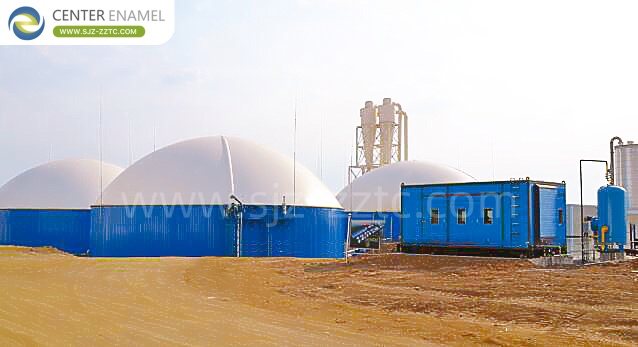
Center Enamel's Glass-Fused-to-Steel (GFS) tanks, paired with Double Membrane Roof technology, form the cornerstone of robust and efficient biogas projects in Turkey.
The GFS tanks are fabricated through a unique process where glass is fused to steel at over 820°C, creating an inert, durable, and exceptionally corrosion-resistant surface. This premium coating provides an impermeable barrier against the corrosive organic acids and hydrogen sulfide generated during anaerobic digestion, ensuring a service life of over 30 years with minimal maintenance . Their modular, bolted design allows for rapid installation across Turkey's diverse geography—from the coastal regions of the Mediterranean to the continental interior—eliminating the long construction times associated with traditional tank construction.
Mounted atop these robust tanks, the Double Membrane Roof serves as an integrated, cost-effective biogas holder. This system consists of an outer membrane that maintains a constant shape via a support air fan and an inner membrane that adjusts to the volume of stored biogas. This design provides superior air-tightness, essential for biogas collection and odour control, while the spherical shape maximizes storage volume, offering excellent space efficiency and optimizing project economics for Turkish agricultural operations.
Diverse Tank Cover Solutions from Center Enamel
Understanding that different projects have unique requirements, Center Enamel offers a comprehensive range of tank cover solutions beyond the Double Membrane Roof, including:
Aluminum Geodesic Dome Roof: Known for advanced corrosion resistance and expansive clear span capability, suitable for various storage applications.
Glass-Fused-to-Steel Roof: A cone-shaped, air-tight GFS roof often used for pressurized structures and odour control.
Aluminum Alloy Trough Deck Roof: A cost-effective and economical option for potable water and wastewater storage, keeping out rain and wind.
Stainless Steel Roof: Provides excellent airtightness and superior anti-corrosion performance, ideal for harsh environments.
FRP Roof: A lightweight, chemically stable option suitable for applications where airtightness is not required, such as drinking water or firewater storage.
A Complete Biogas Equipment Package
Center Enamel's capability extends well beyond primary digestion and storage, offering a full range of supporting equipment for a complete biogas project. This includes essential components such as:
Gas Holder: For secure and stable biogas storage.
Dehydration and Desulfurization Tank: For purifying raw biogas before use.
Torch System: A safety device for burning surplus gas.
Solid-liquid Separator: For processing digestate into valuable fertilizer.
Screw Sludge Dewatering Machine: For efficient management of process byproducts.
Efficient Installation Capabilities for Turkish Projects
Center Enamel's expertise in installing GFS Tanks offers significant advantages for projects across Turkey:
Rapid Installation: The bolted modular design and hydraulic jacking technology eliminate the need for heavy on-site welding and long concrete curing times, accelerating project completion and time-to-revenue—critical for meeting Turkey's renewable energy targets .
Quality Assurance: All tank panels are factory-prefabricated under stringent quality control, including 1500V spark testing, ensuring zero defects upon arrival at the site.
Adaptability to Local Conditions: The installation system is optimized for Turkey's varied conditions—from coastal Mediterranean climates to continental interiors, from agricultural plains to constrained urban sites .
Seismic Resilience: GFS tanks are designed with robust structural integrity, capable of withstanding seismic activity—a critical consideration given Turkey's location in an active seismic zone .
Professional Technical Team: Highly experienced engineers and supervisors provide expert on-site guidance, ensuring correct installation and long-term, reliable performance.
Why Choose Center Enamel as Your EPC Partner?
Center Enamel provides a comprehensive, one-stop solution for your entire biogas project in Turkey:
Customized Engineering & Design: Tailored solutions that adapt to the specific properties of Turkish silage straw, local climate conditions, and energy needs .
Global Expertise, Local Insight: A rich portfolio of successful projects in over 100 countries, combined with proven experience in Turkey's market and regulatory environment .
Premium Quality Equipment: From superior GFS Tanks to advanced biogas purification systems, all supplied equipment meets the highest international standards, including ISO 9001, CE/EN 1090, AWWA D103, and OSHA .
Complete Lifecycle Services: From initial planning and design to manufacturing, installation, commissioning, and long-term after-sales support.
Strong Manufacturing and Delivery Capacity: As Asia's largest GFS tank manufacturer, Center Enamel guarantees stable production, high quality, and reliable delivery for projects of any scale.
Regulatory Compliance Support: Comprehensive guidance on Turkish and EU environmental and safety regulations, ensuring project compliance and minimizing regulatory risks .
Conclusion
Transforming Turkey's abundant silage straw into clean, renewable energy is both an environmental necessity and an economic opportunity. With wheat straw alone offering an estimated 156 million m³ of biogas potential annually, Turkey has the capacity to meet approximately 8% of its natural gas needs through biogas and biomethane production while significantly reducing greenhouse gas emissions .
By integrating advanced anaerobic processes like CSTR with the superior durability of Glass-Fused-to-Steel (GFS) Tanks and the efficiency of Double Membrane Roof systems, Center Enamel provides a proven, reliable, and cost-effective pathway to a sustainable future. As a one-stop EPC contractor with successful project delivery in Turkey, Center Enamel empowers Turkish communities to reduce pollution, generate valuable energy, strengthen energy security, and contribute to the nation's circular economy and climate goals.
FAQ
1. Why is wheat straw identified as the most promising feedstock for biogas production in Turkey?
According to multi-criteria analysis using the Analytical Hierarchy Process, wheat straw scored highest among Turkey's major energy crops (cotton, sunflower, wheat, barley, and corn) based on waste availability, energy efficiency, and economic factors. Turkey's wheat straw alone has an estimated biogas potential of 156 million m³ annually .
2. How can biogas production help Turkey achieve its climate and energy goals?
Biogas and biomethane from agricultural waste could meet approximately 8% of Turkey's annual natural gas demand, reduce foreign exchange outflow, prevent up to 5 billion tons of CO₂ emissions annually, and help key export sectors avoid EU carbon border taxes while supporting alignment with the Green Deal .
3. What advantages do GFS Tanks offer specifically for Turkey's diverse climate conditions?
GFS Tanks provide exceptional corrosion resistance to acidic digestion byproducts, a 30+ year service life, rapid modular installation suited to varied geography, and seismic resilience—all critical for Turkey's diverse climates ranging from Mediterranean coasts to continental interiors .