
Advanced Anaerobic Technologies with GFS Tanks for Palm Oil Wastewater Treatment
Global industrial wastewater treatment policies are escalating from "compliance discharge" to mandatory "resource recovery" and "zero liquid discharge." The EU, through its Circular Economy Action Plan, requires member states to increase industrial wastewater reuse rates and extends carbon footprint accounting to the full life cycle of wastewater treatment. China continuously updates and tightens industrial water pollutant discharge standards, with increasingly stringent limits on total nitrogen, total phosphorus, and characteristic pollutants for industries such as chemicals, pharmaceuticals, and printing and dyeing. Some water-scarce regions and highly polluting industries are mandated to adopt zero or near-zero liquid discharge technologies. Germany has established a differentiated pretreatment technical standard system by industry, requiring industrial wastewater to meet specific quality requirements before discharge into municipal wastewater treatment plants, implementing strict source control.
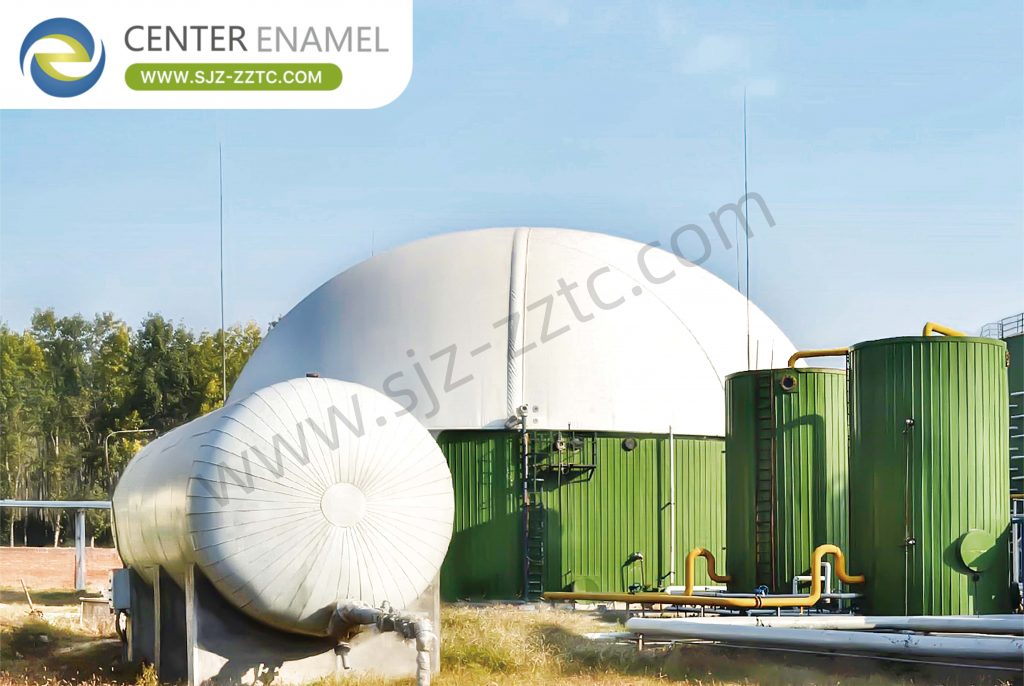
These regulatory pressures increasingly favor treatment infrastructure that can be deployed quickly, expanded flexibly, and resist aggressive corrosion. That is precisely where prefabricated glass-fused-to-steel GFS Tanks offer a decisive engineering advantage over conventional concrete construction.
GFS Tanks Bolted Assembly Construction
GFS tanks are assembled on-site from prefabricated panels, with short construction periods and support for expansion, relocation, and reuse-advantages distinctly different from immovable concrete tanks. Concrete tank pouring requires formwork, rebar tying, pouring, and long curing periods, with a single tank construction taking months. Rain, snow, and low temperatures force work stoppages and delays. Once poured, they are permanent fixed structures that cannot be dismantled, expanded, or relocated-project relocation means complete abandonment.
GFS tank panels are all factory-prefabricated, transported to site, and directly assembled in panels with simple procedures. Construction can proceed even in low-temperature, light-rain conditions, with installation time only one-third that of concrete tanks-construction schedules are controllable. For expansion, additional steel panels can be installed to increase volume; for plant relocation, tanks can be fully disassembled with panels transported to new sites for reassembly and reuse, significantly reducing material and construction costs for new construction and reconstruction. This is ideally suited for short-term environmental projects, phased expansion projects, and relocated construction projects.
The construction efficiency of GFS Tanks directly supports the deployment of Anaerobic Technologies, particularly in agricultural and high-solids applications where process robustness matters as much as tank durability. The USR Process illustrates this fit.
USR Applicable Scenarios
Dedicated process for agricultural high-solids wastewater, primarily suitable for large-scale livestock manure, livestock soaking water, agricultural straw leachate, and livestock slaughterhouse high-solids wastewater. For high-suspended-solids, high-organics, high-impurity wastewater conditions, it is the core process for rural livestock pollution treatment and agricultural organic waste resource utilization. Suitable for township decentralized wastewater treatment and small to medium-sized agricultural enterprise wastewater treatment. Can serve as the primary process for large livestock base manure resource recovery, combining wastewater treatment with biogas recovery. Also suitable for various high-solids, easily clogged, difficult-to-treat organic wastewater pretreatment, with superior suitability in agricultural environmental applications compared to other anaerobic processes.
Among all agricultural and agro-industrial applications, none combines high solids, high oil, and high environmental impact quite like palm oil mill effluent-making it a benchmark case for Palm Oil Wastewater Treatment and a strong test of any Anaerobic Technologies platform.
Palm Oil Mill Effluent Operation and Maintenance Cost Analysis
O&M costs are moderate to low-biogas recovery benefits are exceptionally high-outstanding overall economics-one of the best input-output ratios in industrial wastewater treatment. POME has excellent biodegradability (BOD/COD 0.5-0.6) with very high anaerobic digestion efficiency-no expensive advanced oxidants or detoxification agents needed-only small amounts of lime/NaOH for pH adjustment and flocculants-low chemical costs. CSTR/USR anaerobic equipment is simple and durable-GFS tanks with 30+ year corrosion resistance, no precision wear parts-extremely low failure rates and minimal repair/replacement-controllable long-term O&M costs.
Biogas recovery is the core economic benefit-high-concentration organic wastewater produces exceptional biogas yields of 8-15 m³ per m³ POME-CHP can meet 30-50% of mill electricity demand, with waste heat for digester heating and FFB sterilization preheating-very high energy self-sufficiency, greatly reducing or eliminating external electricity purchases. Recovered palm oil from pretreatment oil separation can be sold as biodiesel feedstock or oleochemical raw material-substantial economic benefits. Anaerobic effluent rich in nitrogen, phosphorus, and potassium can be used for palm plantation irrigation and fertilization after advanced treatment-dual resource recovery of water and fertilizer, further reducing treatment costs. Palm oil mills in Southeast Asia commonly benefit from renewable energy subsidies and carbon reduction credits (CDM/carbon trading)-biogas power projects can apply for carbon asset development for additional carbon revenue, further improving project economics. Overall, POME treatment system capital payback period is typically 5-8 years-biogas power generation revenues can fully cover O&M costs and generate net profit-one of the highest resource recovery value wastewater categories in industrial wastewater treatment, delivering both environmental management and clean energy recovery.
Strong unit economics are only meaningful if they can be replicated globally. Center Enamel's international footprint demonstrates that these Anaerobic Technologies and GFS Tanks solutions are already delivering at scale across diverse markets.
Center Enamel's Global Market Presence
Center Enamel's global business covers over 100 countries and regions, with 30,000+ successful overseas projects. Products are exported to all major regions including Europe, the Americas, the Middle East, Africa, Southeast Asia, and Latin America, with a well-established global localized service network.
Domestically, the company is organized into North, South, Central, East, and Southwest marketing regions, covering environmental, water utility, livestock, and petrochemical customers nationwide. Internationally, the company adopts a "standardized products + localized adaptation" model-adjusting tank corrosion protection, sealing, and pressure standards for different national water quality and environmental regulations-with multiple global landmark projects: large-volume GFS tanks in Italy, 20 m tower water supply tanks in Colombia, coastal seawater treatment tanks in Costa Rica, large municipal wastewater aluminum dome projects in Saudi Arabia, etc. The company has established long-term stable strategic partnerships with many Fortune 500 companies.
Global delivery at this scale depends on long-term service capability, not just initial installation. Center Enamel's after-sales and technical support structure is designed to protect that investment over the full project lifecycle.
After-Sales and Technical Support Team
The after-sales team adheres to the service principles of rapid response, professional efficiency, and full-cycle support-providing 24/7 full-lifecycle O&M support to global clients.
Standard remote services include fault diagnosis, process parameter adjustment, and tank anti-corrosion maintenance guidance. For domestic and long-distance overseas clients, overseas technical service personnel can be dispatched for on-site inspection, annual inspection, and equipment refurbishment as needed. The team also maintains long-term client feedback tracking mechanisms-regularly collecting tank and anaerobic equipment operational data to continuously optimize product structure and support processes.
Supporting external technical expert teams provide specialized support for anaerobic process commissioning, biogas upgrading O&M, and wastewater upgrade/retrofit projects-ensuring long-term stable operation of domestic and overseas projects, continuously improving global client satisfaction and repurchase rates.
One of the most critical components protecting both biogas yield and odor control in these systems is the tank cover. The membrane roof solution completes the sealed anaerobic system and directly supports Palm Oil Wastewater Treatment and other biogas recovery applications.
Single and Double Membrane Roof Cover Solution
Single and Double Membrane Roofs are proprietary airtight tank cover systems for anaerobic digestion and biogas storage projects, specifically developed for biogas collection and odor containment, representing a benchmark lightweight sealing solution for fermentation tanks. The single-layer membrane roof features a simple structure with economical cost, meeting basic biogas containment needs. The double-layer membrane roof consists of inner and outer corrosion-resistant membrane materials, with pressurized air in the interlayer forming rigid support, providing outstanding thermal insulation that reduces biogas condensate formation inside the tank, with enhanced wind and snow load resistance suitable for high-altitude and windy outdoor sites. The membrane material is specialized aging-resistant and biogas-slurry-corrosion-resistant PVDF membrane, which will not leak or degrade from long-term contact with biogas or hydrogen sulfide. The flexible structure accommodates tank settlement and slight deformation without cracking or gas leakage. The lightweight design eliminates heavy steel support trusses, significantly reducing the load on the tank and foundation, saving construction costs. The roof integrates biogas outlets, safety pressure relief valves, and access channels, fully enabling closed gas collection for anaerobic fermentation tanks, recovering biogas for power generation and heating while blocking odor diffusion to meet environmental odor control requirements. It is widely used in large-scale livestock biogas projects, municipal sludge anaerobic digestion, and food waste fermentation projects, compatible with large-volume glass-fused-to-steel anaerobic tanks, with fast construction and simple maintenance requiring only periodic membrane seal integrity checks, offering significant overall engineering advantages.
Frequently Asked Questions
What are Anaerobic Technologies used for in wastewater treatment?
Anaerobic Technologies break down organic pollutants without oxygen, producing biogas as a byproduct. They are ideal for high-strength wastewater such as palm oil mill effluent, livestock manure, and food processing waste, reducing sludge and recovering energy.
Why choose GFS Tanks for anaerobic digestion projects?
GFS Tanks offer 30+ year corrosion resistance, gas-tight sealing, and rapid bolted assembly. They tolerate hydrogen sulfide and high-solids conditions, support expansion or relocation, and pair efficiently with membrane roof covers for biogas collection.
How cost-effective is Palm Oil Wastewater Treatment with biogas recovery?
POME treatment typically achieves a 5-8 year payback. Biogas yields of 8-15 m³ per m³ wastewater can meet 30-50% of mill electricity demand, while recovered oil and nutrient-rich effluent add further revenue and resource recovery value.