
Professional Biogas Plant Project Design Integrating the UASB Process and Durable GFS Tanks
The Asia-Pacific region, particularly China, has become the world's largest industrial wastewater treatment market, with the operation and maintenance service segment's contribution continuing to rise, marking a shift from project construction to long-term operational management. The North American market focuses on upgrading existing facilities, while Europe emphasizes high-value-added resource recovery technologies. Wastewater from the new energy industry chain (lithium batteries, photovoltaics, hydrogen) has become the most notable emerging growth area due to its complex composition and high treatment difficulty, generating significant demand for customized solutions. The maturity of third-party treatment models in industrial parks continues to improve, driving consolidation in the professional operation market. The Middle East has strong demand for advanced treatment and reuse of industrial wastewater due to water scarcity; manufacturing transfer in Southeast Asia drives local industrial wastewater treatment facility construction demand.
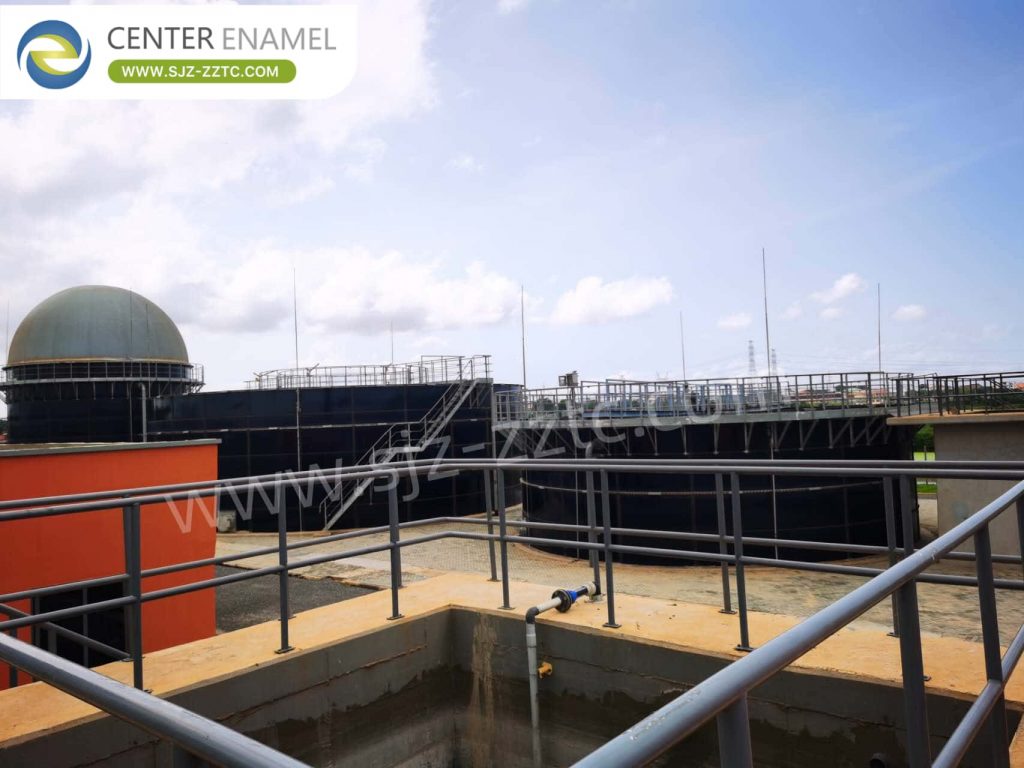
These varied regional drivers underscore the need for adaptable Biogas Plant Project Design that can meet diverse regulatory, climatic, and industrial requirements. As a leader in this field, Center Enamel combines the highly efficient UASB Process with robust GFS tank infrastructure to deliver customized solutions that convert organic pollutants into renewable energy, ensuring compliance and economic viability across all major global markets.
UASB Process Advantages for High-Efficiency Anaerobic Treatment
No mechanical mixing equipment is required, with sludge suspension achieved through hydraulic action, resulting in very low overall energy consumption. High-concentration anaerobic granular sludge can be cultivated, with high sludge concentration, strong activity, excellent settleability, low sludge washout, and low sludge yield, significantly reducing sludge disposal costs. The integrated design combines reaction, sedimentation, and separation simultaneously, with small footprint and moderate capital investment. Simple structure with low failure rates and convenient maintenance. High volumetric loading rate with excellent organic pollutant degradation efficiency and good shock load resistance. Stable biogas production with high resource recovery value. The process is mature and widely adopted, with well-established construction, commissioning, and O&M systems, suitable for large-scale industrial wastewater treatment.
These inherent advantages make the UASB Process the biological cornerstone of modern Biogas Plant Project Design. Its ability to achieve COD removal rates exceeding 85% while producing methane-rich biogas directly supports the circular economy goals now mandated by global policies. For project designers, the UASB's simplicity translates to lower capital costs, faster construction timelines, and more predictable operational performance compared to alternative treatment technologies.
Brewery Wastewater Environmental Toxicity and Treatment Suitability
No chemical toxicity-purely natural organic wastewater with very low ecotoxicological risk and easy environmental restoration. All pollutants are natural organics from grain fermentation-starches, sugars, alcohols, amino acids, proteins-containing no heavy metals, bacteriostats, or persistent toxic organics. They do not inhibit biochemical bacteria and have no acute or chronic toxicity to soil, water, or plants. The core pollution is only high-concentration oxygen-demanding organics-direct discharge rapidly depletes dissolved oxygen, causing oxygen depletion, black-odor conditions, algal blooms, and channel siltation. Pollutants have no bioaccumulation potential and are rapidly decomposed by microorganisms and natural water bodies-no long-term persistent ecological harm.
This pollutant profile makes brewery wastewater an ideal candidate for Biogas Plant Project Design centered on the UASB Process. The absence of inhibitory compounds ensures robust biological activity, while the high organic strength provides excellent biogas yield potential. Center Enamel's project designs capitalize on this synergy, using durable GFS tanks as anaerobic digesters to create treatment systems that are both environmentally protective and economically beneficial through energy recovery.
Indonesia Palm Oil Biogas Upgrade Project
Commissioned in 2013 as the core anaerobic digestion reactor for the POME treatment station, with 3 GFS tanks in two sizes: 17.58 m dia. × 8.4 m height / 16.82 m dia. × 7.2 m height. The tanks serve as the core anaerobic reaction equipment specifically for high-organic palm oil production wastewater-anaerobic digestion degrades pollutants and recovers biogas. Tanks are adapted to local palm industry wastewater needs. GFS tank assembly is convenient with corrosion resistance for Southeast Asia's hot humid high-corrosion environment-a mature biomass energy environmental benchmark project.
This landmark project exemplifies the successful application of Center Enamel's Biogas Plant Project Design in one of the world's most challenging industrial sectors. The combination of the UASB Process within robust GFS tanks has delivered over a decade of reliable performance, effectively treating high-strength POME while recovering valuable biogas. The project's success in a tropical, corrosive environment validates the durability of the design approach and the expertise of Center Enamel as a project partner.
Full-Process Standardized Installation Quality Control
Demonstrating high-standard installation quality through long-term stable global project performance, Center Enamel has established full-chain quality control standards across four dimensions: factory protection, on-site assembly construction, completion inspection, and long-term warranty-ensuring quality control for every GFS tank.
At the factory stage, all enameled panels, seals, and structural components receive rust-proof and moisture-proof independent packaging with dedicated protective supports-preventing damage during sea and land transport and avoiding enamel coating damage. On-site construction strictly follows unified assembly process specifications-panel by panel tightening and leak testing in layers, with air-tightness and verticality testing after each tank section completion-dual-membrane covers and anaerobic piping undergo simultaneous pressure testing and acceptance.
Differentiated quality acceptance standards are customized for different regions: EU/US projects follow stringent CE/NSF inspection criteria; Southeast Asian hot humid regions receive enhanced corrosion protection and sealing acceptance; remote African sites have additional foundation settlement re-inspection procedures. Upon project completion, complete construction inspection reports, pressure test records, and anti-corrosion appearance acceptance documents are issued, with full photo/video archives retained. Over 10,000 tanks delivered globally have operated long-term without large-scale leakage or structural deformation-preventing future O&M issues at source.
This rigorous quality control framework is integral to Center Enamel's Biogas Plant Project Design. By standardizing installation procedures while adapting to regional conditions, the company ensures that every UASB Process reactor and associated GFS tank performs as designed, regardless of project location. This attention to detail minimizes operational risks and maximizes the long-term return on investment for clients.
Installation and Construction Team Expertise
The installation team has practical experience from over 10,000 GFS tank projects globally, strictly following standardized construction procedures-full control over project mobilization, civil coordination, tank assembly, piping, and commissioning schedules and quality.
The team is proficient in complete standardized installation processes for GFS tanks, dual-membrane gas storage covers, USR/CSTR/IC anaerobic reactors, and biogas desulfurization/piping systems-adaptable to large-scale farms, industrial parks, remote mountainous sites, coastal high-corrosion sites, and other complex locations-strictly implementing unified global safety construction standards. For large overseas cross-border projects, the team can be deployed as complete units for on-site construction, technical training, and local worker practical instruction-full control over construction details, air-tightness testing, and corrosion protection-ensuring timely and stable commissioning of global environmental projects through standardized delivery capability.
The expertise of this installation team directly supports the successful realization of complex Biogas Plant Project Design. Their ability to work in diverse and challenging environments ensures that the UASB Process and GFS tank systems are installed to the highest standards, regardless of site constraints. This global deployment capability, combined with comprehensive training programs, ensures that local operators can maintain the system effectively after project handover.
Aluminum Geodesic Dome Roof for Superior Tank Sealing
Aluminum Geodesic Dome Roof independently developed by Center Enamel is manufactured using high-strength aluminum alloy plates through integral stamping. It features a triangular grid spherical self-supporting structure, enabling large-span full coverage without internal support columns. Made of aluminum alloy, the roof offers excellent weather resistance and corrosion resistance, capable of long-term protection against acid rain, salt spray, and UV radiation, suitable for various extreme outdoor climate conditions. The structural design complies with international AWWA D108 standards, with aluminum plate thickness, rib cross-sections, and joint connections all verified by finite element stress analysis, ensuring wind and snow load resistance that meets building code requirements across different global regions.
The weight of the Aluminum Geodesic Dome Roof is only one-third to one-half of a steel roof with the same span, significantly reducing the load on the tank top and allowing direct installation without tank wall reinforcement. The roof provides superior overall sealing performance, with double sealing between panels using specialized sealant strips and mechanical interlocking, enabling both airtight gas storage and enclosed odor control, suitable for biogas collection and storage, wastewater tank odor control, and drinking water contamination prevention. The support-column-free design does not interfere with the installation and operation of internal equipment such as mixers and water distributors. The aluminum material does not support microbial growth, requiring no anti-corrosion maintenance over long-term use, resulting in low total life-cycle costs.
Integrating this Aluminum Geodesic Dome Roof with GFS tanks completes a comprehensive Biogas Plant Project Design that addresses both liquid containment and gas capture. For UASB Process applications, the gas-tight seal is essential for maximizing biogas collection efficiency and preventing fugitive methane emissions. The roof's corrosion resistance and low maintenance requirements make it particularly suitable for anaerobic digestion applications, where the biogas atmosphere can be highly corrosive. This integrated approach ensures that the biogas plant operates safely, efficiently, and in compliance with environmental regulations.
Frequently Asked Questions (FAQ)
Q1: What makes Center Enamel a leader in Biogas Plant Project Design using the UASB Process?
A: Center Enamel combines over 30 years of experience with proprietary GFS tank technology and comprehensive EPC capabilities. The company's Biogas Plant Project Design integrates the UASB Process within durable, corrosion-resistant tanks, delivering high COD removal rates and stable biogas production. With over 1,000 biogas projects globally and full certifications (CE, NSF, ASME), Center Enamel ensures reliable, turnkey solutions.
Q2: Which industries are best suited for Biogas Plant Project Design with the UASB Process?
A: Industries generating high-strength, soluble organic wastewater-including palm oil mills (POME), breweries, food processing, sugar refineries, paper mills, and distilleries-are ideal candidates. The UASB Process excels in treating these waste streams, achieving excellent COD reduction while recovering methane-rich biogas for energy offset or upgrading to biomethane.
Q3: How does the Aluminum Geodesic Dome Roof enhance Biogas Plant Project Design?
A: The Aluminum Geodesic Dome Roof provides a gas-tight, corrosion-resistant cover for GFS tanks used as anaerobic digesters. Its self-supporting structure eliminates internal columns, allowing unrestricted operation of mixers and distributors. The roof's double-sealing system ensures maximum biogas capture, prevents odor release, and requires no maintenance over its service life-reducing overall project lifecycle costs.