
Reliable Biogas Project Contractor Integrating High-Performance GFS Tanks for Anaerobic Digestion Systems
The competitive landscape shows divergence, with leading companies building integrated service capabilities through technical integration and capital operations, and industry concentration gradually increasing. Chinese companies continue to consolidate their advantages in mid-tier equipment exports. International giants target high-end customers and complex industrial wastewater markets, while local players occupy the mid-to-low-end and industrial park centralized treatment markets with service responsiveness and cost advantages. In the anaerobic process segment, UASB, EGSB, and IC anaerobic reactors, with advantages of high loading rates, small footprints, and stable operation, are widely used in high-concentration organic wastewater pretreatment in food processing, pharmaceutical fermentation, alcohol brewing, chemical, and other industries. These reactors use steel tank shells, and their corrosion resistance and gas-tightness directly determine long-term operational stability. The application value of glass-fused-to-steel tanks in such scenarios is increasingly prominent.
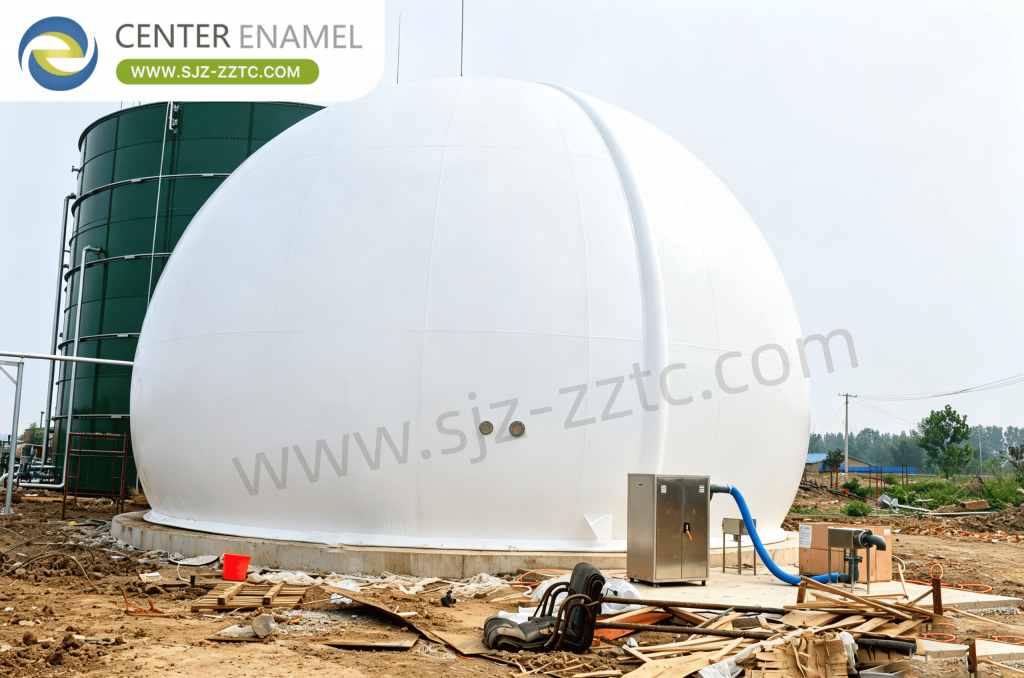
This market reality demands a Biogas Project Contractor that combines process expertise with robust infrastructure. Center Enamel’s GFS Tanks have proven their reliability across thousands of biogas projects worldwide, offering the corrosion resistance and gas-tight sealing essential for long-term anaerobic digester performance. As a full-service EPC contractor, Center Enamel bridges the gap between equipment supply and project execution, ensuring seamless integration of tank systems with biological treatment processes.
GFS Tanks Engineered for Modern Intensive Plant Layouts
GFS tanks offer flexible customization of size and appearance, with higher land utilization rates, ideally suited for modern compact plant layouts, with significant advantages over fixed poured concrete tanks. Concrete tanks cannot alter volume or shape after pouring, with heavy bases occupying large areas, making placement difficult on narrow or irregular plots. Their rough, uniform appearance cannot match modern facility aesthetic requirements.
GFS tank volume can be precisely customized as needed, with capacities ranging from dozens of cubic meters to 50,000 cubic meters freely selectable. Tank height and diameter can be flexibly combined to fit narrow or irregularly shaped plots, effectively saving plant land occupation. Enamel color customization is also supported, achieving visual harmony with plant buildings and environmental facilities. During later plant expansion, GFS tanks can be directly adjusted in layout and expanded; concrete tanks, being monolithic structures, must be demolished and rebuilt, offering less flexibility in land resource utilization. This aligns well with the intensive construction and aesthetic operation and maintenance needs of industrial parks .
For any Biogas Project Contractor, this adaptability translates to faster project delivery and lower total installed costs. The modular bolted construction of GFS Tanks allows for rapid assembly by local labor under expert supervision, reducing on-site construction time compared to welded or concrete alternatives. This efficiency is particularly valuable for overseas biogas projects where skilled labor may be limited and construction windows are tight.
Understanding the UASB Reaction Process for Efficient Biogas Recovery
After pretreatment through screens and equalization tanks to remove impurities and balance water quality and flow, wastewater is uniformly fed into the reactor through the bottom distribution system. The wastewater rises at a constant rate through the high-concentration granular sludge bed at the bottom, where anaerobic microorganisms rapidly degrade most organic matter, converting it into biogas, clean water, and a small amount of sludge. Gentle hydraulic mixing maintains sludge suspension, expanding microbial contact area. Remaining pollutants continue to degrade in the mid-section suspended sludge layer, with the mixed liquor finally entering the top three-phase separator for gas, solid, and liquid separation. Biogas is collected upward for utilization, sludge settles back to the reaction zone, treated effluent overflows from the top, and aged sludge is periodically discharged—fully automated continuous operation.
The UASB process forms the biological core of many projects undertaken by a Biogas Project Contractor. When integrated with high-quality GFS Tanks, the system achieves optimal performance through the tank's inert glass surface, which prevents biofilm adhesion and resists the corrosive effects of sulfide-laden biogas . This combination ensures that the reactor maintains its hydraulic and treatment efficiency over decades of operation, maximizing biogas yield and minimizing maintenance interventions.
Brewery Wastewater Key Water Quality Characteristics and Treatment Implications
High concentration, high suspended solids, high color, slightly acidic, and excellent biodegradability—with significant fluctuations. COD typically 5,000-25,000 mg/L, with high-strength spent mash and still bottoms peaking at hundreds of thousands of mg/L. Suspended solids up to 40,000 mg/L, with thick turbid liquor. Stable slightly acidic pH 3-5. Pollutants are primarily natural organics from grain fermentation—starches, reducing sugars, proteins, alcohols—with no synthetic toxic substances. BOD/COD can reach 0.5-0.6—industry-leading biodegradability. Significant fluctuations with production batches and seasonal capacity, and susceptible to secondary fermentation and odor if left standing.
These characteristics make brewery wastewater an ideal candidate for anaerobic treatment using UASB reactors housed in GFS Tanks. A skilled Biogas Project Contractor will design the pretreatment system to handle the high suspended solids and pH fluctuations, ensuring that the reactor receives a consistent feed. The excellent biodegradability ensures high COD removal rates and robust biogas production, which can be used to offset energy costs in the brewery. The tank's enamel coating provides the necessary protection against the slightly acidic influent and the corrosive biogas environment.
Over a Decade of Global Installation Experience Across Diverse Conditions
Unmatched global practical experience among domestic peers—over a decade covering multiple regions and all industry sectors. In 2009, Center Enamel completed the first overseas GFS tank installation—sending a team to Niger, Africa for drinking water storage tank installation. In 2015, it broke industry ground with China's first GFS tank export and installation to the US—passing strict US acceptance standards. All installed projects have operated stably for many years, covering livestock biogas, POME, municipal wastewater, and drinking water storage applications. Construction has covered Southeast Asia, Africa, the Americas, and other regions—accumulating specialized solutions for complex sites including mountainous terrain, coastal salt spray, tropical high temperatures, and high-standard European/American facility conditions—maturely addressing global special construction requirements .
This extensive track record is the foundation of Center Enamel's reputation as a reliable Biogas Project Contractor. The company has developed standardized procedures for installation in challenging environments, from remote African villages to high-standard US industrial sites. For each project, the GFS Tanks are shipped with detailed assembly instructions and supported by experienced supervisors who ensure that the final installation meets the same quality standards regardless of location.
Full-Industry-Chain Integrated Delivery Capability for Seamless Project Execution
Center Enamel is the only company globally integrating proprietary enamel frit R&D, self-manufactured tanks, and EPC general contracting—full-process self-control from solution design, equipment production, cross-border logistics, overseas construction, to post-construction O&M—significantly reducing client coordination and time costs.
This integrated model provides distinct advantages for clients selecting a Biogas Project Contractor. By owning the entire value chain, Center Enamel eliminates the finger-pointing that often occurs between multiple suppliers on complex projects. The single-source responsibility ensures that the GFS Tanks are designed, manufactured, and installed to work seamlessly with the UASB process and auxiliary equipment. This approach has been validated across more than 1,000 biogas projects globally, demonstrating the company's ability to deliver turnkey solutions that meet performance guarantees.
FRP Roof Cover Solution for Atmospheric Pressure Storage Applications
FRP Roof is a general-purpose economical roof for atmospheric pressure storage tanks without air-tightness requirements, suitable for drinking water storage, agricultural irrigation water, firewater reserve, and general production wastewater temporary storage. It is available in two styles: flat and dome, allowing flexible selection based on tank specifications and site aesthetic requirements. The roof is integrally molded from resin and fiberglass, lightweight, with natural water resistance and mild acid/alkali corrosion resistance. It will not rust or rot in long-term humid environments, eliminating the frequent anti-corrosion maintenance required for metal roofs.
The dome style features excellent drainage performance due to its curved structure, resisting water accumulation, dust buildup, snow load, and strong winds. The flat style facilitates the installation of maintenance walkways, level gauges, and vents on top, making inspection and operation convenient. The product is fully insulated with no risk of galvanic corrosion, will not contaminate drinking water quality, and meets environmental standards for domestic water storage. The modular design with low individual component weight allows for simple on-site hoisting and assembly, offering high construction efficiency and affordable procurement and installation costs. It is only suitable for atmospheric pressure water storage tanks without biogas collection or pressurization requirements, and is not recommended for anaerobic fermentation gas-producing conditions. It is widely used in rural agricultural water storage tanks, industrial park firewater tanks, waterworks buffer tanks, and small to medium-sized domestic wastewater temporary storage facilities, making it a cost-effective general-purpose roof choice for conventional water storage applications.
While GFS Tanks for biogas applications typically require gas-tight Aluminum Geodesic Dome Roofs, the FRP roof offers a valuable complementary solution for other on-site storage needs. A comprehensive Biogas Project Contractor can provide both roof types, ensuring that each tank is fitted with the most appropriate cover for its specific function. For biogas plants, this means the digester tanks are equipped with gas-tight roofs for biogas capture, while effluent storage or firewater tanks use the cost-effective FRP roof, optimizing overall project economics.
Frequently Asked Questions (FAQ)
Q1: What makes Center Enamel a leading Biogas Project Contractor with GFS Tanks?
A: Center Enamel combines over 30 years of experience with proprietary GFS tank technology and full EPC capabilities. As the only global provider integrating enamel frit R&D, tank manufacturing, and project contracting, the company has delivered more than 1,000 biogas projects across 100+ countries, ensuring seamless execution and long-term reliability.
Q2: Which industries benefit most from Biogas Project Contractors using GFS Tanks and UASB reactors?
A: Industries generating high-strength organic wastewater—including palm oil mills, breweries, food processing, sugar refineries, paper mills, and livestock operations—benefit significantly. The combination of durable GFS Tanks and efficient UASB technology treats high-COD wastewater while recovering methane-rich biogas for energy offset.
Q3: How do Center Enamel's GFS Tanks withstand the corrosive conditions of anaerobic digestion?
A: Center Enamel's GFS tanks feature a glass-fused-to-steel coating fired at 820°C-930°C, creating an inert, non-porous barrier resistant to H₂S, acids, and alkalis common in biogas environments. This coating, combined with proprietary enamel formulations developed over 30 years, ensures a minimum service life of 30 years without corrosion or structural degradation.