
Experienced EPC Contractor Providing Corrosion-Resistant GFS Tanks for Global Industrial Wastewater Treatment Projects
The Asia-Pacific region, particularly China, has become the world's largest industrial wastewater treatment market, with the operation and maintenance service segment's contribution continuing to rise, marking a shift from project construction to long-term operational management. The North American market focuses on upgrading existing facilities, while Europe emphasizes high-value-added resource recovery technologies. Wastewater from the new energy industry chain (lithium batteries, photovoltaics, hydrogen) has become the most notable emerging growth area due to its complex composition and high treatment difficulty, generating significant demand for customized solutions. The maturity of third-party treatment models in industrial parks continues to improve, driving consolidation in the professional operation market. The Middle East has strong demand for advanced treatment and reuse of industrial wastewater due to water scarcity; manufacturing transfer in Southeast Asia drives local industrial wastewater treatment facility construction demand.
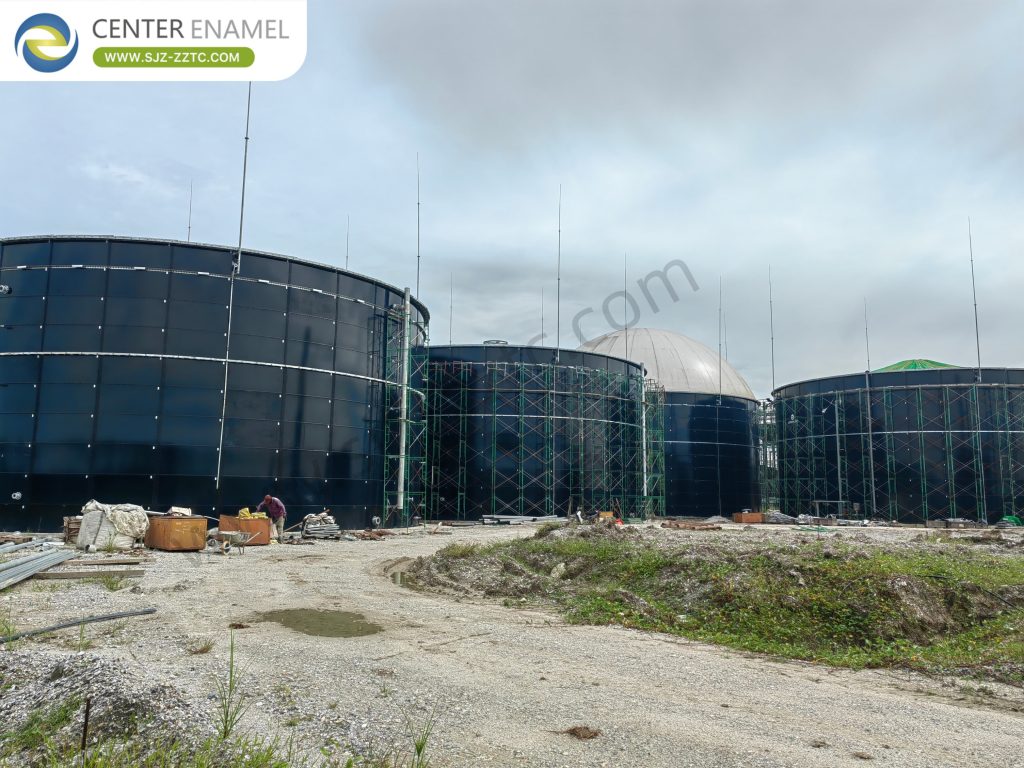
These regional dynamics create a complex global landscape where project owners need partners capable of navigating diverse regulatory, climatic, and technical requirements. As an experienced EPC Contractor, Center Enamel responds to this demand by combining proven GFS Tanks technology with localized engineering expertise-delivering Industrial Wastewater Treatment infrastructure that performs reliably across both developed and emerging markets.
GFS Tanks: Engineered Adaptability for Complex Operating Conditions Across All Industries
Center Enamel has independently developed over 200 specialized enamel frit formulations and supporting patents, capable of customizing anti-corrosion enamel based on customer storage media, with adaptability comprehensively superior to concrete tanks. Concrete tanks use a single material, only suitable for neutral clean water storage. When storing corrosive materials such as livestock manure, palm oil mill effluent, chemical wastewater, food waste digestate, high-salinity wastewater, etc., additional anti-corrosion linings must be applied. These linings are prone to failure, preventing long-term stable operation and cannot adapt to alternating high/low concentration storage conditions.
GFS Tanks can be specifically formulated with specialized enamels resistant to strong acids, strong alkalis, high organic content, and high salinity. A single tank can switch between multiple wastewater and fermentation feedstock storage requirements. They are universally applicable across biogas anaerobic digestion, municipal wastewater, livestock farming, food processing, and industrial water treatment scenarios, eliminating the need to rebuild tanks for media changes, perfectly meeting the needs of diversified, multi-condition environmental protection projects. This material versatility forms the technical foundation that enables Center Enamel to operate as a full-scope EPC Contractor across widely varying Industrial Wastewater Treatment applications.
USR Process: A Purpose-Built Anaerobic Solution for High-Solids Wastewater
USR, or Upflow Solids Reactor, is an upflow anaerobic process modified for high-suspended-solids, high-solids organic wastewater, specifically designed to solve problems of clogging, sludge washout, and uneven reaction common in traditional anaerobic processes for high-solids wastewater. The process eliminates complex three-phase separators, simplifies internal structure, and relies on upflow hydraulics to promote thorough mixing of solid materials and anaerobic sludge. No strict granular sludge formation conditions are required-flocculent sludge can operate stably. The key feature is high solids tolerance and impurity resistance, with very high influent suspended solids tolerance. It is a dedicated high-efficiency anaerobic process for livestock manure, agricultural organic waste, and high-solids livestock wastewater, specifically developed for agricultural and environmental applications.
This process expertise complements Center Enamel's role as an EPC Contractor by providing a treatment pathway for feedstocks that would clog or overwhelm conventional anaerobic systems. The same engineering philosophy-simplicity, durability, and tolerance for challenging conditions-carries directly into POME Treatment, where high organic loading and suspended solids demand equally resilient infrastructure.
POME Wastewater Sources: Understanding the Challenge Behind Palm Oil Mill Effluent
Palm oil mill effluent (POME) originates from the entire processing chain of fresh fruit bunches (FFB) in palm oil milling-the highest pollution load and largest volume high-concentration organic industrial wastewater in tropical agricultural processing. Palm oil mills typically process 30-120 tons of FFB daily, generating approximately 0.5-1.0 m³ of wastewater per ton of FFB processed-single mills discharging hundreds to thousands of cubic meters daily, representing a core environmental challenge for the palm oil industry. Wastewater comes from three main sources:
- Sterilization: FFB enter sterilization vessels for high-temperature steaming to deactivate lipase and prevent free fatty acid increase-producing sterilization condensate, the largest volume source at 80-90°C, rich in soluble sugars, amino acids, organic acids, COD 15,000-30,000 mg/L;
- Clarification: Pressed crude oil undergoes centrifugal separation and gravity settling to remove water and impurities-producing large volumes of oily wastewater with extremely high oil content and suspended solids, COD 50,000-80,000 mg/L, the highest organic load source;
- Kernel recovery: Palm kernels are separated by hydrocyclones and washed for recovery-producing sandy wash water with high suspended solids but relatively lower organic concentration. Auxiliary discharges include CIP cleaning, floor wash, boiler blowdown, and cooling tower water. POME is acidic (pH 4.0-5.0), high-temperature (60-80°C), brown colloidal, rich in oils, suspended solids, colloidal proteins, and soluble sugars-a typical high-concentration, high-oil, high-suspended-solids organic industrial wastewater.
Understanding these characteristics is essential for any EPC Contractor designing effective Industrial Wastewater Treatment systems for palm oil mills. It is precisely this complexity that makes durable, corrosion-resistant GFS Tanks indispensable for POME containment and anaerobic digestion.
Ghana Municipal Domestic Wastewater Treatment Project: A Proven Reference Case
Completed installation in 2021, treating 1,800 m³/day of municipal wastewater using UBF anaerobic + A²/O nitrogen/phosphorus removal mature processes. Equipped with multiple Center Enamel GFS Tanks including 1 UBF anaerobic reactor, 1 secondary clarifier, and 2 internal/external double-layer A²/O biological tanks. Influent has high COD, BOD, suspended solids, and nitrogen/phosphorus concentrations-after full treatment, effluent parameters are significantly reduced with pH stable at 6.5-9.0, fully meeting local environmental discharge standards. Corrosion-resistant, conveniently assembled GFS Tanks efficiently solve urban domestic wastewater pollution while balancing treatment effectiveness and O&M economics-a mature municipal wastewater case in Africa.
This project demonstrates the cross-application versatility of Center Enamel's infrastructure-the same GFS Tanks technology deployed for POME Treatment and biogas projects proving equally effective in municipal Industrial Wastewater Treatment contexts. It also reflects the company's ability to deliver complete treatment trains as a single-source EPC Contractor.
Center Enamel R&D Team: The Technical Backbone Behind Every Project
Center Enamel has built a full-chain professional team covering R&D, design, marketing, installation, and after-sales. The R&D team is led by national-level materials technology experts, specializing in enamel frit and tank anti-corrosion core technologies. External senior environmental engineering and mechanical structure engineers are retained to strengthen R&D capabilities, focusing on anti-corrosion coating formulations, specialty corrosion-resistant tanks, and anaerobic supporting integrated equipment-continuously breaking through industry technological barriers.
The team operates through proprietary laboratories with external university research collaboration-conducting year-round new material and new process durability pilot testing and long-term corrosion simulation testing. Specialized enamel formulations are iteratively developed for extreme conditions such as high-salinity wastewater, strong acid/alkali POME, and high-organic livestock manure-providing core technical support for the company's annual new invention and utility patents-building a proprietary material technology barrier.
This R&D depth is what separates Center Enamel from ordinary suppliers and allows the company to function as a true EPC Contractor-not merely fabricating GFS Tanks, but engineering complete Industrial Wastewater Treatment solutions backed by proprietary material science.
Innovative Material Technology: 30+ Year Corrosion Resistance for Global Applications
Center Enamel has independently developed over 200 anti-corrosion enamel formulations, with proprietary double-sided double-layer enameling technology-GFS Tanks anti-corrosion service life exceeds 30 years-far surpassing concrete and ordinary equipment-suitable for global high-corrosion wastewater and biogas fermentation conditions.
Ready to discuss your Industrial Wastewater Treatment project? Contact Center Enamel today for a free consultation and customized GFS Tank solution tailored to your specific wastewater challenges. Our engineering team is available to provide technical guidance, project feasibility assessment, and competitive quotations-reach out now and let us help you turn wastewater into valuable resources.
FAQ
What types of Industrial Wastewater Treatment projects does Center Enamel handle as an EPC Contractor?
We deliver biogas, POME, municipal, livestock, and high-salinity industrial projects. Our scope covers design, GFS Tank manufacturing, installation, commissioning, and operator training across 100+ countries.
Why are GFS Tanks preferred over concrete for corrosive Industrial Wastewater Treatment?
GFS Tanks resist pH 1-14 without linings, install faster, and last 30+ years. Concrete cracks and requires coatings that fail in high-sulfide or high-salinity wastewater environments.
How does Center Enamel support POME Treatment projects specifically?
We provide USR/CSTR anaerobic systems, corrosion-resistant GFS Tanks, and full EPC delivery. Typical biogas yields reach 8-15 m³ per m³ POME with 5-8 year payback.