
How GFS Tanks and the IC Process Work Together to Treat Papermaking Wastewater
Papermaking is the light industry's largest wastewater generator-tens of thousands of tons per day from a single mill, ranging from caustic black liquor to dilute white water. Treating it well requires two things working in lockstep: a reactor that degrades concentrated organics efficiently, and vessels that survive decades of alkaline, lignin-bearing service. At Center Enamel, that pairing is the IC Process inside GFS Tanks-a combination engineered from the enamel frit up.
From Compliance Discharge to Mandatory Resource Recovery
Global industrial wastewater policy is escalating from "compliance discharge" to mandatory "resource recovery" and "zero liquid discharge." The EU, through its Circular Economy Action Plan, requires member states to increase industrial wastewater reuse rates and extends carbon footprint accounting to the full life cycle of wastewater treatment. China continuously tightens industrial water pollutant discharge standards, with increasingly stringent limits on total nitrogen, total phosphorus and characteristic pollutants for chemicals, pharmaceuticals, and printing and dyeing. Some water-scarce regions and highly polluting industries are mandated to adopt zero or near-zero liquid discharge technologies. Germany has established a differentiated pretreatment standard system by industry, requiring industrial wastewater to meet specific quality requirements before discharge into municipal plants-strict source control in practice.
For paper mills, these rules point in one direction: recover fiber and water upstream, then degrade what remains with a compact, energy-positive biological stage. That is where the IC Process and GFS Tanks earn their place in a modern treatment train.
Factory-Standardized GFS Tanks: Quality You Can Predict
GFS tanks are fully factory-prefabricated to standardized specifications, with finished product quality stability far exceeding cast-in-place concrete tanks. All concrete tank processes are completed in the open air, with rebar tying, pouring and curing heavily influenced by worker skill, temperature and rainfall. Wall thickness, density and strength vary significantly between batches, and hidden defects like honeycombing, voids and insufficient wall thickness are common-quality cannot be uniformly controlled.
Center Enamel's GFS Tank steel panels, seals and reinforcement components are all mass-produced in automated factories. Steel stamping, high-temperature enameling and dimensional cutting are controlled by CNC equipment, with each panel's parameters and enamel thickness strictly following unified national standards. All components are uniformly packaged and transported to site, with assembly following standardized construction drawings. Full-process quality inspection from raw materials to finished components ensures highly consistent performance parameters, completely eliminating the uncontrollable quality risks of on-site concrete construction-so every tank delivers stable, consistent performance.
The IC Process Explained
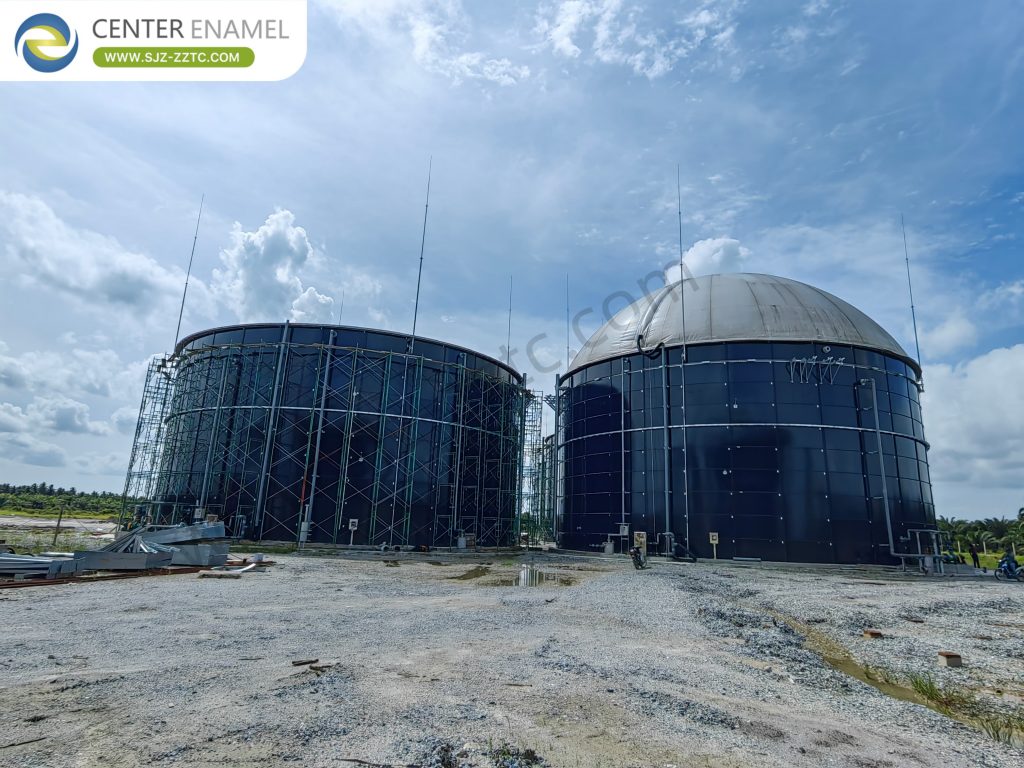
IC, or Internal Circulation Anaerobic Reactor, is the third-generation high-efficiency anaerobic treatment technology built upon UASB. Its core innovation is the built-in gas-lift internal circulation system, enabling autonomous wastewater recirculation without external return pumps. The reactor features a dual-zone configuration: a lower main reaction zone and an upper polishing zone. Biogas gas-lift creates hydraulic internal circulation, significantly increasing upflow velocity and enhancing sludge-wastewater contact. With extremely high compactness, the IC Process is specifically designed for high-concentration, high-flow industrial organic wastewater, combining high efficiency, energy savings and minimal footprint-the core process for modern industrial high-strength wastewater treatment. Paired with corrosion-resistant GFS Tanks, it forms a durable, low-maintenance anaerobic stage.
Where Papermaking Wastewater Comes From
Papermaking wastewater originates across the entire production chain, covering chemical pulping (alkaline and sulfate processes), mechanical pulping, recycled fiber pulping and papermaking-the largest-volume, highest-suspended-solids industrial wastewater in the light industry sector. Key pollution stages include raw material preparation (chipping and washing of wood or grass), cooking (the core chemical pulping stage producing high-concentration black liquor), washing and screening, bleaching (multistage bleaching discharges), papermaking (sheet forming, pressing and drying discharges), and white water recirculation (wire section and press section water).
Cooking black liquor is the core pollution source, with extremely high COD and strong alkalinity. White water has large volume but low pollutant concentration and can be recycled. Recycled fiber pulping wastewater contains inks, adhesives and fillers requiring deinking treatment. Large paper mills discharge tens of thousands of tons daily-one of the largest-volume industrial wastewater sectors. This diversity explains why the train must separate streams: black liquor to alkali recovery and anaerobic digestion, white water to fiber recovery and reuse, and the remainder to aerobic polishing. Throughout, GFS Tanks hold the corrosive streams while the IC Process handles the concentrated organic load.
The table below maps each stream to its treatment route.
| Source Stream | Characteristics | Primary Treatment Route | Tank / Process Role |
| Cooking black liquor | Very high COD, strong alkalinity | Alkali recovery + IC anaerobic digestion | GFS tanks resist alkali and lignin corrosion |
| White water | Large volume, low concentration | Microfiltration / DAF / disc filter, fiber recovery for repulping | Reduces discharge 60–80% before biological stage |
| Washing & screening | Medium COD, fiber solids | Screening, sedimentation, anaerobic + aerobic | GFS equalization and reactor tanks |
| Bleaching effluent | Variable load, color | Equalization, chemical decolorization, membrane filtration | GFS tanks for corrosive service |
| Recycled fiber pulping | Inks, adhesives, fillers | Deinking, DAF, biological treatment | GFS reactors with enamel anti-corrosion lining |
Proven Performance: South Africa Brewery High-Strength Wastewater Project
The same core pairing-GFS Tanks plus high-rate anaerobic digestion-has been proven beyond paper. Center Enamel's South Africa brewery project focuses on high-concentration organic wastewater in the brewing industry, featuring both GFS tanks and stainless steel tanks as core equipment. GFS tanks serve as the primary anaerobic digestion system, suited to brewery wastewater's high-COD, high-sugar, readily decomposable characteristics for efficient organic pollutant degradation. Stainless steel tanks handle wastewater transfer and chemical storage supporting processes. The complete package offers excellent corrosion resistance and flexible assembly, providing long-term stable treatment of brewery production and cleaning wastewater-solving local brewing industry pollution challenges and standing as a mature brewery wastewater reference in Africa.
The table below summarizes representative deliveries and the role of GFS Tanks and the IC Process.
| Project | Industry | Core Treatment | Main Equipment | Key Challenge | Outcome |
| South Africa Brewery | Brewing / beverage | Anaerobic high-load digestion | GFS tanks + stainless steel tanks | High COD, high sugar, seasonal peaks | Stable year-round treatment, mature African reference |
| Pulp & Paper Mill (EPC) | Paper / pulp | Black liquor recovery + IC anaerobic + aerobic | GFS reactors, epoxy tanks, aluminum covers | High alkalinity, lignin corrosion, fiber loss | 60–80% discharge reduction, compliant effluent |
| POME / Palm Oil Mill | Agro-processing | High-rate anaerobic biogas system | GFS digesters, dual-membrane roofs | High temperature, oil and solids | Biogas recovery + effluent reuse |
| Livestock / Swine Farm | Agricultural | Anaerobic manure digestion | GFS digesters, gas-tight roofs | High solids, odor, nutrient load | Odor control, biogas, nutrient stabilization |
Construction Manpower That Keeps Global Projects on Schedule
Equipment quality means little without reliable erection. Center Enamel has established its own domestic and international certified construction teams, with regular practical training on GFS tank installation and overseas construction standards for various countries. Domestically, regional construction teams cover multiple zones, capable of simultaneously deploying multiple teams for large tank farm projects. Internationally, cross-border professional installation teams are equipped to various country construction standards-sufficient manpower reserves ensure uninterrupted construction delivery for remote African sites, high-standard European and American facilities, and other projects.
Material Technology Behind the 30-Year Service Life
Underpinning all of this is materials science. Center Enamel has independently developed over 200 anti-corrosion enamel formulations, with proprietary double-sided double-layer enameling technology-GFS Tank anti-corrosion service life exceeds 30 years, far surpassing concrete and ordinary equipment, and suitable for global high-corrosion wastewater and biogas fermentation conditions. This is what allows paper mills to specify enamel-coated tanks for black liquor and bleaching streams with confidence, and what makes the combination of GFS Tanks and the IC Process a genuinely long-term investment rather than a maintenance burden.
Covering the Non-Biogas Side of the Plant
Not every tank in a paper mill needs a gas-tight biogas cover. The Aluminum Alloy Trough Deck Roof is a cost-effective tank cover solution for clean water and wastewater storage, primarily designed for drinking water, production wastewater and firewater reserve tanks, balancing practicality and cost. The main body is integrally formed from anti-corrosion aluminum alloy plates paired with aluminum support trusses. Its lightweight design imposes less load on the tank foundation, reducing civil construction investment.
A naturally formed dense oxide layer resists rain and mild wastewater corrosion, withstands outdoor exposure, and blocks wind, rain, insects, fallen leaves and odor volatilization, preventing dust and debris from causing secondary contamination. The flat roof structure allows maintenance walkways, guardrails, vents and level monitoring ports on top, facilitating daily inspection. The simple sealing structure enables straightforward installation with short construction timelines and virtually eliminates anti-corrosion painting maintenance, resulting in extremely low operational costs. It suits small, medium and large atmospheric pressure water storage tanks and is widely used in waterworks clear water tanks, industrial circulating water tanks, park firewater tanks and domestic wastewater temporary storage-highly compatible with water storage applications that do not require biogas collection or high-pressure sealing.
Frequently Asked Questions
Q: Why pair GFS tanks with the IC Process for papermaking effluent?
A: The IC Process degrades concentrated organics efficiently in a footprint one-third that of traditional anaerobic systems, while GFS tanks resist the strong alkalinity and lignin corrosion that destroy concrete and standard-coated steel-together they deliver a durable, compact treatment core.
Q: How long do GFS tanks last in corrosive black liquor service?
A: Center Enamel's double-sided double-layer enameling technology provides an anti-corrosion service life exceeding 30 years, far surpassing concrete and ordinary equipment in high-corrosion wastewater conditions.
Q: Can white water really be recycled rather than discharged?
A: Yes. Microfiltration, DAF and disc filters recover fiber from paper machine white water for repulping, reducing discharge volume by 60–80% before the biological stage.
Are you still dealing with black liquor that eats through tanks, white water that wastes fiber and discharge limits that keep tightening? Contact Center Enamel today with your wastewater flow, COD range and target discharge standard, and our engineers will return a tailored GFS tank and IC Process configuration within two business days. Talk to our team now-from the first process flow diagram to the last roof bolt tightened on site, we are ready to turn your papermaking effluent challenge into a compliance and recovery advantage.