
How the IC Process Delivers High-Performance Brewery Wastewater Treatment?
Breweries around the world are under growing pressure to treat effluent faster, recover more energy, and do it on increasingly compact sites. The answer lies in a third-generation anaerobic solution: the Internal Circulation (IC) reactor. As a proven centerpiece of any Industrial Wastewater Treatment Project, the IC Process combines a small footprint, shock-load tolerance, and biogas recovery-all inside a corrosion-resistant GFS tank engineered for decades of service.
Why Brewery Effluent Is Ready for Treatment
Brewery wastewater is, in nature, a forgidding-to-treat stream. It contains no heavy metals, no bacteriostatic agents, and no persistent toxic organics. Every pollutant is a natural byproduct of grain fermentation-starches, sugars, alcohols, amino acids, and proteins-none of which inhibit biochemical bacteria or pose acute or chronic toxicity to soil, water, or plants.
The real issue is concentration. High-strength oxygen-demanding organics, if discharged directly, rapidly deplete dissolved oxygen in receiving waters, causing oxygen depletion, black-odor conditions, algal blooms, and channel siltation. The pollutants have no bioaccumulation potential and are quickly broken down by microorganisms, so once a treatment system is in place, ecological recovery is straightforward. This makes brewery effluent an ideal candidate for high-rate anaerobic treatment-and therefore for the IC Process at the heart of a modern Industrial Wastewater Treatment Project.
The Market Demand Behind Every Project
The urgency is reinforced by global market shifts. The Asia-Pacific region, led by China, has become the world's largest industrial wastewater treatment market, with operation and maintenance services growing faster than new construction-owners increasingly want partners who can run plants for decades, not just build them once. North America is upgrading aging facilities, while Europe emphasizes high-value resource recovery.
Southeast Asia's manufacturing transfer is driving new plant construction, and the Middle East, constrained by water scarcity, is pushing advanced treatment and reuse. Across all these regions, breweries need an Industrial Wastewater Treatment Project partner who understands local climate, water quality, and regulations-and can deliver a process compact enough for modern sites. The IC Process answers both requirements at once.
Inside the IC Process Advantage
What makes the IC Process the preferred choice? Its treatment efficiency is top-tier: for the same capacity, its footprint is only one-third that of traditional anaerobic systems-a decisive advantage when brewery land is scarce.
The built-in gas-lift internal circulation needs no external recirculation equipment, autonomously forcing mixing of sludge and water. Strong hydraulic contact ensures thorough microbe-pollutant contact, raising degradation efficiency and letting the reactor withstand high water-quality and hydraulic shock loads from fluctuating brew batches. A dual-zone configuration pairs high-rate degradation with deep polishing for stable effluent, while a high degree of sludge granulation keeps activity strong and washout minimal. The result is high automation, low failure rates, large biogas production, and long-term energy and O&M costs far below traditional anaerobic systems-tailor-made for large-flow, high-concentration Industrial Wastewater Treatment Project applications.
GFS Tanks: The Right Envelope for the Job
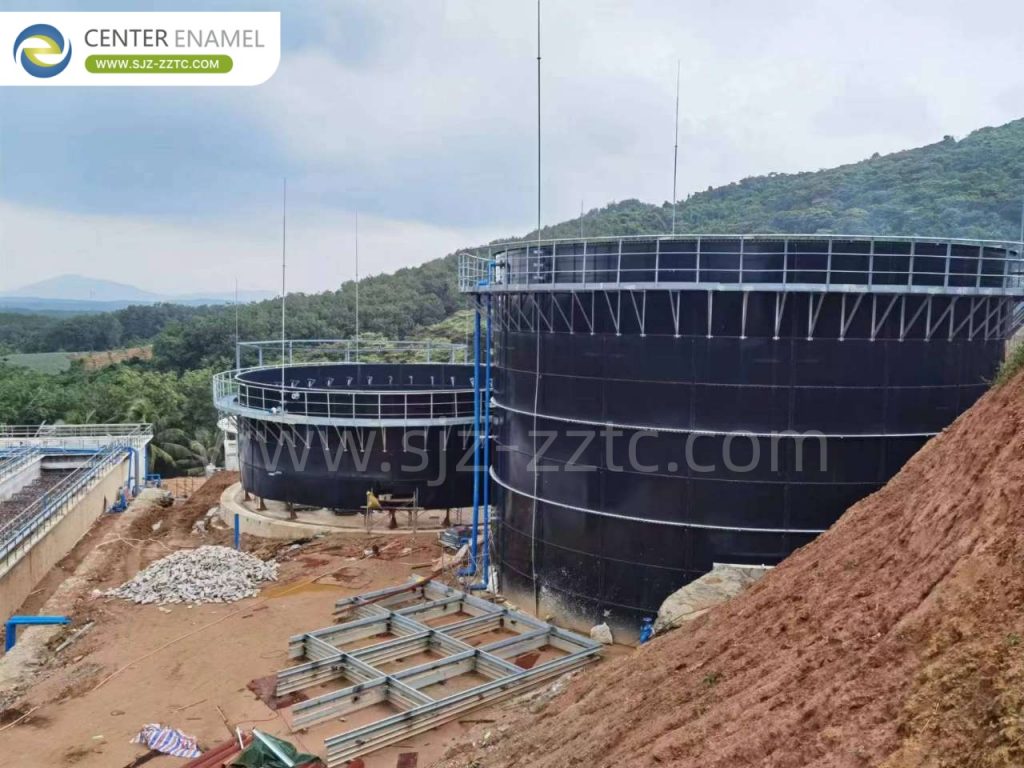
An IC reactor lives inside a steel shell, and that shell's corrosion resistance and gas-tightness directly determine long-term stability. Glass-fused-to-steel (GFS) tanks are built for exactly this role, and their flexibility suits modern compact brewery layouts far better than poured concrete.
Concrete tanks cannot change volume or shape after pouring, with heavy bases occupying large footprints that are hard to place on narrow or irregular plots. GFS tanks, by contrast, are customizable from dozens to 50,000 cubic meters, with height and diameter flexibly combined to fit awkward sites and save land. Enamel colors can be matched to surrounding buildings, and when a brewery expands, GFS tanks can be reconfigured or extended-concrete must be demolished and rebuilt. This aligns with the intensive construction and aesthetic O&M expectations of modern industrial parks.
Quality Control from Factory to Field
Technology and tank mean nothing without disciplined execution. Center Enamel has established full-chain quality control across four dimensions: factory protection, on-site assembly, completion inspection, and long-term warranty.
At the factory, every enameled panel, seal, and structural component receives rust-proof, moisture-proof independent packaging with dedicated supports to prevent enamel damage during sea and land transport. On site, crews follow unified assembly specifications-panel-by-panel tightening and layered leak testing, with air-tightness and verticality checks after each tank section, while double-membrane covers and anaerobic piping undergo simultaneous pressure testing. Regional standards are tailored: EU/US projects follow stringent CE/NSF criteria; Southeast Asian hot-humid sites receive enhanced corrosion and sealing acceptance; remote African locations add foundation settlement re-inspection. Over 10,000 tanks delivered globally have operated long-term without large-scale leakage or structural deformation.
Global Benchmark Footprint
That execution track record is reflected in Center Enamel's project portfolio, which covers more than 100 countries across Southeast Asia, Africa, Europe, and the Americas-over 30,000 mature projects spanning palm oil, livestock, municipal, brewing, and food-waste biogas. This depth allows rapid customization for different regional climates, water compositions, and regulations, giving every Industrial Wastewater Treatment Project a proven reference base.
| Project / Capability | Key Data |
| Countries served | 100+ across Southeast Asia, Africa, Europe, Americas |
| Mature projects delivered | 30,000+ |
| GFS tanks with long-term leak-free operation | 10,000+ |
| IC Process footprint vs. traditional anaerobic | One-third for equal capacity |
| GFS tank customizable volume | Dozens to 50,000 m³ |
| Served industry sectors | Palm oil, livestock, municipal, brewing, food-waste biogas |
The FRP roof itself is a cost-effective choice for non-pressurized vessels: integrally molded from resin and fiberglass, lightweight, naturally water-resistant, and mildly acid/alkali tolerant, so it never rusts or rots in humid environments and needs none of the repeated anti-corrosion maintenance that metal roofs demand. It is deliberately reserved for atmospheric storage without biogas collection, keeping gas-tight duties on the dedicated double-membrane covers that match the IC Process reactor.
Frequently Asked Questions
1. Why is the IC Process preferred for brewery wastewater treatment?
The IC Process delivers the same treatment capacity in one-third the footprint of traditional anaerobic systems, with no external recirculation pump. Its gas-lift internal circulation tolerates seasonal shock loads from fluctuating brew batches and recovers biogas as a useful byproduct.
2. What does an Industrial Wastewater Treatment Project include with Center Enamel?
Center Enamel provides the full chain-GFS tank manufacturing, IC/CSTR reactor integration, double-membrane biogas covers, factory-to-site quality control, and long-term O&M support across 100+ countries.
3. How are GFS tanks protected during delivery and installation?
Enameled panels receive independent rust-and moisture-proof packaging; on-site crews perform layered tightening and leak testing, with regional CE/NSF, corrosion, and foundation inspections, and over 10,000 tanks have run leak-free long term.
Planning a brewery effluent plant or upgrading an aging digester? Send us your batch volumes, peak COD, and local discharge limits, and our engineers will recommend the right IC reactor size, GFS tank configuration, and cover system within days. Contact Center Enamel today-let us engineer, build, and support an Industrial Wastewater Treatment Project that runs quietly in the background and pays back in biogas.