
How GFS Tanks Power Modern Wastewater Treatment Technology for Breweries?
Breweries face a double challenge: their effluent is among the strongest in the food industry, yet modern production sites are increasingly compact. Conventional poured-concrete tanks cannot keep up-they are fixed, slow to build, and impossible to expand. This is why leading breweries are turning to glass-fused-to-steel vessels as the backbone of modern Wastewater Treatment Technology, with GFS Tanks replacing concrete and ordinary steel as the preferred digester envelope.
The Reality of Brewery Effluent
Before choosing a tank, engineers must first size up what they are dealing with. Brewery wastewater is characterized by high concentration, high suspended solids, high color, a slightly acidic pH of 3-5, and-despite all that-excellent biodegradability. COD typically runs 5,000-25,000 mg/L, with high-strength spent mash and still bottoms peaking at hundreds of thousands of mg/L, while suspended solids can reach 40,000 mg/L in thick, turbid liquor.
The pollutants themselves are benign in origin-starches, reducing sugars, proteins, and alcohols from grain fermentation-with no synthetic toxic substances. BOD/COD ratios of 0.5-0.6 rank among the most biodegradable industrial effluents, making anaerobic treatment exceptionally effective. The practical headache is fluctuation: loads swing with production batches and seasonal capacity, and untreated liquor left standing quickly undergoes secondary fermentation and odor release. A modern Wastewater Treatment Technology built around GFS Tanks must therefore tolerate shock loads while resisting acidic, corrosive conditions for decades.
Why GFS Tanks Fit Compact Brewery Sites
This is precisely where GFS Tanks outperform poured concrete. Concrete tanks cannot change volume or shape after pouring, with heavy bases occupying large footprints that are hard to place on narrow or irregular plots, and their rough, uniform appearance clashes with modern facility aesthetics.
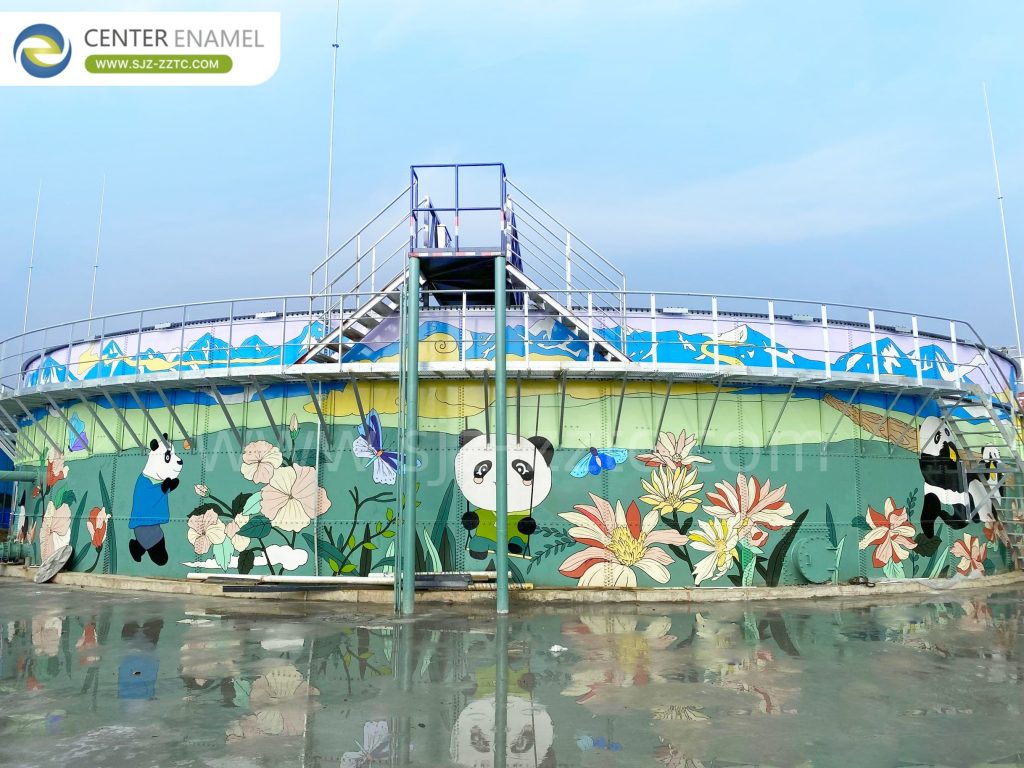
GFS tanks, by contrast, offer fully customizable volume-from dozens to 50,000 cubic meters-with height and diameter flexibly combined to fit awkward sites and save plant land. Enamel colors can be matched to surrounding buildings, and when a brewery expands, GFS tanks can be reconfigured or extended in layout; monolithic concrete must be demolished and rebuilt. This flexibility aligns naturally with the intensive construction and aesthetic O&M expectations of modern industrial parks, and it frees breweries from the long lead times and site preparation that concrete construction demands.
Inside the IC Reactor Process
The tank envelope is only half the story-what happens inside determines treatment performance. In the IC reaction process, pretreated high-strength wastewater enters the lower main reaction zone from the bottom, mixing with a recirculated sludge-water stream and rising rapidly. Anaerobic microorganisms efficiently degrade organic matter and produce large volumes of biogas.
The gas-lift action of the biogas carries the mixed liquor upward to a top gas-liquid separator, where the gas is collected. The degassed sludge-water mixture then returns by gravity through downcomers to the reactor bottom, creating an autonomous internal circulation that repeatedly intensifies pollutant degradation. After multiple cycles, the wastewater moves to the upper polishing zone for further reaction and sludge-water separation; residual trace organics are fully broken down, settled sludge returns to the lower zone, treated effluent overflows from the top, and aged sludge is periodically wasted. Fully autonomous and continuously efficient, the IC reactor is a centerpiece of modern Wastewater Treatment Technology, and its steel shell-with critical corrosion and gas-tightness requirements-is best protected by GFS Tanks.
A Shifting Market Toward Integrated Solutions
The industry landscape is moving in the same direction. Leading companies are building integrated service capabilities through technical integration and capital operations, and industry concentration is gradually rising. International giants target high-end customers and complex industrial wastewater markets, while local players compete on responsiveness and cost. In the anaerobic segment, UASB, EGSB, and IC reactors-valued for high loading rates, small footprints, and stable operation-are widely adopted for high-concentration pretreatment across food processing, pharmaceutical fermentation, alcohol brewing, and chemical industries.
Because these reactors rely on steel tank shells, corrosion resistance and gas-tightness directly determine long-term operational stability. As a result, the application value of GFS Tanks in such scenarios is becoming increasingly prominent, and brewers are right to demand a supplier who owns both the process and the vessel.
Design Engineering Behind Every Vessel
Delivering that combined capability requires serious engineering. Center Enamel's design team includes senior engineers registered in the Hebei Provincial Science and Technology Expert Database, with design standards aligned to strict European and American high-end equipment safety norms. The team provides complete integrated design for overseas projects across livestock biogas, POME, municipal wastewater, hazardous-waste storage, and seawater desalination-covering tank structure, anti-corrosion and sealing systems, biogas piping, and anaerobic process integration.
Before design begins, the team investigates local seismic zones, wind pressure, soil bearing capacity, water corrosivity, and environmental discharge standards, then applies thickened panels, reinforced anchored bases, and optimized sealing structures as needed. Every solution is tailored to the customer's plant area, wastewater load, treatment targets, and budget-balancing safety, economics, and local adaptation.
Full-Chain Delivery Under One Roof
That engineering depth is backed by unmatched delivery control. Center Enamel is the only company globally integrating proprietary enamel frit R&D, self-manufactured tanks, and EPC general contracting-full-process self-control from solution design and equipment production through cross-border logistics, overseas construction, and post-construction O&M. This dramatically cuts client coordination and time costs, and ensures the GFS Tanks arriving on site are engineered for the exact Wastewater Treatment Technology specified for that brewery.
Benchmark in the Field
The Pakistan Food Waste + Napier Grass Biogas Demonstration Project illustrates how the system works in practice. Center Enamel served as general contractor, using a CSTR core anaerobic process with food waste and Napier grass as mixed fermentation feedstock. A mechanical mixing system ensures thorough contact between feedstock and anaerobic microorganisms, delivering a stable daily biogas output of 100 m³. As the local official demonstration project validating gas production efficiency and long-term continuous stability, it has paved the way for multiple large-scale Napier grass biogas projects across the region.
| Project / Capability | Key Data |
| Brewery effluent COD range | 5,000-25,000 mg/L (peaking at hundreds of thousands in spent mash) |
| Brewery suspended solids | Up to 40,000 mg/L |
| Brewery pH | Slightly acidic, 3-5 |
| BOD/COD biodegradability | 0.5-0.6 |
| GFS tank volume range | Dozens to 50,000 m³, fully customizable |
| Pakistan demonstration biogas output | 100 m³/day, CSTR with mechanical mixing |
| Center Enamel delivery chain | Enamel R&D → tank manufacturing → EPC → O&M |
| Served Sector | Typical Effluent | GFS Tank Application |
| Brewery & distillery | Spent mash, still bottoms, fermentation yellow water | IC / UASB digester shells with acid-resistant enamel |
| Palm oil mill (POME) | Strong acid/alkali, high organic load | CSTR biogas digesters |
| Livestock & manure | High solids, high nitrogen | USR anaerobic tanks |
| Municipal wastewater | Dilute steady flow | Equalization and treatment tanks |
| Hazardous waste / seawater | High corrosivity | Specialized sealed GFS storage |
Frequently Asked Questions
Why are GFS tanks preferred over concrete for brewery wastewater treatment? GFS tanks resist the acidic pH 3-5 and corrosive brewery effluent for decades, customize volume from dozens to 50,000 m³ to fit compact sites, and can be expanded or reconfigured as breweries grow. Concrete is monolithic, slow to build, and must be demolished when capacity changes.
Which Wastewater Treatment Technology works best for high-strength brewery effluent?
Anaerobic systems-UASB, EGSB, and especially the IC reactor-are the standard. The IC reactor uses gas-lift internal circulation with no external recirculation pump, tolerates seasonal shock loads, and recovers biogas as a useful byproduct.
Does Center Enamel deliver the full project or only tanks?
Center Enamel is the only global company integrating enamel frit R&D, tank manufacturing, and EPC general contracting, covering design, production, logistics, overseas construction, and long-term O&M under one accountable roof.
If your brewery is planning a new effluent plant, expanding an existing digester, or switching from concrete to modular vessels, our engineers can model your batch volumes and local discharge limits and return a tailored GFS tank and process proposal quickly. Contact Center Enamel today with your influent data-let us build the wastewater system that protects your operations, recovers biogas, and lasts for decades.