
New Zealand Kitchen Waste Solutions: EPC Contractor Provides GFS Tanks with CSTR Process for Biogas
New Zealand, renowned for its pristine natural environment, faces a significant challenge in managing its organic waste. The country generates thousands of tonnes of kitchen waste annually from households, restaurants, hotels, and food processing industries . This waste includes vegetable leaves, leftovers, fruit peels, eggshells, tea dregs, and bones—materials rich in organic matter but problematic for the environment.
A major hurdle in New Zealand is that a substantial portion of this organic waste ends up in landfills, where it decomposes anaerobically to release methane, a potent greenhouse gas that contributes to climate change . With over 300,000 tonnes of food scraps sent to landfills each year, New Zealand's waste sector is a considerable contributor to the nation's emissions profile . Furthermore, the country's geographic isolation and dispersed population create logistical challenges for centralized waste processing, making localized, efficient solutions essential . The need to divert this waste stream and turn it into a valuable resource has never been more pressing.
The Advantage of Converting Kitchen Waste to Biogas
Converting kitchen waste into biogas presents a transformative environmental and economic opportunity. When organic matter is processed in an oxygen-free environment through anaerobic digestion, it breaks down to produce biogas—a renewable energy source primarily composed of methane and carbon dioxide . This process effectively captures the methane that would otherwise escape from landfills, turning a potent greenhouse gas into a source of clean energy.
The benefits extend beyond just greenhouse gas reduction. The resulting biogas can be used for electricity generation, heating, and even upgraded to biomethane for injection into the national gas grid . Additionally, the nutrient-rich digestate left over from the process serves as a high-quality fertilizer, reducing reliance on synthetic chemical inputs and completing a sustainable loop .
Center Enamel: A Professional EPC Contractor for Biogas Projects
Center Enamel (Shijiazhuang Zhengzhong Technology Co., Ltd.) has positioned itself as a leader in the sustainable energy sector . As a professional EPC Contractor (Engineering, Procurement, and Construction), Center Enamel offers comprehensive, turnkey waste-to-energy solutions. By utilizing advanced anaerobic digestion systems, they convert organic waste streams—including food processing residuals, agricultural byproducts, and livestock manure—into commercially viable biogas .
Center Enamel’s vertically integrated expertise encompasses advanced process engineering, precision equipment manufacturing, and proven on-site installation practices. This allows them to handle complex environmental challenges while creating renewable energy assets for their clients, from feasibility studies to operational optimization and long-term after-sales support .
The Kitchen Waste Treatment Process Flow
Center Enamel has developed an innovative kitchen waste treatment system designed to ensure harmlessness, volume reduction, and maximum resource recovery. The treatment process follows a well-structured flow:
Pre-treatment System: Incoming kitchen waste is first processed to remove large impurities and sand. The remaining slurry is then sent to a hydrolysis and homogenization tank, where organic acids are produced, and the material's temperature and pH are balanced through constant stirring.
Anaerobic Fermentation and Biogas Production: The homogenized slurry is pumped into the main anaerobic fermentation tank. At a controlled mesophilic temperature of 35°C, the slurry remains in the tank for approximately 28 days. This environment allows microbes to break down the organic matter, generating biogas.
Biogas Purification and Utilization: The raw biogas produced is directed to a purification system. This step removes impurities, producing a clean, high-calorific-value gas suitable for power generation, heating, or other energy needs.
Post-digestion Treatment: After fermentation, the remaining digestate is processed. The liquid digestate undergoes dewatering in a sludge dewatering system (e.g., a plate and frame dehydrator). The fibrous solid digestate can be sent for incineration, while the separated water is treated in a sewage treatment system to meet environmental discharge standards.
Oil and Fat Processing: A key step is the extraction of oils and fats from the food waste, which can be processed into raw materials for biodiesel, further enhancing resource recovery.
Core Technology: The CSTR Process
At the heart of Center Enamel's food waste treatment system is the CSTR Process (Continuous Stirred Tank Reactor). This is a highly effective anaerobic treatment technology recognized globally for its efficiency in processing high-solids organic feedstock .
The CSTR is a completely mixed reactor where the fermentation substrate and microorganisms are kept in a homogenous, constant state. The reactor is equipped with a mechanical mixing system that ensures an even distribution of nutrients and bacteria, preventing the formation of a crust on the surface and avoiding sedimentation at the bottom.
Key features of the CSTR include:
Continuous or Semi-Continuous Feeding: This allows for a stable, constant biogas output.
Constant Temperature: It operates at a stable temperature, typically mesophilic (around 35°C), which is optimal for the methane-producing bacteria.
High Organic Loading: The CSTR is designed to handle the high concentration of suspended solids found in food waste, effectively degrading volatile fatty acids and maintaining a neutral pH to prevent acidification, ensuring consistent and reliable biogas production .
Durable Infrastructure: GFS Tanks with Glass-Fused-to-Steel Roof
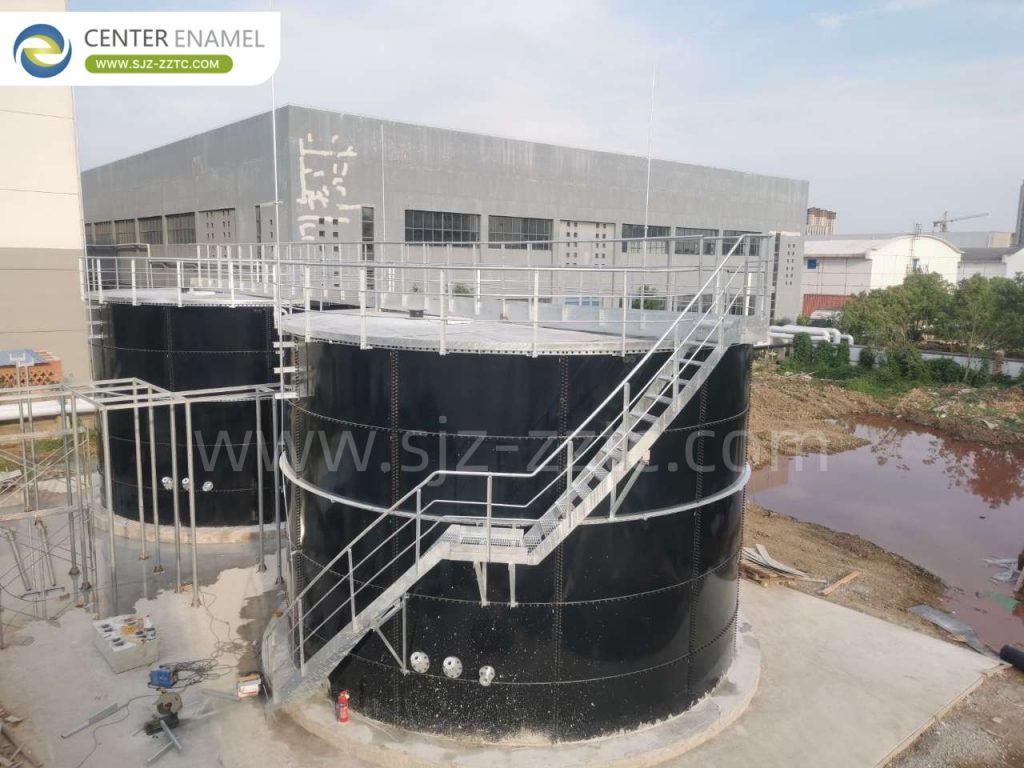
The reliability of any biogas project hinges on the durability of its containment systems. Center Enamel's GFS Tanks (Glass-Fused-to-Steel) are the premier choice for biogas infrastructure in New Zealand. These tanks are manufactured using a unique high-temperature firing process (820°C–930°C), which fuses the glass to the steel surface . This creates an inert, inorganic bond that combines the strength and flexibility of steel with the outstanding corrosion resistance of glass.
For demanding applications like biogas production, a Glass-Fused-to-Steel Roof is also available. This roof type offers:
Superior Airtightness: Essential for capturing biogas and controlling odors .
Exceptional Corrosion Resistance: Withstands the corrosive environment inside the digester.
Structural Integrity: Often featuring a cone shape with internal or external beams, it provides a robust and durable solution for pressure applications .
These tank systems are bolted and modular, allowing for rapid, localized construction—a significant advantage for projects in New Zealand's varying geographical and climatic conditions . They are certified to international standards including ISO, NSF, WRAS, and FDA, ensuring quality and safety.
The Advantages of Center Enamel Solutions
Center Enamel offers comprehensive turnkey solutions that effectively address waste management challenges while maximizing environmental and economic benefits.
Environmental Benefits: The solution is designed to be compatible with the surrounding environment, significantly reducing the emission of pollutants and assisting in the control of environmental pollution.
Economic Rationality: The systems are engineered to achieve maximum resource utilization, which reduces the actual operating costs and increases operating income.
Appropriate Technology: Center Enamel combines process design with the actual project situation to select the most appropriate technical solution to achieve the best conversion and utilization of food waste.
Reliable Operation: The adopted technology and equipment ensure that the project operates reliably post-completion, with minimal other negative impacts.
Key Equipment and Systems
Beyond the core GFS tanks and CSTR, a biogas plant relies on a range of specialized auxiliary equipment to ensure efficient operation. Center Enamel provides a comprehensive suite of supporting systems, including:
Mixing Systems: Mechanical agitators and hydraulic mixers for CSTR and AD tanks, ensuring thorough mixing and preventing crusting .
Gas Holders: Double-membrane gas holders for safe biogas storage and pressure control .
Dual-shaft Crushers and Multi-function Crushing & Sorting Machines: For effective pre-treatment and size reduction of incoming waste.
Pumping, Heating, and Insulation Systems: To manage the flow and maintain the optimal temperature for the digestion process.
Dehydration and Desulfurization Tanks: For biogas purification and removal of corrosive hydrogen sulfide gas.
Solid-liquid Separators: For efficient separation of digestate into liquid and solid fractions.
Efficient Installation Capabilities
Center Enamel's ability to deliver projects efficiently is a key factor in their success, particularly for the New Zealand market. Their installation process is built for speed, safety, and adaptability .
Using a hydraulic jacking top-down installation method for their modular GFS Tanks, they can assemble tanks on-site without the need for high scaffolding, making it safer and more suitable for various site conditions. The modular, bolted assembly eliminates the need for on-site welding, reducing quality risks associated with weather and local labor conditions—a vital consideration for New Zealand's diverse environments.
With a dedicated and experienced on-site team, Center Enamel ensures full-process guidance, training, and collaboration with local contractors. This approach guarantees that projects meet schedules and that equipment is commissioned efficiently for stable, long-term performance .
Center Enamel: A One-Stop Solutions Provider for New Zealand
As an experienced EPC Contractor, Center Enamel offers a one-stop solution for New Zealand's biogas projects, covering the entire project lifecycle from A to Z . They manage everything:
Customized Process Engineering: Tailoring solutions to match regional feedstock characteristics (food waste, distillers grains, dairy manure) and New Zealand's climatic conditions .
High-Quality Manufacturing: Producing world-class equipment, including GFS Tanks, at their 150,000m² facility.
Turnkey EPC Services: Providing design, manufacturing, transportation, installation, commissioning, and after-sales maintenance.
Comprehensive Systems Integration: Seamlessly integrating auxiliary technologies such as gas holders, mixers, and purification systems for a fully functional plant.
With over 35 years of history and a successful track record in more than 100 countries, Center Enamel adapts proven international innovations to satisfy local regulatory standards and unique operating environments in New Zealand .
Conclusion
As New Zealand intensifies its focus on meeting carbon neutrality goals and building a circular economy, converting kitchen waste into renewable energy is a vital strategy. The collaboration of proven anaerobic digestion technologies, robust infrastructure, and expert project management is key to success. With its professional turnkey solutions, advanced CSTR Process, and durable GFS Tanks with Glass-Fused-to-Steel Roof, Center Enamel is poised to help New Zealand transform its organic waste challenge into a clean energy opportunity, paving the way for a more sustainable future.
Frequently Asked Questions (FAQs)
1.How does the CSTR process differ from other anaerobic digestion methods?
The CSTR Process is specifically designed for treating high-solids waste streams like food waste. Unlike simpler methods, it features a mechanical agitator that constantly mixes the slurry. This keeps all organic matter in suspension, prevents solids from settling, and ensures bacteria and food are in constant contact, leading to higher and more stable biogas yields compared to plug-flow or contact-based systems .
2.Why are GFS Tanks with a Glass-Fused-to-Steel Roof preferred for biogas plants?
GFS Tanks offer superior corrosion resistance due to the impermeable glass coating fused to the steel at high temperatures. This is essential for withstanding the acidic and corrosive environment inside an anaerobic digester. A Glass-Fused-to-Steel Roof provides exceptional airtightness to capture gas and control odors, a long service life of over 30 years, and structural strength for pressure requirements, making them a highly durable and low-maintenance option .
3. What are the main benefits of choosing an EPC Contractor for a biogas project?
Choosing a professional EPC Contractor like Center Enamel offers a single point of responsibility for the entire project. This simplifies delivery, reduces risk for the client, and ensures seamless integration of all project elements—from process engineering and equipment manufacturing to on-site installation, commissioning, and after-sales support. It guarantees a turnkey solution that is on time, on budget, and built for optimal performance .